
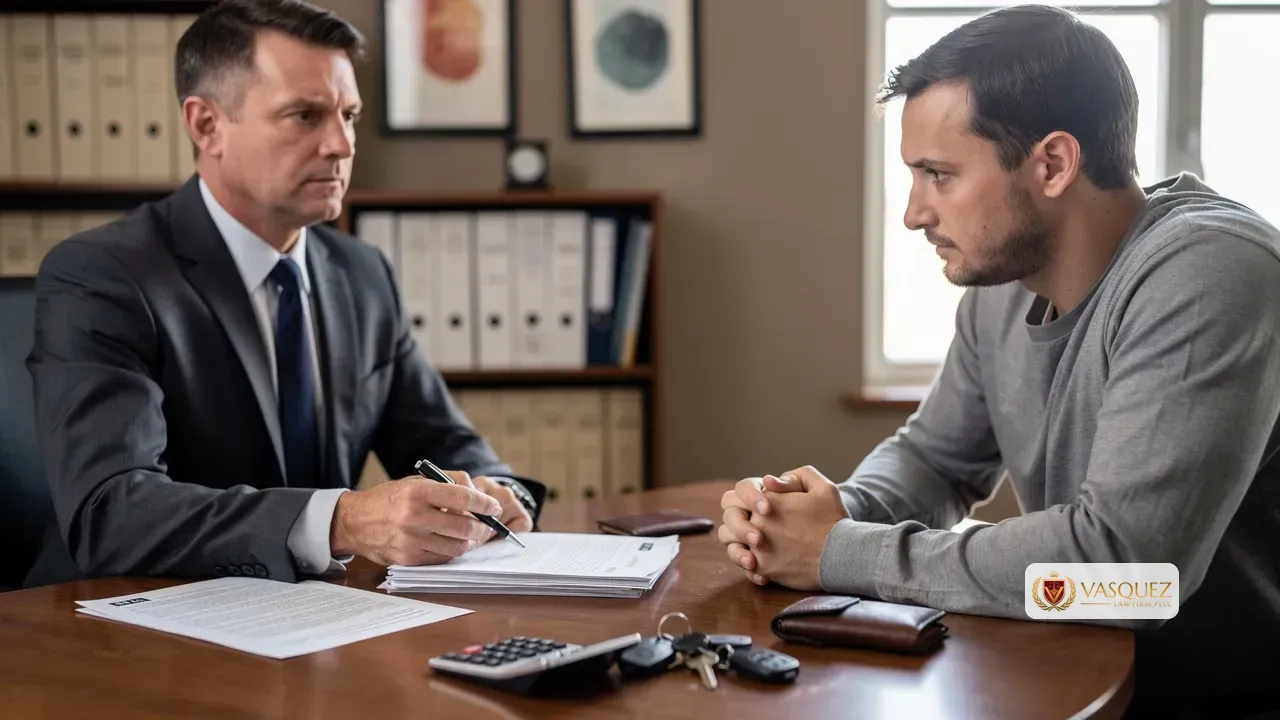
Treat the allegation as a decision point, not a final result
A probation violation allegation is not the same as a new criminal conviction, but it can still lead to added conditions, extended supervision, jail time, or revocation, depending on the jurisdiction and case. The allegation is a starting point for a response process, not a final result. Depending on the jurisdiction and circumstances, the court may leave probation in place, change its conditions, extend supervision, impose treatment or other requirements, or revoke probation; revocation may result in incarceration or an original sentence.
That range makes prompt review useful. You need to identify the condition at issue, the court handling the matter, the date or instruction in the notice, and whether a warrant or arrest risk is involved before deciding how to respond.
Alleged probation violations can involve conduct that appears administrative or technical as well as conduct connected to a new accusation. Examples include:
- Missing a required report to a probation officer.
- Failing a required drug test.
- Failing to pay fines or restitution.
- Changing your address without giving the required notice.
- Associating with people whom your probation terms prohibit.
The written conditions control the analysis. Do not assume that an allegation automatically proves a violation, and do not assume that a technical allegation carries no serious consequences.
Read the notice, warrant, or court instruction first
A probation notice, summons, or warrant tells you what the authority says happened and what response may be expected next. A reported alleged violation may lead to a probation warrant and potential arrest, after which the court may assess whether sufficient evidence exists to proceed with a hearing. A warrant can lead to arrest and affect bond decisions, and it is usually more urgent than a summons with a future court date.
Read the document for these details:
- The court or authority that issued it.
- The condition allegedly violated.
- The hearing date, location, and appearance instructions.
- Whether the document identifies a warrant, arrest order, or summons.
- Any deadline for contacting the court, probation office, or counsel.
If you cannot tell whether the document requires immediate action, contact the responsible court or authority and a qualified criminal defense attorney promptly. Do not guess about whether a warrant is active or whether a scheduled appearance can be missed.
Use the sentencing jurisdiction as the first filter
The sentencing jurisdiction is the first filter because probation procedures, hearing rights, notice rules, arrest practices, and financial obligations can differ from state to state. Florida and North Carolina illustrate why you should not apply one state’s process to another matter.
In Florida, a suspected violation may lead to an affidavit, judicial review, and an arrest warrant or sometimes a notice to appear. In Florida, a warrant in a felony violation-of-probation case typically includes a no-bond condition. That description is Florida-specific and should not be treated as a rule for every state.
North Carolina uses its own statutory procedure. In North Carolina, an arrest for an alleged probation violation may be based on a court-issued arrest order or a probation officer’s written request with a signed statement identifying specified violated conditions. Unless the revocation hearing is held first or waived, a preliminary violation hearing must be held within seven working days after arrest. A probationer is entitled to counsel at the hearing and, if indigent, may have counsel appointed under applicable indigent-defense rules.
For unsupervised probation in North Carolina, mailed hearing notice must be sent at least 10 days before the hearing, addressed to the last known address, and state the nature of the violation. The 10-day period measures the minimum time between mailing the notice and the hearing in that unsupervised-probation situation; it is not a universal deadline for every probation matter.
North Carolina financial obligations can also depend on the type of supervision or court appointment. In North Carolina, the community service fee is $250, and no statute governs waiver of that fee. In North Carolina, the electronic house arrest fee is a $90 setup fee plus $4.48 per day; a court may exempt a person from paying it for good cause upon the probationer's motion.
These amounts are specific to the North Carolina obligations described above. They are not a private attorney’s quote, and they do not establish what you will owe in Florida or another jurisdiction.
Match the alleged conduct to the written probation condition
The written probation condition is the reference point for testing an allegation. Depending on the circumstances, a defense attorney may review the written terms, examine the alleged breach and supporting records, communicate with probation or the prosecutor, and provide documentation before a formal filing.
Preparation may include comparing these materials:
- The sentencing docket.
- The signed probation conditions.
- The probation file.
- The violation notice or affidavit.
- Records and other evidence related to the alleged conduct.
The comparison asks whether the allegation matches a condition imposed and communicated by the court. It can also identify whether the notice describes the condition accurately, whether the timeline is consistent, and whether the material cited actually concerns you.
A defense attorney may challenge the accuracy, reliability, and completeness of probation reports, drug-test results, missed-appointment records, and other evidence. Possible issues in a Florida revocation proceeding include lack of willfulness, inability to comply, insufficient or unreliable evidence, procedural defects, conduct outside the written condition, mistaken identity, and conflicting evidence.
The Florida cost guide identifies Fla. Stat. § 948.06 as addressing probation violations. That reference belongs to Florida law; it does not tell you which statute controls in North Carolina or another state.
Financial conditions can create additional questions about what the alleged violation means.
If payment is part of the allegation, gather payment records and ask a qualified attorney or the responsible court how the written order treats the amount at issue.
One California market guide reports $2,500 to $8,000 for misdemeanor probation violations and $5,000 to $15,000 for felony probation violations. Those figures measure reported legal costs in one California market guide, not a nationwide price and not a quote for your matter. Keep them separate from North Carolina and Florida procedure.
Build the record before explaining disputed conduct
The records connected to the allegation can give you and counsel a clearer starting point. Gather copies of the materials you already have rather than waiting until the hearing date:
- The probation order and signed conditions.
- The sentencing docket and any later modification.
- The notice, summons, affidavit, warrant information, or court instruction.
- Payment receipts, fine or restitution records, and appointment notices.
- Class-attendance logs, treatment records, and drug-test records.
- Communications with your probation officer, including dates and attachments.
- Proof of corrective steps, such as a completed appointment or enrollment record.
Payment receipts, class-attendance logs, probation communications, treatment and test records, appointment notices, and proof of corrective steps may support or contradict an alleged violation. Keep the original files where possible and make a simple timeline showing what happened, when it happened, and what document supports each entry.
Preserve relevant records, and do not make admissions or send lengthy explanations about disputed conduct without qualified legal advice. A short factual record of dates and documents is different from an argument about what the court should decide. If an authority has given you a required reporting or appearance instruction, do not use this caution as a reason to ignore it; obtain qualified guidance promptly about how to respond.
Know what a violation hearing may ask the court to decide
A probation revocation hearing is decided by a judge, not a jury, and its proof standard may differ from the standard used at a criminal trial. When a preponderance standard applies, the violation must be shown to be more likely than not, which is lower than proof beyond a reasonable doubt. The exact standard and procedure depend on the jurisdiction.
Evidence rules may be relaxed at probation-violation hearings, and some evidence inadmissible at trial may be considered. That difference makes the hearing worth preparing for even when the allegation does not involve a new criminal conviction. A person accused of a probation violation may have rights to be present, have counsel, present evidence, and cross-examine witnesses, but the exact rules depend on the jurisdiction.
North Carolina law identifies specific hearing protections and notice requirements. At a North Carolina preliminary hearing, the State must give notice of the hearing and alleged violations, and the probationer may speak, present relevant information, and request to question adverse informants unless the court finds good cause otherwise. Before revoking or extending probation, the court must generally hold a hearing, make supporting findings, and create a summary record.
At that hearing, evidence against the probationer must be disclosed, and the probationer may speak, present relevant information, and confront and cross-examine adverse witnesses unless good cause limits confrontation.
The possible court response depends on the jurisdiction and circumstances. For a North Carolina matter, statutory limits govern the court's authority after a finding of violation.
Those limits do not predict what will happen to you. The useful preparation question is what the notice alleges, what the written order requires, what records support your account, and what response the controlling court can legally consider.
In North Carolina, an authorized judge may reduce, terminate, continue, extend, modify, or revoke probation as the statute allows.
Compare private-fee estimates with the work involved
Private probation-violation pricing varies by source, jurisdiction, billing structure, lawyer experience, case complexity, and the work included. A market estimate places typical probation-violation lawyer costs at $1,500 to $5,000, with the final price depending on the type and severity of the violation. The same guide lists $150 to $400 per hour or $1,500 to $5,000 as a flat fee; it lists technical violations at $1,500 to $3,000 and violations involving new criminal charges or repeated violations at $3,000 to $5,000 or more.
A separate cited market guide places common probation-violation work at $1,500 to $5,000, with hourly billing around $150 to $400 and major-city rates reaching $250 to $400 per hour. Private probation-violation attorneys may charge retainers and hourly rates of $200 to $750 per hour, depending on experience and case complexity. In Florida, a probation-violation attorney may cost $250 to $600 per hour.
These ranges cannot be combined into one definitive rate. They come from different sources and do not establish the price for your jurisdiction or matter.
| Option or estimate | What the reported figure measures | What can change the amount |
|---|---|---|
| Private flat-fee estimate | One cited guide lists $1,500 to $5,000 for probation-violation work; it lists $1,500 to $3,000 for technical violations and $3,000 to $5,000 or more for new-criminal-charge or repeated violations. | Violation type, severity, repeat history, and whether the matter is contested. |
| Private hourly estimate | Hourly estimates include about $150 to $400 per hour and $200 to $750 per hour; a Florida estimate lists $250 to $600 per hour. | Jurisdiction, experience, complexity, billing structure, and included work. |
| Florida appointed-counsel schedule | The cited schedule for appointment dates from July 1, 2023, through June 30, 2024, lists a $625 flat fee for a felony violation of probation, including VOCC, and a $375 flat fee for a misdemeanor violation of probation, including VOCC. | Appointment eligibility, case classification, the applicable schedule, and work outside the listed flat-fee category. |
The Florida appointed-counsel amounts measure scheduled payments for the listed appointment categories during that past appointment period. They are not private-market quotes and do not show what you will pay for privately retained counsel.
The work behind a quote matters as much as the headline number. Probation-defense pricing can reflect revocation risk and the possibility of custody, not only a courtroom appearance. A first-time technical violation may be treated differently from repeated violations; a history of violations may require more preparation and higher fees.
Before you compare quotes, ask what the fee covers:
- Review of the probation order, sentencing record, notice, and evidence.
- Communication with probation, the prosecutor, or the court.
- Preparation for a preliminary or revocation hearing.
- Negotiation or requests to modify conditions, if applicable.
- Witness preparation, document review, and courtroom time.
- Additional hearings, travel, testing, records, or other expenses.
Request the scope and billing method in writing. A lower initial figure may cover less work, while a higher figure may reflect contested evidence, a warrant, repeated allegations, or a hearing requiring more preparation. Neither price alone predicts the outcome.
Seek qualified help when urgency or exposure is high
Take these steps without waiting for the situation to become clearer on its own:
- Preserve the notice, warrant information, court papers, and probation records.
- Identify the court, jurisdiction, hearing date, and alleged condition.
- Continue following existing conditions unless the court changes them.
- Contact the responsible authority about required appearance instructions when needed.
- Contact a qualified criminal defense attorney with the organized records.
Do not ignore a probation notice, warrant, hearing, or ongoing condition. Do not make disputed admissions or send a lengthy explanation before receiving qualified guidance about the response.
In the selected Georgia guidance, speaking with an attorney before turning yourself in can help you understand what to expect. That Georgia-specific guidance does not establish surrender procedure elsewhere. A person facing a warrant should verify the required next step with the responsible court, authority, or qualified attorney rather than assume that a procedure from another jurisdiction applies. The applicable jurisdiction controls the procedure for responding to the warrant.

Start the consultation with a usable decision packet
A usable consultation packet lets you discuss urgency, jurisdiction, documents, possible work, and cost without relying on memory. Include the notice or warrant information, sentencing docket, written probation conditions, hearing date and location, probation communications, payment and treatment records, test results, attendance records, and proof of corrective steps. Add a short timeline that separates what the document says from what you remember happening.
Ask the qualified criminal defense attorney to identify the controlling jurisdiction, explain what the notice requires, describe the work the representation would include, and separate any private fee from court-appointed or supervision-related amounts. Your individual legal position requires a qualified professional's assessment. Do not delay contact because you are still gathering every document - send the records you have and identify what is missing.
The immediate goal is a clear response plan: know which authority controls, protect every deadline and condition, preserve the evidence connected to the allegation, and understand the scope and cost of any representation before you proceed.
Questions to clarify before contacting a probation-violation attorney
What does a criminal defense attorney for probation violation typically cost?
Published estimates vary rather than providing a universal price. One cited guide lists about $1,500 to $5,000 for probation-violation work, with hourly estimates ranging from $150 to $400 in one guide and $200 to $750 in another. The amount may change with the jurisdiction, violation type and severity, repeat allegations, case complexity, attorney experience, billing method, and whether the hearing is contested. Ask what the fee includes before comparing quotes.
Can a probation violation allegation be dismissed?
It may be possible to challenge an allegation when the evidence is insufficient or unreliable, the alleged conduct does not violate the written condition, required procedures were not followed, or the allegation involves mistaken identity or conflicting evidence. A defense attorney may compare the notice with the court-ordered conditions and review supporting records. Dismissal is not guaranteed, and the available remedies depend on the jurisdiction and case facts.
What happens if the alleged violation involves unpaid fines or supervision fees?
The response depends on the jurisdiction and the written probation order. In North Carolina, before imprisoning a probationer for failure to pay, the court must inquire into the reasons for nonpayment and consider alternatives when the person could not pay despite a good-faith effort. The court may also allow more time, reduce a fine or installment, or revoke the unpaid obligation in whole or in part in circumstances allowed by law. Gather payment records and documentation of income, expenses, or efforts to pay, and obtain jurisdiction-specific guidance.
Are court-appointed probation-violation fees the same as private attorney fees?
No. Court-appointed schedules measure payments for specified appointment categories and are not private-market quotes. For example, a cited Florida schedule covering appointment dates from July 1, 2023, through June 30, 2024, listed $625 for a felony probation violation and $375 for a misdemeanor probation violation. Eligibility, classification, the applicable schedule, and work outside the listed category can affect the amount, so verify current terms with the responsible court or qualified attorney.
Sources
- 15A‑1345. Arrest and hearing on probation violation. - ncleg.gov
- 15A‑1344. Response to violations; alteration and revocation. - ncleg.gov
- Probation Violation Lawyer In Georgia | McCranie Law - mccranielawfirm.com
- Can a Probation Violation Be Dismissed? - strolenylaw.com
- Probation Violation Arrest Warrants in Florida - myrentzlaw.com
- Best Strategies for Probation Violation Defense in California: The Legal Defense Guide - myrightslawgroup.com
- Probation Violation Warrants: Legal Help - Watson Law Firm - watsonesq.com
- Defenses to a Massachusetts Probation Violation - serpalaw.com
- Probation Violations in Texas: Your Rights | Starr Law - criminaldefenseattorneymckinney.com, 2026-06-08
- How to Prepare for a Probation Violation Hearing - FindLaw - findlaw.com, 2017-09-22
- Steps to Take If You’re Accused of Violating Probation | The Law Office of Aaron Fonseca - afonsecalaw.com
- What Happens If You Violate Probation In Texas? | Morgan Bourque Attorney At Law - woodlandsattorneys.com
- Probation Violations | Joseph A. Simon, PLLC - themichigandefenders.com
- Probation Violation Lawyer Cost | GMP Criminal Defense - mycriminaldefense.com
- Probation Violation Lawyer Cost - How Much Does a Probation Violation Lawyer Cost? | Legal Cost Calc - legalcostcalc.com
- Restitution Fines Costs Fees Attorney Fees - sog.unc.edu
- florida legislature's court-appointed attorney flat rates by case type* appointment date july 1, 2023 through june 30, 2024 - justiceadmin.org
- What to Expect: Costs of a Probation Violation Attorney - chriscampbelllaw.com
- Probation Violation Attorney Costs in Florida | Premier Lawyer - premierlawyer.com, 2025-09-22