
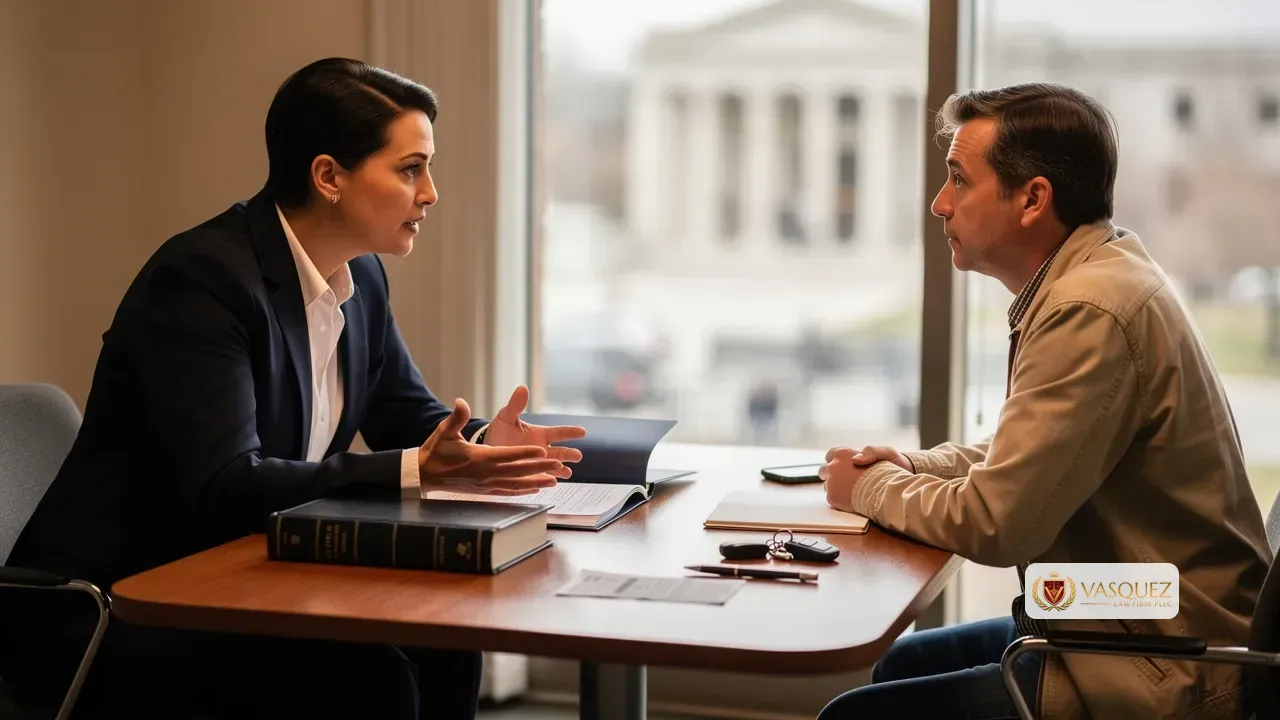
What a Defense Attorney Means in Plain Language
A defense attorney is a lawyer who represents you in the criminal justice system and defends you against criminal charges in court. The term describes the lawyer’s role in relation to you and the government’s case, not a promise about how your case will end.
Criminal defense representation can involve a misdemeanor or felony charge in state or federal court. If you are trying to understand whether the term applies to your situation, start with the legal issue in front of you: a criminal charge, an investigation, or a traffic matter that may require legal information. The label helps you identify what kind of legal role to ask about, but it does not decide the facts, strategy, or outcome of your case.
Overview
Criminal defense work answers three practical questions: whom the lawyer represents, what work the lawyer may perform, and what kind of legal issue brings you to the conversation. A defense attorney represents you rather than the government, reviews the charges and evidence, helps protect your rights, and may represent you in court or negotiate a plea. A prosecutor has the opposite representative role: the prosecutor represents the government or state and seeks to prove guilt.
A public defender is also defense counsel, but a public defender may be provided by the state, county, or federal government if you do not have enough money to hire private legal counsel. That makes “defense attorney” the broader role and “public defender” one way that defense representation may be provided.
You can use those topics to decide whether you need more information about a DUI, traffic ticket, investigation, or criminal charge.
The basic role map looks like this:
- Defense attorney: Represents you and defends you against criminal charges.
- Prosecutor: Represents the government or state and works to prove guilt beyond a reasonable doubt.
- Public defender: May represent you as defense counsel when you cannot afford to hire legal counsel privately.
- Consultation: Gives you an opportunity to ask questions, discuss the offense, and address fees before you decide what information or representation you need.
These descriptions explain the roles. They do not determine which option applies to your facts or what a lawyer may recommend after reviewing them.

Where Criminal Defense Representation Applies
A criminal defense attorney can defend against misdemeanor or felony charges in state or federal court. That broad range is why the phrase may appear in discussions about different criminal allegations rather than one particular type of offense.
The general definition does not tell you what defense applies, whether a plea should be considered, or what result is possible.
If you are unsure whether your issue is criminal, traffic-related, or another kind of legal matter, identify the document, notice, citation, or contact that prompted your question. Bring that information to a legal-information conversation rather than assuming that every lawyer handles every type of case.
What a Criminal Defense Attorney Generally Does
A criminal defense attorney can review the charges and evidence, offer guidance intended to protect your rights, represent you in court, negotiate plea deals, and represent you at trial. Those functions describe the work that may occur as your legal matter develops; they do not mean that every case follows the same path.
Reviewing the charges and evidence gives the attorney information to consider with you. Negotiating a plea is different from representing you at trial, and neither description promises that a particular offer will be made or accepted. The attorney’s role is to help you understand the legal situation and act as your defense counsel within the process.
These functions are best understood as connected parts of one role, not as a checklist that every matter follows in the same order. Reviewing the charge and evidence helps identify what the attorney and client need to address. Rights-focused guidance may matter while the issue is being handled, whether the next discussion concerns a negotiated plea or court representation. Trial representation is a different setting from plea negotiations, but both remain forms of defense advocacy. The label “defense attorney” therefore identifies the lawyer’s side and responsibilities without deciding which path will be used. The charge and circumstances determine which questions belong in a consultation.
Police questioning is another point at which an attorney may represent you. An attorney can help ensure that law enforcement respects your rights during questioning. The practical lesson is narrow: if law enforcement contact is part of your situation, ask about your legal position before treating the contact as something you must handle without counsel.
Criminal defense lawyers also focus on protecting defendants’ rights and helping build defenses that reduce the negative consequences of an arrest. That description concerns the purpose of the work, not an assurance that charges will be dismissed, reduced, or resolved in a particular way.
Our Charlotte DWI and drug-charge defense team has over 85 years of combined attorney experience. This experience describes our Charlotte DWI and drug-charge defense team; it does not predict the result of a particular case or replace a review of your specific circumstances.
How a Defense Attorney Differs From a Prosecutor
A prosecutor and a defense attorney occupy different sides of a criminal case. The prosecutor represents the government or state, while the defense attorney represents you and protects your rights throughout the legal process.
| Role | Represents | Main responsibility |
|---|---|---|
| Defense attorney | You, the defendant | Protect your rights and defend you against the criminal charge |
| Prosecutor | The government or state | Work to prove guilt beyond a reasonable doubt |
A prosecutor typically works with law enforcement to build the government’s case and focuses on securing convictions. A defense attorney’s role is not to act as the prosecutor’s counterpart for the government; it is to represent you. Understanding that difference can make legal conversations easier to follow because each role has a different client and responsibility.
Where a Public Defender Fits
A public defender is defense counsel who may be provided when you do not have enough money to hire private legal counsel. A public defender represents you against the prosecutor, who typically works for the district attorney or attorney general.
The phrase “public defender” therefore identifies how defense representation may be provided, while “defense attorney” identifies the lawyer’s role on your side of the criminal case. A private defense attorney and a public defender both fit within the broader defense function described in this article, even though the way you obtain representation differs.
In the United States, the Sixth Amendment right to counsel has been interpreted to include the right to have an attorney appointed if you cannot afford to hire one. A public defender may be provided by the state, county, or federal government in that situation.
This general explanation does not determine whether you qualify for appointed counsel or how appointment works in your particular court. If you need appointed representation, ask the appropriate court or legal-services channel about the process that applies to your case.
What an Initial Consultation Can Clarify
Fee questions belong in that conversation. Some attorneys may offer payment plans or require a down payment before starting work on your case, so ask how the attorney handles fees rather than assuming that every practice uses the same arrangement.
Preparing for a criminal defense consultation means giving the attorney a complete and honest account of the situation. Bring relevant records when you have them, such as a police report or criminal complaint, and include information about previous criminal charges.
A practical preparation list includes:
- The notice, citation, complaint, or other document connected to the matter.
- The date and place of relevant police or court contact, if you know them.
- The names or descriptions of agencies involved, when available.
- Information about previous criminal charges.
- Questions about the charge, the process, representation, and fees.
Complete information matters because the attorney needs a realistic picture of your situation. Do not leave out an unfavorable detail simply because it feels embarrassing or difficult to explain.
Information you share with your lawyer is protected by attorney-client privilege and the ethical rules governing law practice. That protection is one reason to be honest during the consultation rather than trying to present only the facts that seem helpful.
The consultation still has a defined purpose: it lets you discuss your situation and questions with counsel. It does not turn a general article into advice about your case, and it does not let anyone decide the legal consequences without reviewing the facts.
When a Consultation May Be a Sensible Next Step
The type of legal contact you have received can help you decide whether to seek information or a consultation. Consider these situations:
- You are facing criminal charges. Seeking appropriate legal counsel should be your first step, and a defense attorney can review the charges and evidence with you.
- You are under investigation. A criminal defense attorney may help you understand the legal issue and offer guidance about protecting your rights.
- You received a speeding ticket or face another traffic charge. We recommend contacting a traffic attorney to discuss your case.
- You are dealing with a DUI or another charge and do not understand your options. Use an initial consultation to ask what the offense involves, what information the attorney needs, and what fees may apply.
These situations are signals to ask questions, not conclusions about guilt, defenses, eligibility, or outcome.
The criminal court system can be difficult to navigate alone, so you may consider working with a criminal defense lawyer to help protect your rights. That consideration is especially practical when you do not understand the charge, a document requires a response, or you need to distinguish a traffic matter from a criminal matter.
Start with the issue you actually face. A speeding ticket calls for traffic-related questions, while a criminal charge or investigation calls for criminal-defense questions. If several issues overlap, describe each one instead of assuming that a single label explains the entire situation.
A consultation is a way to gather legal information and discuss your circumstances; it is not a promise that an attorney will take the matter or recommend a particular result. If your concern involves a traffic charge, contact a traffic attorney to discuss the case. If your concern involves a criminal charge or investigation, seek appropriate criminal-defense information.
Key Highlights
The main points about a defense attorney are these:
- The work can be practical and varied. The attorney may review charges and evidence, offer guidance to protect your rights, assist during police questioning, and negotiate a plea.
- The prosecutor has a different client. The prosecutor represents the government or state and works to prove guilt beyond a reasonable doubt.
- A public defender is still defense counsel. A public defender may be provided if you cannot afford to hire private legal counsel.
- A consultation can answer focused questions. You can discuss the offense, ask for legal information, prepare relevant documents, and discuss fees.
- The type of issue guides the next inquiry. Criminal charges and investigations call for criminal-defense questions, while a speeding ticket or another traffic charge may call for a traffic-attorney conversation.
The useful decision is not whether the phrase sounds serious. The useful decision is whether you need information about a specific charge, investigation, traffic matter, or possible representation.
Use the Explanation to Choose Your Next Step
A defense attorney represents you in a criminal matter, while a prosecutor represents the government or state. A public defender is one possible form of defense representation when you cannot afford private legal counsel. Knowing those distinctions helps you ask for the right kind of information without treating a general definition as an answer to your case.
If you face a criminal charge or investigation, gather the documents and facts you have and seek appropriate criminal-defense information. If you received a speeding ticket or face another traffic charge, discuss that matter with a traffic attorney. An initial consultation can help you ask questions, understand the offense involved, and discuss fees before you decide what comes next.
General legal education cannot decide what advice applies to your facts. A qualified attorney must review your circumstances to provide case-specific guidance.
The clearest next step is the one that matches the issue in front of you: identify the charge or traffic matter, preserve the relevant documents, and ask focused questions about the legal role you need. That preparation gives your next conversation a clear starting point.
Questions to Ask Before Seeking Criminal Defense Information
What is the difference between a defense attorney and a prosecutor?
A defense attorney represents the person accused of a crime and protects that person’s rights. A prosecutor represents the government or state and works to prove guilt beyond a reasonable doubt. The two lawyers therefore serve different clients and have different responsibilities.
Is a public defender a defense attorney?
Yes. A public defender is defense counsel who may be provided if you cannot afford to hire private legal counsel. The general term describes the lawyer’s role, while “public defender” describes one way that representation may be provided. Whether you qualify for appointed counsel depends on the process that applies to your case.
When should I seek a criminal defense consultation?
Consider seeking legal information if you are facing a criminal charge, under investigation, or unsure what a legal notice means. A consultation can help you ask questions, understand the offense involved, discuss the information an attorney needs, and address fees. A traffic ticket may call for a traffic-attorney conversation rather than assuming it is the same as a criminal case.
What should I bring to a criminal defense consultation?
Bring the notice, citation, complaint, police report, or other documents connected to the matter when available. Be honest about what happened and include information about previous criminal charges. A complete account helps the attorney understand your situation, but only a review of your specific facts can provide case-specific guidance.
Can I discuss fees during an initial consultation?
Yes. An initial consultation can include questions about legal fees and the offense involved. Fee arrangements differ, and some attorneys may offer payment plans or require a down payment before beginning work, so ask about the terms rather than assuming a particular arrangement.
Sources
- Find Top Criminal Defense Lawyers Near You | LawInfo Attorney Directory — lawinfo.com
- Criminal Defense Initial Consultation | LawInfo — lawinfo.com, 2022-05-26
- What Is a Defense Attorney? | LawInfo — lawinfo.com, 2020-05-18
- Criminal Defense Attorney Serving Atlantic, IA — dltlawyers.com