

Start with the decision family reunification parole creates
Family reunification parole creates two separate questions for your family: how the process generally connects a family petition, an invitation, a supporter, a beneficiary, and travel, and whether a particular process is available or affected by later policy developments. Understanding the first question can help you organize the facts. It cannot answer the second one by itself.
A petitioner generally must be a U.S. citizen or lawful permanent resident whose Form I-130, Petition for Alien Relative, has been approved and who received a written invitation before submitting Form I-134A under a family reunification parole process. A beneficiary living outside the United States becomes a parolee only when that person is paroled into the United States at a port of entry. An approved petition, an invitation, or a completed form should therefore be treated as one part of a sequence rather than as proof that entry or parole will occur.
Current availability creates a separate checkpoint because an Immigration Policy Tracking Project report stated that the covered processes for several nationalities were terminated on December 15, 2025, and that certain existing grants were to terminate on January 14, 2026, subject to exceptions described in the report. Those dates are now past. The report does not, by itself, answer what a later court order required, which exception applied to a particular person, or whether a filing route accepts new action on October 30, 2026.
Use this guide to sort the questions before you rely on an invitation, prepare a filing, make a trip, or assume that parole will lead to permanent residence. Keep the family record together, identify the exact program or notice involved, and separate historical information from the instruction that governs the action you are considering.
What family reunification parole means in plain language
Family reunification parole is a process that may connect an approved family petition with consideration for parole for a qualifying beneficiary outside the United States. In the general structure described by USCIS, the petitioner has an approved Form I-130, receives a written invitation, and may then take the next step identified by the applicable process. The beneficiary is the family member who may be considered for parole, and that person becomes a parolee only if parole is granted and the person is paroled into the United States at a port of entry.
The word “parole” matters because it describes a particular form of permission connected to entry or presence; it does not rename the family petition or turn the petition into a green card. Your family may have more than one immigration question at the same time: whether the petition is approved, whether a parole process applies, whether a person may travel or seek entry, and whether a separate immigrant visa or adjustment process is available.
Form I-131 can relate to different travel or parole documents, but the form number alone does not identify which route applies to your family.
Start by identifying where the beneficiary is now, what notice or invitation the family received, and whether the paperwork refers to initial parole, re-parole, advance parole, or another document. Those labels can change the question you need to ask. Do not assume that a familiar form number answers the eligibility or travel question.
A useful working definition has three parts: the family relationship may be connected to an approved petition, the person outside the United States may be considered for a parole document under a particular process, and the person becomes a parolee only after parole into the United States at a port of entry. Form I-131 can be relevant to more than one parole or travel situation, so the form number alone is not the definition of the program.
That sequence also explains why a family should avoid treating every notice as interchangeable. An invitation, a petition approval, a parole document, an admission record, and an advance parole document can each relate to a different stage or question. Put the documents in order before drawing a conclusion from any one of them.
How the approved family petition, invitation, and supporter fit together
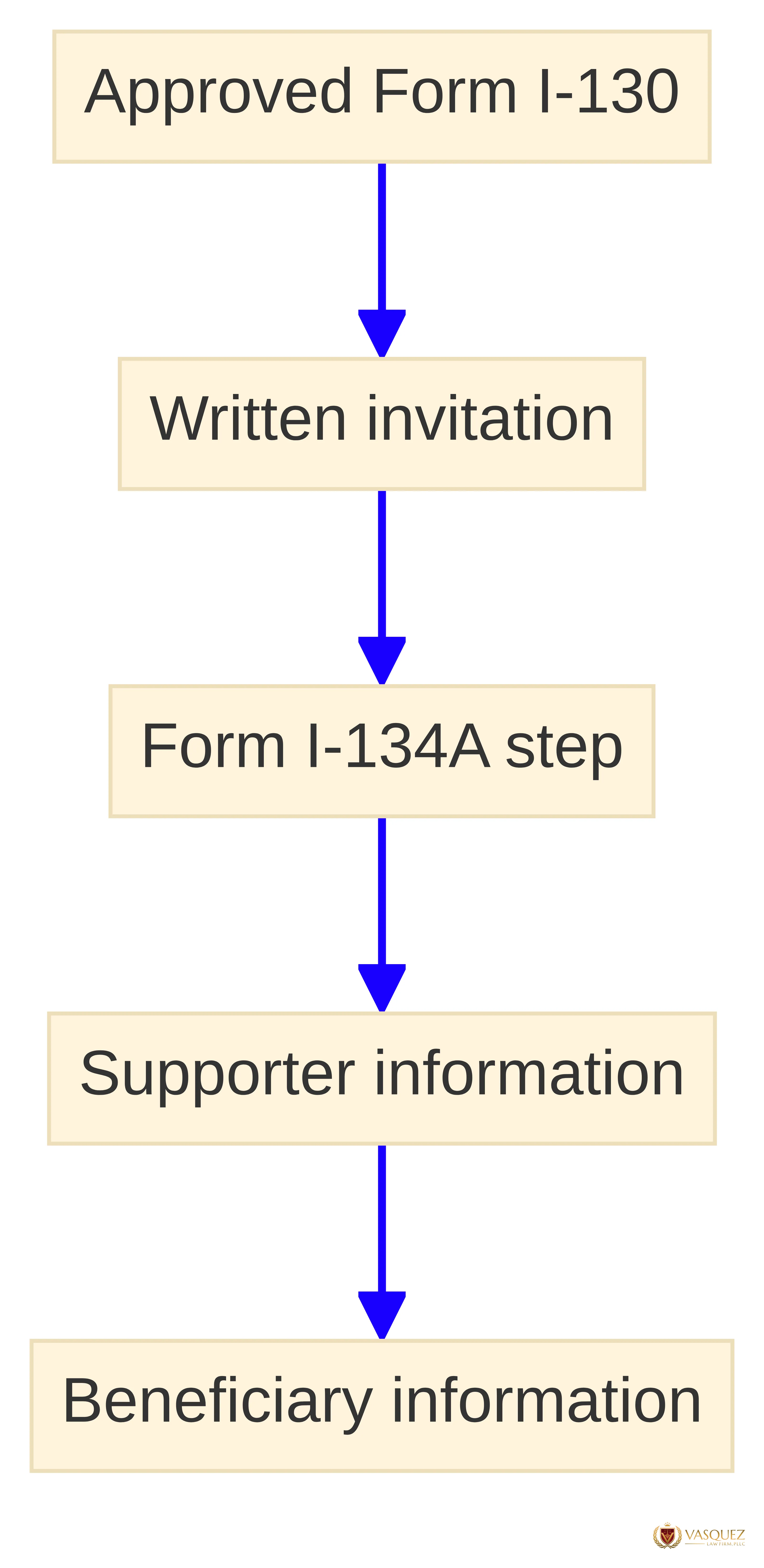
An approved Form I-130, a written invitation, and the supporter step occupy different places in the family reunification parole sequence. Read the notice for the exact process and action it names instead of treating the approved petition as the whole sequence. Under the cited process description, only a petitioner who receives a written invitation can submit Form I-134A under that process.
That sequence gives you a way to read the family’s notices. First, identify the petitioner and the approved family petition. Next, determine whether the written invitation identifies a particular process or action. Then identify what form, supporter information, and beneficiary information the notice requires. An approved I-130 without the required invitation does not establish that the next parole step is available.
The word “supporter” can refer to related but distinct paperwork, so keep the form names separate. The process description identifies the invited petitioner as the supporter on Form I-134A. General USCIS parole guidance defines a financial supporter as a person who agrees to provide financial support for a parole beneficiary by filing Form I-134, Declaration of Financial Support.
Do not replace one form with the other because both involve support. Preserve the exact form number, the name of the person who signed it, the beneficiary named in it, and the date it was filed or received. A supporter’s undertaking is part of the process described in the applicable paperwork; it does not by itself establish that parole will be granted or that the beneficiary will be admitted.
The relationship among petition, invitation, and support is procedural rather than a promise of an outcome. A petition identifies a family relationship for immigration processing. An invitation may open a particular parole step when the process permits it. Support paperwork addresses the financial-support component described by the form.
Keep those functions distinct when you explain the case or compare the family’s notices. If two documents use different form numbers, names, or dates, preserve that difference instead of combining them into a single description. A clean document trail makes it easier to identify which question remains unanswered.
Which family members may appear in the process
Family reunification parole uses several role names, and each role points to a different person in the record. The petitioner is generally the U.S. citizen or lawful permanent resident whose approved Form I-130 supports the process and who received the written invitation required for the Form I-134A step. The principal beneficiary is the family member for whom the petition was filed. Listed derivative beneficiaries are family members included on that petition.
The USCIS process description also identifies certain spouses or minor children who later joined the family and were not listed on the original petition as possible additional derivative beneficiaries. The word “certain” limits the statement. A relationship that appears familiar in ordinary family terms may still require the applicable program’s documents, timing, and current requirements.
Create a family relationship chart before you assume that every relative can be included. List the petitioner, the principal beneficiary, each derivative beneficiary named on the approved petition, and any spouse or minor child who joined the family later. For every person, record the relationship, date of birth, country and current location, and the document where that person appears.
That chart helps you ask a precise question: is this person the principal beneficiary, a listed derivative beneficiary, or a later-added family member whose inclusion depends on current program requirements? It does not determine eligibility. It gives you a clean starting point for reviewing the family’s records.
The family chart should distinguish people who appear on the approved petition from people who joined the family afterward. Use the exact names and dates shown in the records, and note any spelling difference between a petition, passport, birth record, marriage record, or notice. Record the document that supports each relationship rather than relying on a verbal family description.
A later-added spouse or minor child may raise a different question from a derivative beneficiary already listed on the petition. Keep those categories separate when you prepare the file. The applicable process and its current instructions control whether the relationship can be addressed through that route.
Why parole is not a green card or immigrant visa
Parole is not a green card or an immigrant visa. A beneficiary living outside the United States becomes a parolee when that person is paroled into the country at a port of entry, while an approved Form I-130 can continue through a separate immigrant-visa or adjustment-of-status route. These are different immigration questions, even when the same family petition appears in both discussions.
For a relative whose address is outside the United States, USCIS generally sends an approved petition to the Department of State’s National Visa Center for consular processing. For a relative in the United States who appears eligible for adjustment of status, USCIS generally retains the petition for adjustment-of-status processing. Those routing descriptions do not decide whether the person qualifies for either process, but they show why parole should not be treated as the final permanent immigration result.
The practical difference between parole and permanent residence is the question each document answers. Parole concerns whether the beneficiary has been paroled into the United States under the applicable process. A green card concerns lawful permanent residence. An immigrant visa concerns travel to the United States for admission in the immigrant-visa process. Form I-131 can relate to an initial parole document, parole in place, re-parole documentation, or other travel-document functions identified in its instructions.
Treat parole as a temporary, process-specific step rather than as a permanent status. The family should track any separate immigrant-visa or adjustment-of-status case independently, including its notices and deadlines. Do not describe a parolee as a permanent resident unless a separate process has produced that status.
An approved family petition can support more than one conversation about the future, but the petition does not erase the distinction between those conversations. Ask which process is being discussed, what status or document it produces, where the beneficiary must be located, and what action remains outstanding.
Keep the parole record and the permanent-residence record in separate folders. Place petition approvals, visa-processing notices, adjustment filings, parole documents, and travel documents in the folder that matches the question they answer. This simple separation can prevent a parole notice from being mistaken for an immigrant visa notice or a green card.
When a document arrives, ask three narrow questions: does it address entry or travel, temporary parole, or permanent immigration status; does it name the beneficiary or a different family member; and does it require another action? Form I-131 may address a travel or parole-document issue, while the approved I-130 may be routed toward consular processing or adjustment of status.
Those labels should guide your file organization, not determine the outcome. A document can be relevant without answering every immigration question in the family’s case.
What travel and entry documents can and cannot establish
Travel and entry documents answer narrower questions than many families expect. A person already paroled into the United States who wants to travel may apply for an Advance Parole Document by filing Form I-131; the cited USCIS FAQ describes that document as allowing the person to seek parole at a port of entry when returning from a trip outside the country.
A form receipt, an approval notice, or a travel document should not be read in isolation.
The cited Cuban program guidance gives a country-specific travel warning. Under that guidance, a beneficiary outside Cuba may need to travel to Cuba for a program interview. That instruction has a direct practical consequence: do not book travel merely because a family petition or parole application exists. Identify whether the Cuban program actually governs the case, determine what interview location and travel document the guidance requires, and pause the departure decision until the applicable facts and instructions have been addressed.
Before discussing travel, write down four separate facts:
- Where the beneficiary is physically located now.
- Whether the person is outside the United States, already paroled into the country, or seeking re-parole or another document.
- Which form or notice identifies the proposed travel or entry step.
- Whether the applicable program contains a country-specific interview or return instruction.
Use those facts to frame the question. Do not use a general description of Form I-131 as a substitute for the travel analysis.
An advance parole document addresses the ability to seek parole at a port of entry after travel; it does not convert the document into a guarantee of return. The Cuban guidance adds a separate warning for the circumstances it covers, including the possibility that return may not be possible if the application is denied after travel to Cuba.
Keep copies of the document, the filing receipt, the approval or decision, and the travel history together. If the wording is unclear, identify the exact sentence that creates the concern rather than describing the document generally.
Use the Cuban program as context, not a universal template
The Cuban Family Reunification Parole Program is a specific example of how a family-reunification parole process can relate to immigrant-visa processing. A DHS fact sheet describes the program as allowing beneficiaries of certain approved family-sponsored immigrant visa petitions to travel to the United States before their immigrant visas become available. The same fact sheet describes the program’s purpose as supporting family reunification through safe, legal, and orderly migration channels and discouraging dangerous and irregular maritime migration.
That description explains the program’s stated purpose. It does not turn every family petition into a Cuban program case, and it does not make the Cuban interview or travel guidance a universal rule.
The Cuban program has its own factual setting. The cited guidance discusses an interview in Cuba. Use that information only after you establish that the Cuban program is the relevant program. If the family’s documents concern another nationality, another process, or a later policy notice, ask a separate question rather than importing the Cuban rule. Country, location, notice language, and program name all matter.
A useful comparison separates shared structure from country-specific operation. The shared structure may include an approved family petition, a beneficiary, a supporter, and a possible parole step. The Cuban example adds its own immigrant-visa context, stated migration purpose, interview setting, and travel warning. Those added details cannot be assumed for another process.
When you find a website or notice using the phrase family reunification parole, identify the country or program first. Then match the instructions to the exact beneficiary and petition instead of relying on a familiar label.
Check current termination and litigation developments separately
Termination developments can affect both new action and existing parole, so treat those questions separately. An Immigration Policy Tracking Project report stated that USCIS announced termination of the covered processes for Colombians, Cubans, Ecuadorians, Guatemalans, Haitians, Hondurans, and Salvadorans on December 15, 2025. The report also stated that certain grants for people already in the United States would terminate on January 14, 2026, subject to exceptions described in the report.
Those are historical dates as of October 30, 2026. The report’s statement does not, by itself, establish what later court orders required, which exceptions applied to a particular person, whether a grant had another basis, or what agency instruction governs a case today.
Litigation can create a separate status question from the underlying termination announcement. If your family has seen a court case, injunction, appeal, agency notice, or later update, capture the exact title, date, court, affected process, and language describing who is covered. A headline may describe a dispute without answering whether it changes filing acceptance, existing parole, departure consequences, or a particular exception.
Do not treat a litigation reference as an automatic preservation of parole. Do not treat a termination reference as an automatic answer for every beneficiary. Match the development to the person, process, date, and action at issue.
Separate the status review into these questions:
- Does the notice concern a new request, an existing grant, or both?
- What process and nationality does it identify?
- What effective date does it use?
- Does it describe an exception, a pending application, or a court-related protection?
- What action is the family considering now: filing, travel, continued stay, work-related documentation, or another immigration step?
A precise question is more useful than a general statement that the process was “ended” or “saved.”
A termination record should be read with the beneficiary’s own timeline. Compare the date of the grant or application with the effective date in the notice, then identify whether the notice discusses the same nationality, process, and type of action. Record the source of each conclusion because a family may have several notices that use similar terms but address different people.
If a court document is part of the file, preserve the complete document and the page or paragraph that describes its scope. A case name without the operative language does not show what protection or change it created.
Verify whether the current process accepts new action
Current filing availability is a separate checkpoint from historical program structure. Before you rely on a written invitation, Form I-134A, or another filing route, identify the current USCIS or DHS instruction that applies to the exact process and nationality. Check whether the instruction addresses new submissions, pending requests, existing grants, exceptions, and the effective date of any change.
The December 15, 2025 termination announcement and January 14, 2026 date described in the policy-tracking report are past events. They may be relevant to the timeline, but they are not automatic proof that a new action is accepted or rejected on October 30, 2026. Do not fill out a form or make a travel plan based only on the existence of an old invitation.
Use a written freshness checkpoint before taking action:
- Name the exact parole process.
- Record the date and wording of the most recent agency notice you have.
- Identify whether a later court order or agency update addresses that process.
- Ask whether the update applies to new requests, pending matters, existing parole, or a stated exception.
- Record the consequence for the action you are considering.
If the family cannot answer those questions from its records and the applicable current instructions, pause the filing or travel decision instead of relying on a historical webpage or an old notice.
The phrase “available” can describe different actions, so define it before asking the question. A process might be discussed in relation to a new request, a pending request, an existing grant, a notice already issued, or a travel document. An answer about one action does not automatically answer the others.
Write the action at the top of the family’s timeline: “new filing,” “pending request,” “existing parole,” or “planned travel.” Then match the current instruction to that exact category. This prevents a notice about existing grants from being used as proof that new submissions are accepted.
Build a family-status and document timeline
A family-status and document timeline turns scattered notices into a sequence you can explain. Start with the petitioner’s immigration status and the date Form I-130 was filed and approved. Add the written invitation, any Form I-134A or financial-support paperwork, the beneficiary’s location, and every notice about parole or termination.
For each event, record the date shown on the document, the person named, the form or process identified, and the action the document appears to request. Keep the original file and a readable copy. Do not rely on memory for whether a notice concerned the principal beneficiary, a derivative beneficiary, or a later-added spouse or minor child.
Gather the records that answer the basic process questions:
- The approved Form I-130 notice and the petition’s listed family members.
- The written invitation or other notice identifying the parole step.
- Form I-134A, Form I-134, or other support paperwork named in the family’s documents.
- Passports, identity records, and documents showing each beneficiary’s current location.
- Parole documents, admission records, arrival or departure records, and any re-parole notice.
- Form I-131 filings, receipts, decisions, or advance parole documents connected with travel.
- Agency notices or court-related documents discussing termination, exceptions, or continued parole.
The form list is a preparation tool, not a conclusion about which documents your family must file.
The beneficiary’s location belongs on the timeline because it can affect the general processing route described by USCIS. After Form I-130 approval, USCIS generally routes a petition for a relative outside the United States to the National Visa Center for consular processing. USCIS generally retains a petition for a U.S.-based relative who appears eligible for adjustment-of-status processing.
Record location changes with dates rather than listing only the current address. A move can change which notice, interview, or processing question needs attention, while the general routing description does not determine whether the beneficiary qualifies for the process.
Add every planned or completed trip to the timeline. Note the departure country, destination, date, travel document, interview purpose, and return information. For a person already paroled into the United States, the USCIS FAQ describes Form I-131 as the route to apply for an Advance Parole Document before travel.
Use the timeline to identify a travel question before a ticket is purchased. A document that supports seeking parole on return does not remove the need to analyze the person’s facts and the applicable process.
Mark gaps instead of guessing. A missing invitation, unclear beneficiary location, unexplained change in parole status, or notice with no identifiable effective date should appear as an open question on the timeline. Note who received the document and whether it refers to the principal beneficiary, a derivative beneficiary, or another family member.
A gap list gives you a practical order for the next review: identify the missing document, locate the relevant date, match the process name, and write down the action that depends on the answer. That approach is more useful than collecting unrelated paperwork without a question attached to it.
Prepare questions for individualized immigration review
Your first questions should identify the process rather than ask only whether the family “qualifies.” Prepare these questions:
- Which process, if any, is named in our notice?
- Is the petitioner’s Form I-130 approved, and who is listed as the principal or derivative beneficiary?
- Does the written invitation authorize the next action for this petitioner and these beneficiaries?
- Which supporter form does the notice require, and who must complete it?
- Is the beneficiary outside the United States, already paroled into the country, or seeking another form of parole documentation?
- Does the person’s location point toward consular processing or an adjustment-of-status question after Form I-130 approval?
These questions separate the family relationship, the parole process, and the permanent immigration process instead of treating them as one application.
Your second group of questions should address time-sensitive developments:
- Does a termination announcement apply to this nationality, process, beneficiary, or type of parole grant?
- Was the grant, application, or notice issued before an effective date identified in the announcement?
- Does a later court order or agency update change the practical result?
- Is the family asking about a new filing, a pending matter, an existing grant, or travel after parole?
- What exception, if any, does the notice describe, and what record supports that exception?
- If travel is being considered, is an interview required in a particular country, and what document addresses return?
The cited Cuban guidance makes travel location and advance parole part of the question for the circumstances it covers. The termination report makes dates and exceptions part of the status question. Neither source answers every family’s facts.
Your third group of questions should keep temporary parole separate from permanent immigration planning:
- What immigration process, if any, addresses permanent residence for this beneficiary?
- Is the family discussing consular processing, adjustment of status, or another route separate from parole?
- What does the beneficiary’s current location mean for that separate process?
- If the beneficiary must travel, what document is being requested, and does it merely allow the person to seek parole on return?
- What could departure change for the pending parole, petition, or other immigration matter?
Form I-131 and an Advance Parole Document can be part of a travel discussion, but they do not answer the permanent-residence question. Ask for the two analyses separately and keep the resulting documents in separate parts of the family record.
Bring a short written timeline and a family relationship chart to the discussion. Include the exact wording of invitations, approval notices, parole documents, travel documents, termination notices, and any court-related papers. We can help determine which forms of immigration relief may apply to your situation.
Put the questions with the greatest immediate consequence first. Travel, departure, a filing deadline, an expiring document, and a termination date can change what information needs attention before a broader discussion of long-term options. Write the proposed action and its intended date beside each question.
A useful packet therefore contains more than forms. Add a one-page timeline, the family relationship chart, a list of open questions, and a short description of the action you are considering. We can use that organized record to determine which forms of immigration relief may apply to your situation.
Know what this general guide cannot decide
General information cannot decide whether you are eligible, admissible, invited, protected by an exception, or likely to receive parole. It also cannot determine whether a termination announcement applies to your grant, whether a court development changes your case, or whether departure would affect your ability to return. Those conclusions depend on the person, the documents, the process, the dates, and the governing instructions.
Do not travel because a family petition was approved. Do not file because an old form appears online. Do not assume that an existing parole grant continued because another family member received a different notice. The cited Cuban guidance specifically warns that return may not be possible after travel in the circumstances it describes, and the termination report describes exceptions that must be examined rather than presumed.
An approved Form I-130 does not settle the parole question, and parole does not settle the permanent-residence question. USCIS generally routes an approved petition differently depending on whether the relative is outside the United States or appears eligible for adjustment of status inside the country. A beneficiary becomes a parolee only when parole occurs at a port of entry.
Use this guide to identify the records and questions that need attention. Stop short of treating the general sequence as an individualized eligibility decision, filing strategy, or travel clearance.
The available policy reports also leave important distinctions that must be matched to the family’s own documents. A termination announcement, a court development, a country-specific program instruction, and an existing parole document may each address a different question. Do not combine them into a single conclusion merely because they use similar terminology.
Write down the unresolved point in concrete terms: whether a new filing can be submitted, whether a pending matter remains active, whether an existing grant continues, whether an exception applies, or whether travel creates a return problem. That wording keeps the next step tied to the actual concern.
Organize the record before choosing your next step
Your next step is to organize the family’s record around three separate questions: what the approved petition and invitation establish, what the applicable parole process currently allows, and what permanent immigration process may exist apart from parole. Put the petition, notices, beneficiary chart, travel history, parole documents, and policy updates in date order. Mark every uncertainty instead of filling it with an assumption.
A qualified immigration professional must determine individual suitability, filing strategy, and the effect of current policy or litigation on your facts.
Practical questions families should ask before relying on parole
What is family reunification parole?
Family reunification parole is a process that connects an approved family petition with consideration for parole for a qualifying beneficiary outside the United States.
What happens if a family reunification parole process is terminated?
If a family reunification parole process is terminated, existing grants may also terminate, subject to exceptions. It's important to check the specific details regarding your case and any applicable court orders or agency updates.
What should I prepare before contacting an immigration professional about family reunification parole?
Before contacting an immigration professional, prepare a timeline of your family's immigration status, including the approved petition, any invitations received, and the current location of beneficiaries. Also, gather relevant documents such as Form I-130 approvals and any notices regarding parole.
What travel considerations should I keep in mind if I am paroled into the U.S.?
If you are paroled into the U.S.
What are the implications of current policy changes on family reunification parole?
Current policy changes can affect the availability and operation of family reunification parole processes. It's essential to stay updated on any announcements from USCIS or DHS regarding these changes.
Sources
- Humanitarian or Significant Public Benefit Parole for Aliens Outside the United States | USCIS — www.uscis.gov
- Family Reunification Parole Processes | USCIS — www.uscis.gov
- Fact Sheet — www.dhs.gov
- The Cuban Family Reunification Parole Program | USCIS — www.google.com
- USCIS terminates family reunification parole processes for Colombians, Cubans, Ecuadorians, Guatemalans, Haitians, Hondurans, and Salvadorans | Immigration Policy Tracking Project — www.google.com
- Frequently Asked Questions About the Family Reunification Parole Processes | USCIS — www.uscis.gov
- Petition for Alien Relative — www.google.com
- How Federal Immigration Cases Work in Charlotte NC in 2026 | Vasquez Law Firm