
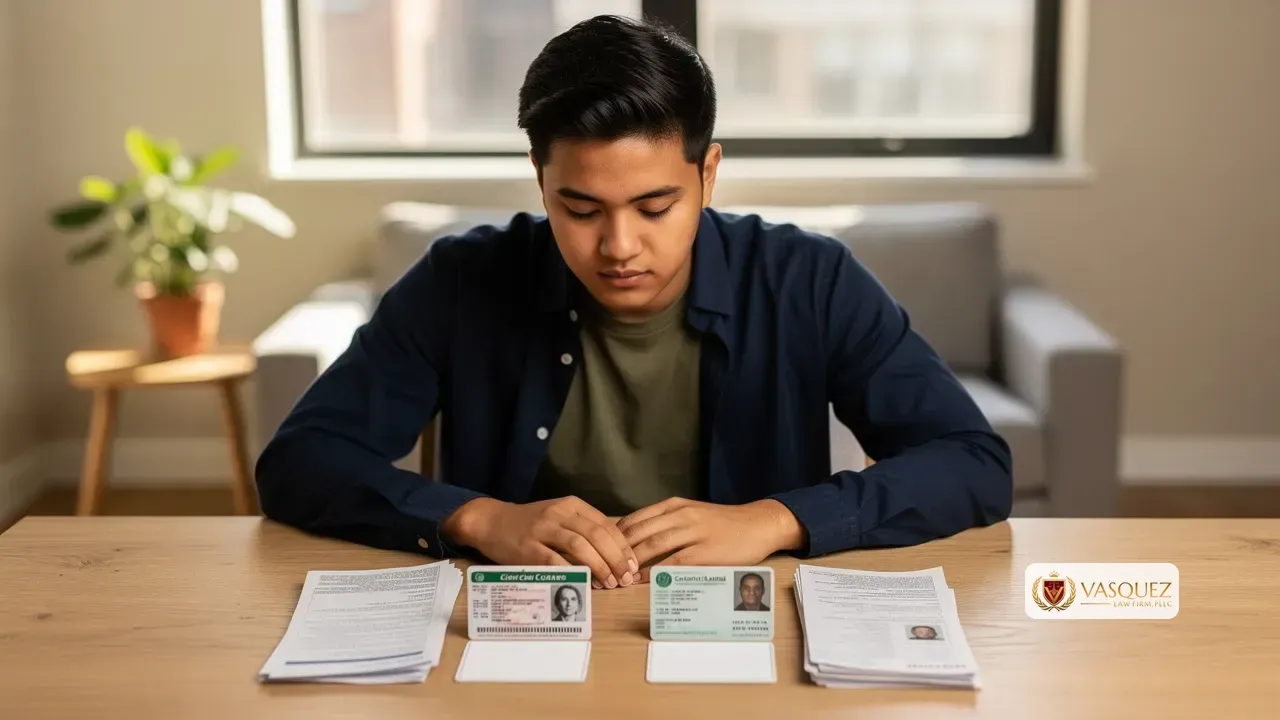
A green card is not the same as citizenship
A green card and U.S. citizenship are different immigration statuses, even though a green card can be part of a longer path toward naturalization. A green card generally refers to lawful permanent resident status, while the Permanent Resident Card is the document used as proof of that status. U.S. citizenship is a separate status, so holding a card does not by itself mean that you are a citizen.
Lawful permanent resident status does not expire unless it is terminated or you naturalize, but you must have valid, unexpired proof of that status. The status and the card are related, but they are not the same thing. That distinction affects how you organize records, think about travel, and assess whether naturalization fits your goals.
The question is not simply whether citizenship sounds like a higher status. Your answer depends on what you want your status to support, how you have lived and traveled, what your immigration history shows, and whether you want to pursue a separate naturalization process. A clear comparison helps you identify the questions that need current answers before you file anything.
Your goals should guide the comparison between a green card and citizenship. A green card may already support the life you are building in the United States, while citizenship may be worth exploring if you want a different long-term status and are prepared to examine the requirements and your history.
The practical questions are more useful than a simple ranking:
- What status do you have now, and what document proves it?
- How have your travel and residence patterns affected the connection between you and the United States?
- What does your immigration record show about the way you obtained permanent residence?
- Which civic or travel questions require a current rule rather than an assumption?
- Are you comparing a status you already hold with a pathway you may or may not qualify to pursue?
This guide gives you a framework for those questions. It does not decide whether you qualify for naturalization or tell you that one status is universally better.
Green card and citizenship at a glance
A green card and U.S. citizenship should be compared by status, proof, residence, civic questions, and pathway rather than by title alone.
| Question | Green card status | U.S. citizenship | What you should examine |
|---|---|---|---|
| What does the status mean? | Lawful permanent resident status, supported by a Permanent Resident Card | A separate status that is not created merely by holding a green card | Identify the status you hold now before discussing a future pathway |
| What proves the status? | You must have valid, unexpired proof of lawful permanent resident status | A citizenship record or document is a separate matter from a Permanent Resident Card | Keep the document that proves your present status and preserve relevant immigration records |
| How does residence matter? | Travel may be permitted, but residence intent and the circumstances of an absence can affect the status | Your citizenship comparison still requires a review of your naturalization history and applicable rules | Examine trips, time outside the United States, and your continuing ties before relying on a general rule |
| How does civic participation fit? | Do not assume that a green card answers every question about voting or another civic activity | Do not assume that a citizenship label answers every question without checking the rule for the specific activity | Verify the current requirement for the activity before you participate or make a status decision |
| How does citizenship arise? | Holding a green card is not the same as completing naturalization | Naturalization is a separate process with its own requirements and review | Treat naturalization as a pathway to assess, not an automatic result of time passing |
| What can a comparison tell you? | It can show which records and travel questions need attention | It can show which naturalization questions need attention | Use the comparison to prepare for a fact-specific review, not to decide eligibility by yourself |
The table separates established status rules from questions that require a current, activity-specific answer. Travel and permanent resident status deserve particular care: temporary or brief travel usually does not affect permanent resident status, but the circumstances and purpose of a longer absence can matter. The civic-participation row is a prompt to verify the applicable rule, not a substitute for that rule.
The trade-off is not simply convenience versus difficulty. A green card may be the status you already rely on, but it remains connected to residence intent, proof of status, and the history behind your admission. Citizenship may align with your long-term plans, but exploring it requires a separate review of lawful admission, residence history, application requirements, and any exceptions that may apply.
Use this comparison in two stages:
- Describe your present position accurately. Separate your lawful permanent resident status from the expiration date on the physical card, and separate both from any question about citizenship.
- Identify the consequences you care about. Travel, long-term residence, civic participation, records, and the possibility of naturalization may matter differently in your circumstances.
The result should be a focused list of questions. A focused list is more useful than assuming that one status fits every goal.
What a green card establishes—and what it does not
Lawful permanent resident status establishes your position as a permanent resident, while the Permanent Resident Card provides valid proof of that status. The physical card has an expiration date, but the status itself does not expire unless it is terminated or you naturalize. That distinction matters whenever you are deciding what an expired, lost, or damaged card means.
A card problem and a status problem are not automatically the same problem. An expired card can raise a document question, while a long absence, an indication that you no longer intend to make the United States your permanent home, or another issue can raise a status question. Do not treat the date printed on the card as a complete answer about your immigration position.
The green card also does not answer every future question for you. It does not tell you whether you should seek citizenship, whether your travel history creates a concern, or whether your original admission for permanent residence meets the requirements for naturalization. Those questions require a closer look at your records and circumstances.
A useful way to understand permanent resident status is to keep three items separate:
- The status: your lawful permanent resident position in the United States.
- The proof: your Permanent Resident Card or other document used to show that status.
- The history: the admission, applications, travel, residence, and correspondence that explain how the status was obtained and maintained.
These items answer different questions. The proof helps show your status at a particular time. The history may matter when you seek naturalization or when an absence raises a question about whether you continued to make the United States your permanent home. Keeping the categories separate prevents a document date from being mistaken for a complete legal conclusion.
What citizenship changes in the comparison
U.S. citizenship changes the comparison because citizenship is a separate status reached through its own pathway rather than an automatic result of holding a green card.
That distinction shows why time alone cannot answer the question. A card may show that you hold or held permanent resident status, but a naturalization review can also involve the way you were admitted and the history connected to that status. The distinction is practical: you are comparing an existing status with a separate application pathway that examines eligibility requirements.
Citizenship may fit a person who wants to explore a different long-term status, but this article does not treat that goal as universal. You may have reasons to remain focused on your permanent resident status, reasons to explore naturalization, or facts that need review before either choice makes sense. Start with your objective, then test it against your records and the requirements in effect when you act.
Rights, responsibilities, travel, and civic participation should be treated as separate comparison categories. For each category, write down the specific outcome you are considering:
- If your concern is voting or another civic activity, identify the activity and verify the current rule that governs it.
- If your concern is travel, identify the length, purpose, and circumstances of your absences rather than relying on a simple calendar rule.
- If your concern is residence, examine whether your plans continue to place the United States at the center of your permanent home.
- If your concern is responsibility, identify the requirement or duty at issue instead of treating a general label as the answer.
- If your concern is protection from immigration consequences, ask what specific protection you mean and what facts control that question.
Specific questions produce more reliable next steps than a broad statement that one status is better.
Travel and residence can affect a green card holder’s position
Travel outside the United States is permitted for permanent residents, and temporary or brief travel usually does not affect your permanent resident status. That general rule does not turn every trip into a routine trip. The purpose of the absence, your intention to return, and the facts showing where you maintain your permanent home can matter.
An absence can raise questions about whether the United States remains your permanent home. A general guide is an absence of more than a year, but abandonment can also be found after a trip of less than a year. The length of the trip is therefore a warning point, not a complete test.
The practical question is not only how long you were away. Consider why you left, what you planned when you left, whether the trip changed into an open-ended stay, and what your records show about your continuing connection to the United States. These facts do not produce an automatic answer in every case, so avoid relying on the phrase that returning once a year always protects your status.
The Permanent Resident Card may be used as a travel document for returning to the United States if you have not been abroad for a year or more. That point concerns a travel document and a stated period of absence; it does not erase the separate question of whether your conduct and intentions support continued permanent resident status.
Before a trip, organize the facts that may affect how you describe it:
- Your departure date and expected return date.
- The reason for the trip and whether that reason changed.
- The places where you lived, worked, kept records, and maintained family or community ties during the absence.
- The documents you will use for travel and return.
- Any prior absence that may make the overall pattern more complicated.
A short trip can still require attention if the surrounding facts suggest that the United States was no longer your permanent home. A long trip is not the only situation that deserves review.
Travel is one area where green card status and citizenship should not be compared through a slogan. Permanent resident status has a direct connection to the intention to maintain the United States as your permanent home, while a naturalization decision may also require examination of residence and history. The relevant questions can change depending on your records and the reason for the trip.
Use a cautious decision path:
- Separate a planned temporary visit from a move or an extended stay.
- Record the dates and circumstances of every significant absence.
- Preserve documents that show your continuing ties and physical presence.
- Obtain fact-specific guidance before filing or traveling if your absence was lengthy, repeated, or connected to a change in your permanent home.
Do not use a one-year statement as a promise that your status is protected. Treat it as one supported reference point within a broader review.
Separate permanent resident status from proof of that status
Permanent resident status and an unexpired Permanent Resident Card are separate issues. The Permanent Resident Card is proof of your status, and that proof must remain valid and unexpired. A card that is close to expiration therefore deserves attention even when the expiration date does not, by itself, answer whether the underlying status continues.
A properly submitted Form N-400 can affect the proof question in a specific way. If you properly submit Form N-400, your receipt notice, presented with your Permanent Resident Card, automatically extends the card's validity for 24 months from its expiration date. Keep the receipt notice with the card when you need to show the extended validity.
The receipt notice does not turn the naturalization application into citizenship. It also does not remove the need to examine whether your application and immigration history support the pathway you are pursuing. Keep the proof issue, the application issue, and the underlying status issue in separate notes.
Use a simple document check before treating a card problem as a citizenship decision:
- Identify whether the concern is an expired, lost, damaged, or otherwise unavailable card.
- Identify what other proof you possess and what agency correspondence you have received.
- Keep any Form N-400 receipt notice with the Permanent Resident Card if you properly submitted the application.
- Separate the card’s expiration date from the dates and circumstances of your travel.
- Preserve earlier cards, applications, notices, and correspondence that explain your immigration history.
This checklist helps you describe the problem accurately. It does not decide whether your status is intact or whether naturalization is available to you.
Naturalization is a separate pathway from holding a green card
Naturalization is a separate pathway from holding a green card. In general, you must be a lawful permanent resident for 5 years before applying for naturalization, although exceptions may apply. The timing rule is only one part of the comparison.
If your permanent resident status was not lawfully obtained, you may be ineligible even if you have a Permanent Resident Card. This means that a card and the length of time you have held it may not resolve every question about the pathway.
Naturalization should therefore be treated as an application decision, not as a status conversion that happens automatically. Your records, admission history, residence pattern, travel, and the requirements in effect when you apply all deserve attention. A general article can identify those subjects, but it cannot determine how they apply to your history.
The naturalization process includes more than completing a form. USCIS says to review the instructions, collect the required documents and evidence, complete the application, submit it with two passport-style photos and the required fees, and keep your address current with USCIS. Those steps describe preparation and filing themes, not a finding that you qualify.
The interview also has practical features that may matter as you prepare. You may ask the USCIS officer to repeat or rephrase interview questions. Certain applicants may qualify for English-language exemptions or take the civics test in the language of their choice based on age and time as a lawful permanent resident.
Use the official instructions that apply when you act. Requirements, forms, fees, and procedures can change, so a past application experience or an informal checklist should not replace the instructions in effect at the time of filing.
A pathway is not a promise of an outcome. You can use the general sequence to decide what to examine:
- Confirm the status you hold and the proof you have.
- Review how you were admitted or adjusted to permanent residence.
- Map your residence and travel history.
- Identify the naturalization timing rule and any possible exception that may relate to you.
- Gather the documents and evidence needed for a current review.
- Resolve questions before submitting an application rather than relying on the green card alone.
This sequence keeps the focus on the difference between holding permanent resident status and applying for citizenship.

Use your goals and history to decide what to explore
Your goals and history should determine what you explore next, not a general assumption that citizenship is always better. A useful comparison asks what you want your status to support and whether your records fit the pathway you are considering.
Start with these five questions:
- Long-term home: Do you plan to keep the United States as your permanent home, or have your plans shifted toward living elsewhere?
- Travel pattern: Have you taken brief trips, extended trips, repeated trips, or an absence that changed the way you lived? - Status history: Was your permanent residence obtained through a process you can document? Naturalization generally requires lawful admission for permanent residence, even if you have a Permanent Resident Card.
- Timing: Have you held lawful permanent resident status for the general five-year period, or does a possible exception require a closer review? The five-year rule is general and exceptions may apply.
- Personal objective: Are you focused on maintaining your current status, exploring naturalization, resolving a document issue, or understanding a travel concern?
These questions organize the review without deciding eligibility.
Different goals lead to different next questions:
- If your goal is stability in the United States: begin with your permanent resident documents, residence pattern, and plans for maintaining the United States as your permanent home. Do not assume that a travel schedule is harmless without examining its purpose and circumstances.
- If your goal is to explore citizenship: treat naturalization as a separate application pathway. Review lawful admission, the general timing rule, your residence and travel history, and the records supporting your account before deciding whether to file.
- If your goal is to travel: separate the permission to travel from the question of preserving permanent resident status. Record the expected absence, retain the relevant documents, and address unusual or extended travel before departure.
- If your goal is to understand civic participation: name the specific activity and verify its current rule. Do not rely on a broad label such as green card holder or citizen to answer an activity-specific question.
- If your goal is to resolve an old immigration concern: collect the original applications, notices, cards, work permits, and agency correspondence. A complete history may matter more than the expiration date on the document you currently carry.
Each branch ends with a different action because each goal creates a different factual question.
Citizenship is not a universal recommendation, and remaining a permanent resident is not a universal recommendation either. The right comparison depends on your objectives and on facts that may not appear on the front of your card.
You may value the ability to keep your present status without pursuing a separate application. You may instead want to explore naturalization because your long-term plans make a different status worth considering. You may also discover that your first task is neither choice: it may be resolving a missing record, a lengthy absence, or uncertainty about how you obtained permanent residence.
Make the next step match the unresolved question. If the question is general, continue organizing information. If the question depends on your admission, travel, residence, or document history, move from general comparison to individualized review.
A general comparison cannot answer eligibility questions
Pause before treating a green card versus citizenship comparison as enough if any of these points applies to you:
- You are unsure whether your permanent residence was lawfully obtained.
- Your immigration history includes a prior application, denial, inconsistent statement, or agency notice you do not understand.
- You spent an extended period outside the United States or made repeated trips that changed your residence pattern.
- You are unsure whether you maintained the United States as your permanent home.
- Your Permanent Resident Card is expired, missing, damaged, or inconsistent with other records.
- You are considering naturalization but cannot reconstruct your residence, travel, or admission history.
- You want an answer about a specific civic activity, travel document, or immigration consequence rather than a general explanation.
The supported action is to gather the facts and address the unresolved issue before filing or making a time-sensitive travel decision.
Gather records that can support a later review
Your immigration records can make the green card versus citizenship comparison more precise. We recommend gathering relevant immigration documents, including green cards, previous visa applications, work permits, and correspondence with immigration authorities. Keep the documents together even when an older record seems unrelated; it may help explain the status history you need to review.
We also recommend keeping evidence of physical presence, such as bank records and pay stubs, to support continuous residence claims for citizenship. Documents proving your ties and continuous residence may include tax returns, pay stubs, leases, and utility bills. Separate the records into practical groups:
- Status documents: current and previous green cards, notices, and other proof.
- Immigration history: visa applications, adjustment materials, work permits, and correspondence.
- Residence records: leases, utility bills, tax returns, pay stubs, and bank records.
- Travel records: dates, tickets, entry and departure information, and explanations for extended absences.
- Questions: a short note identifying what each document may clarify.
A labeled file keeps the records organized for review.
Build a timeline before you decide what the documents mean. List when you obtained permanent resident status, when you received or replaced cards, where you lived, and when you traveled outside the United States. Add the applications and notices that correspond to those events.
Mark any gap you cannot explain. An unexplained gap does not automatically establish a problem, but it tells you where a fact-specific question may exist. Mark changes in residence, work, family circumstances, and travel plans as well. Your goal is not to write a legal conclusion; your goal is to create an accurate account that can be reviewed against the applicable requirements.
Avoid discarding a document because it looks old or because the card it relates to has expired. The document may still help explain how your status developed or what you told an agency at an earlier stage.
Verify current USCIS requirements before filing

Know when individualized immigration guidance is important
Individualized immigration guidance is important when the answer depends on your lawful admission, residence history, travel, records, or the circumstances behind your status. A general comparison can explain the difference between a green card and citizenship, but it cannot determine how those facts affect your pathway.
Seek a fact-specific review before filing or making a time-sensitive decision if:
- You cannot document how you were admitted for permanent residence.
- Your Permanent Resident Card is the only record you can locate, and you have questions about the applications or notices behind it.
- You were outside the United States for a lengthy period or had a trip of less than a year that may still raise a question about your intention to maintain the United States as your permanent home.
- Your residence, work, family, or travel history is difficult to reconstruct.
- You are unsure whether a prior statement or application was accurate.
- You want to know whether naturalization fits your circumstances rather than simply understand the general process.
We offer legal help for immigration issues. Bring your timeline and organized records so the discussion can focus on the facts that control your question.
The point of individualized guidance is not to replace your goals with someone else’s recommendation. The point is to examine the facts that a general comparison cannot resolve, identify the rule that applies, and explain the available next steps and boundaries. A qualified immigration professional should decide individual suitability after reviewing your circumstances rather than relying on the label on your card alone.
If your question is limited to the difference between the two statuses, the comparison in this guide can help you name the issue. If your question is whether you qualify, whether a past event creates a concern, or whether you should file now, gather the records and move to a fact-specific review.
Make the next status decision with verified information
The difference between a green card and U.S. citizenship is a difference between an existing permanent resident status and a separate naturalization pathway. Compare your long-term goals, travel and residence history, lawful-admission records, proof of status, and the specific civic or immigration question you want answered.
Review the USCIS instructions in effect when you act, collect the documents and evidence they require, and keep your address current with USCIS. We recommend gathering your green cards, previous visa applications, work permits, agency correspondence, and records that show physical presence and continuous residence. If your history includes uncertain admission, lengthy or complicated travel, missing records, or a question about whether naturalization fits, do not decide from a general comparison alone.
A qualified immigration professional can assess individual suitability after reviewing your circumstances. We offer legal help for immigration issues.
Your next step is to write down the status you hold, the result you want, and the fact you still need to verify. That short list will help you distinguish a document question from a status question and a general question from an eligibility question.
Questions to review before comparing a green card with citizenship
Can I apply for citizenship if my green card is expired?
An expired card does not by itself answer whether you still hold lawful permanent resident status or whether you qualify for naturalization. If you properly submit Form N-400, USCIS says the receipt notice presented with your Permanent Resident Card automatically extends the card’s validity for 24 months from its expiration date. Keep the card and receipt notice together, and review any separate status or eligibility concerns before relying on them.
Can travel outside the United States affect a green card holder’s path to citizenship?
It can require review. Brief or temporary travel usually does not affect permanent resident status, but a longer absence—or even a shorter trip if the surrounding facts suggest you no longer intended the United States to be your permanent home—may raise concerns. Before applying, organize your travel dates, reasons for absences, residence history, and evidence of continuing ties.
What records should I gather before exploring naturalization?
Collect your current and prior green cards, visa or adjustment records, work permits, immigration correspondence, and documents showing residence and physical presence. Useful records may include tax returns, pay stubs, leases, utility bills, and bank records. Create a timeline of your status, addresses, applications, and travel, and mark any dates or events you cannot explain.
When should I seek individualized immigration guidance about naturalization?
Seek a fact-specific review before filing or making a time-sensitive travel decision if you cannot document how you became a permanent resident, had lengthy or repeated absences, are unsure whether you maintained the United States as your permanent home, have inconsistent or missing immigration records, or want to know whether naturalization fits your circumstances. A general comparison cannot resolve those history-dependent questions.
Sources
- International Travel as a Permanent Resident | USCIS — www.uscis.gov
- Commonly Asked Questions About the Naturalization Process | USCIS — www.uscis.gov
- Form N-400, Instructions for Application for Naturalization — www.uscis.gov