
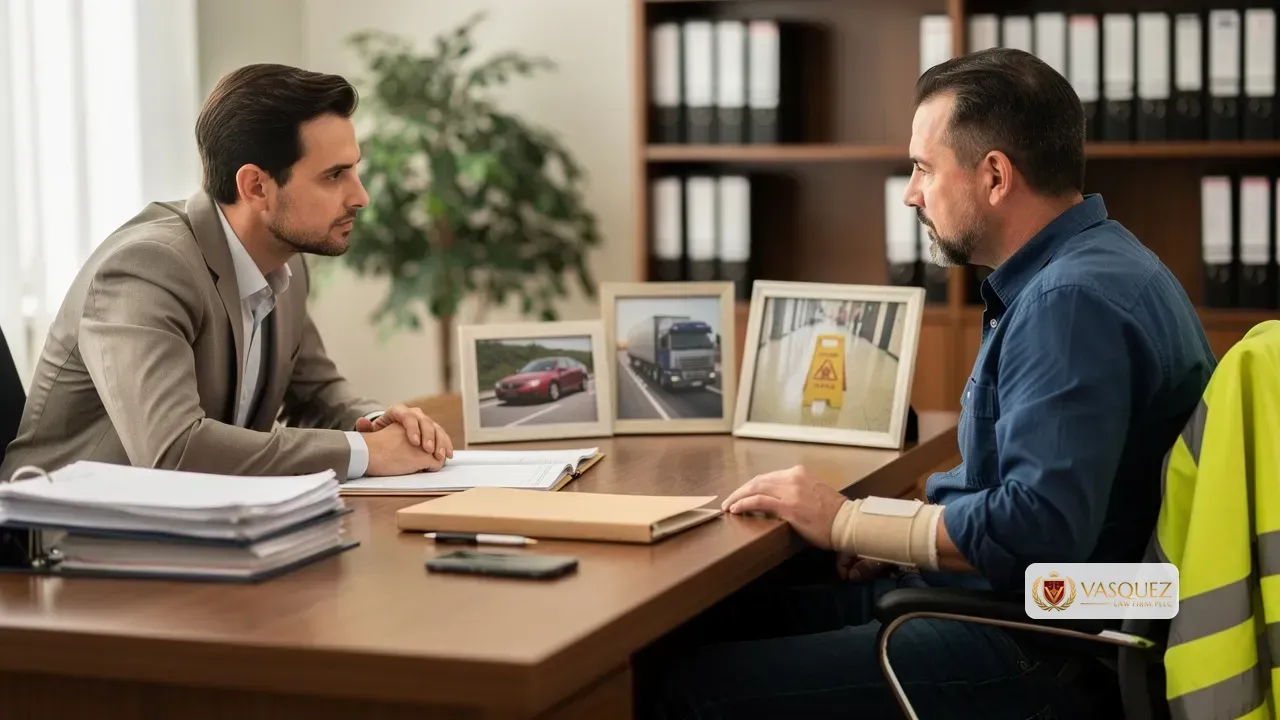
Start with the type of injury matter you need help with
Our personal injury service covers claims involving car accidents, truck crashes, slip and falls, and wrongful death. If you are in or near Charlotte, those categories offer a starting point for deciding what to ask us about.
Use the list to identify the subject of your inquiry:
- Car accident: Your concern follows a car crash.
- Truck crash: Your concern follows a truck crash.
- Slip and fall: Your concern involves an injury after a slip or fall.
- Wrongful death: Your inquiry concerns a death following an incident.
These descriptions are service categories, not conclusions about your situation. A close match does not establish eligibility, the merits of a claim, or what outcome is possible. It also does not tell you whether contacting a lawyer is the right choice for you.
If you recognize your situation in one of the categories, you can ask whether it is within our personal injury services. If you are uncertain how to describe what happened, give the general type of incident and ask about it rather than trying to settle the classification yourself. If your situation does not seem to match a listed category, ask whether it falls within the stated scope instead of assuming that it does or does not. The aim of this first comparison is to frame a clear question, not to decide a claim. The firm has a Charlotte office, which is relevant to a nearby search, but location alone does not establish whether a particular matter fits the listed services. Keep the two checks separate: proximity can prompt an inquiry; the incident category and the help you are asking about are still questions to raise.
What a lawyer may help with after a car accident
For a car accident matter, a personal injury lawyer can assist by investigating the scene, gathering evidence, handling communications with insurance companies, and negotiating for a fair settlement.
Those are different kinds of assistance, not a promise that each one applies to your situation or leads to a particular result. Investigating the scene and gathering evidence concern information about the accident. Communicating with insurers is a separate task, while negotiating for a fair settlement describes one possible part of resolving a claim—not a prediction that an agreement will be reached.
If your inquiry concerns a car accident, you can ask which of these areas may relate to your circumstances. For example, you might ask whether you can get help understanding communications from an insurer, or what information could be useful when discussing the accident. You do not need to know in advance which task matters most. Start with the question that is weighing on you.
A focused question also helps keep the conversation separate from an assessment of the claim. You can ask about a type of assistance without assuming that it will be provided in every case or that it determines the result. If you are unsure what to ask first, name your main concern in general terms and ask what information would help clarify the next discussion.

How records can help explain an injury’s effects
A car accident lawyer often works with providers and employers to gather records and explain how injuries affect your life.
That general description does not identify which records apply to your situation or establish a claim’s value. The question you want to discuss can help you decide what to ask about first.
If time away from work is part of your concern, you can mention lost wages as a topic without estimating an amount or deciding which records prove it. Ask whether information from an employer may be relevant and what, if anything, would be useful to provide. You can take the same approach if you want to explain how an injury has affected another part of your life: describe the concern generally and ask what information may help explain it. A list of possible records is not a required checklist. Before sending detailed or sensitive material, ask what is needed and why it is relevant to the question you want to discuss.
Keep the distinction clear: you can identify the effect that concerns you without deciding what it means for a claim. An initial question about records can help you understand what information may be useful later, while leaving the significance of your individual circumstances for a separate review. The firm’s description names providers and employers as parties a car accident lawyer may work with, but it does not identify particular records or say what a record establishes in an individual matter. It also describes two related but distinct activities: gathering records and explaining how injuries affect a person’s life. The first concerns information; the second concerns describing effects. Neither statement provides a calculation of claim value, and neither determines which details matter in a particular situation.
Compare your situation with the firm’s stated services
A useful first fit check separates two things: the type of incident behind your injury and the question you need help answering. The incident category helps you describe the subject; your question might concern insurer communications, records, injury effects, or lost wages. Neither point, on its own, decides whether you have a claim.
- If your situation involves a car accident or truck crash, ask whether our listed personal injury services fit an inquiry about that incident. A match to a listed category does not establish eligibility or claim merits.
- If your situation involves a slip and fall, ask whether we handle an inquiry about that kind of incident. The label alone does not determine what legal issues apply.
- If your inquiry concerns a wrongful death, ask whether the service description covers the kind of matter you have in mind. Do not treat the category as a decision about anyone’s rights or the merits of a claim.
- If you are unsure how to categorize what happened, describe the incident generally and ask whether it fits the listed services. Do not guess at a legal label.
- If your concern involves work circumstances or lost wages, mention that context and ask which service area is relevant to your inquiry. Do not assume the personal injury list answers that question by itself.
- If your situation does not seem to match a listed type, ask whether it falls within our stated services rather than assuming it is covered.
This comparison is meant to narrow your first question, not to make you choose a legal path before speaking with someone. You may know the kind of incident but not which concern to lead with, or you may know what is worrying you without knowing the right category. Either is a reasonable starting point for an inquiry. Keep the two details separate: “what happened” and “what I want to ask about.” That gives you a straightforward way to describe the situation while preserving the distinction between service fit and an assessment of your claim.
One boundary is the difference between the breadth of the service list and the narrower description of particular tasks. The list names car accidents, truck crashes, slip and falls, and wrongful death, but the specific examples of investigating a scene, gathering evidence, communicating with insurers, and negotiating for a settlement are described for car-accident matters. If your inquiry concerns another listed type, you can still ask whether the matter fits the service scope, then separately ask what kinds of assistance may apply to that situation. Do not assume that each car-accident example automatically applies to every listed category. This two-part question—whether the type of matter is within the stated services, and whether the help you are looking for is available for it—keeps a service description from being mistaken for a promise about an individual claim.
The firm also lists workers’ compensation as a practice area, separate from personal injury. If work circumstances are part of your concern, the fact that lost wages matter to your question does not by itself tell you which service area applies. You can identify the work context and ask whether the inquiry belongs with personal injury, workers’ compensation, or both; the available descriptions do not settle that for an individual situation.
Keep an initial inquiry focused and low-disclosure
A low-disclosure initial inquiry can begin with a general description and one clear question, rather than a detailed account or a packet of records. You can jot down three points for yourself:
- The general matter type: Note whether you are asking about a car accident, truck crash, slip and fall, wrongful death, or an incident you are unsure how to describe.
- Your main concern: Identify the issue you want to raise, such as insurer communications, information about how an injury has affected you, or a lost-wage concern.
- Your first question: Decide whether you want to ask about service fit or what information would be useful for an initial discussion.
These notes are for your own organization, not a required checklist. You can begin with a broad description and leave sensitive details out until you understand what information is being requested and why. A simple question could be: “Does your personal injury service cover this type of matter, and what information would you need for an initial discussion?” If you already know the general incident type, you can name it and add your main concern. If you do not know how to categorize what happened, say so and ask how to describe it. You do not need to resolve that uncertainty before reaching out.
Before sending detailed records, ask what information is needed for the next conversation. If you are not ready to share a detail, keep it out of your first description and ask whether a general account is enough to begin. A clear initial question does not have to include every detail of an incident or explain its legal significance. The purpose of your notes is to help you state what you want to ask and to make an informed choice about what to share.
Vasquez Law Firm describes its personal injury claims as handled on a contingency basis. That general description does not set out fee terms or explain how they apply to a particular matter. If payment arrangements affect whether you want to proceed with an inquiry, ask what contingency basis means for the service you are discussing, whether any costs are treated separately, and what terms you should understand before deciding whether to proceed. Do not infer a particular fee, expense, or payment obligation from the short service description. The firm also describes itself as bilingual; if you would rather begin in Spanish, say so and ask what language support is available for the inquiry.
Decide whether to make an initial inquiry
If your concern resembles one of the listed personal injury matters, an inquiry can help you ask whether our services fit and what information may be useful next. If the category is unclear, you can lead with that uncertainty rather than trying to resolve it yourself.
Our inquiry form asks for your name, phone number, and email. You can keep your first description general and ask what information is needed before sharing detailed or sensitive records.
Questions to consider before contacting a personal injury lawyer
What should I have ready before contacting a personal injury attorney near me?
For an initial inquiry, note the general type of incident, your main concern, and the question you want answered. Keep sensitive details out of the initial description until you know what information is needed and why.
Can I ask about a work-related injury or lost wages through the personal injury service?
Mention the work context or lost-wage concern and ask which service area is relevant. The listed personal injury categories do not by themselves determine how a work-related situation fits, so do not assume the category or claim path without an individual review.
Does a listed injury type mean the firm can take my claim?
No. The categories—car accidents, truck crashes, slip and falls, and wrongful death—describe the service scope, not whether a particular claim is eligible or has merit.
What can a personal injury lawyer help with after a car accident?
A lawyer may assist with investigating the scene, gathering evidence, handling insurer communications, and negotiating for a fair settlement.