
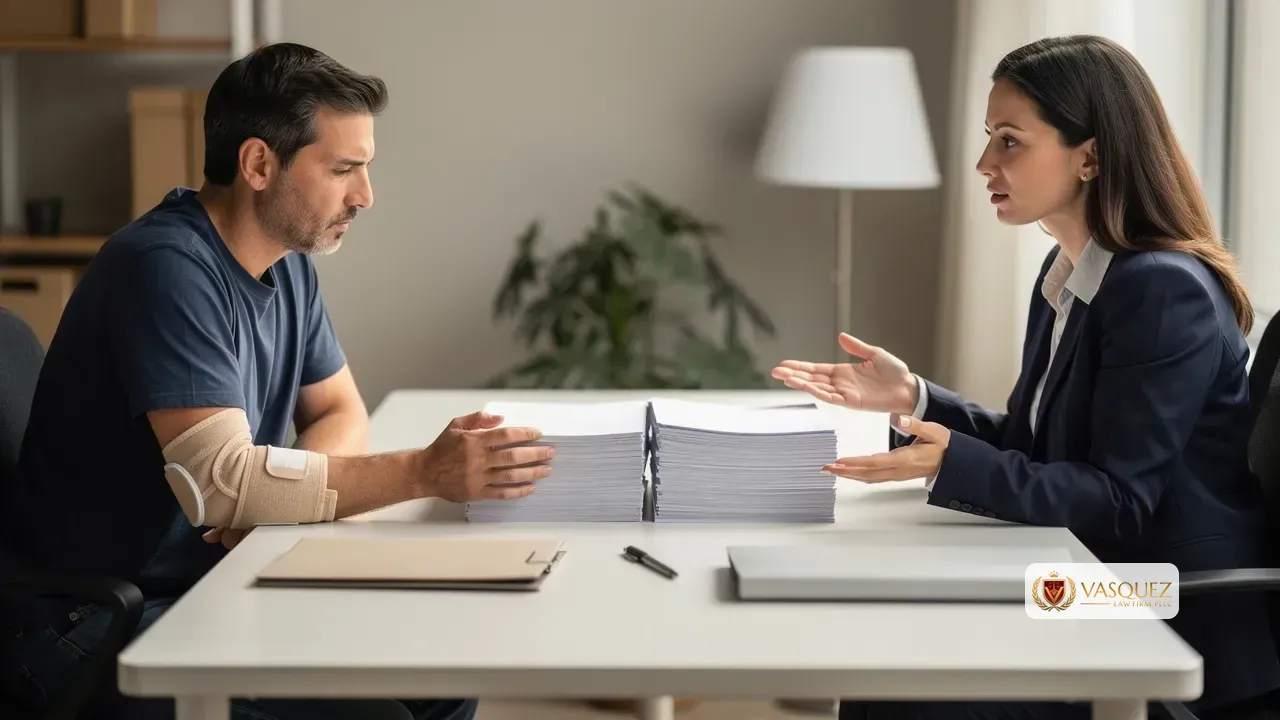
Start with the responsibility question
Personal injury liability means asking who may be responsible for an injury and what losses may follow. A personal injury claim may ask the person or company that caused harm to pay for losses such as medical bills, lost earnings, pain and suffering, diminished quality of life, or permanent injury. A potential claim is a civil matter seeking monetary damages; it is not a conclusion that another person is legally responsible. Your location, the facts, the available evidence, and the applicable law all affect the analysis.
Negligence is the most common basis for personal injury claims. It arises when someone fails to use the level of care that a reasonably prudent person would have used in the same circumstances. Responsibility and payment are related but separate questions: an injury may lead to a claim for losses, while an insurance policy may determine whether and how money is available. Across all auto injury coverages, attorney representation rose from 40% of claimants in 2017 to nearly 50% in 2022. These figures describe claimants, not the result of any particular case.
Identify the possible basis for responsibility
Negligence is the ordinary starting point in many injury analyses. The question is usually whether the person who caused the injury acted carelessly or failed to use ordinary care. That question is answered by examining the circumstances rather than by assuming that an injury alone establishes responsibility. The legal analysis may also ask whether the conduct caused the losses being claimed and whether the available proof supports each part of the account.
Other theories can change the responsibility question:
- Strict liability: Strict liability can hold a defendant liable for an action regardless of the defendant's intent or mental state. A defective product injury is one example.
- Recklessness: Depending on the circumstances, responsibility may involve conduct more serious than ordinary carelessness. The applicable legal test depends on the situation and jurisdiction.
- Intentional conduct: Intentional torts result from an intentional act. Examples include battery, assault, false imprisonment, and trespass to land.
These categories help organize the facts; they do not identify which theory applies to your incident. Preserve the facts and obtain case-specific legal guidance before treating a category as an answer. A product defect can make a manufacturer responsible for an injury even if the manufacturer did not act negligently or intend for the product to cause harm.
Connect responsibility to injury, loss, and proof
A potential injury claim requires more than proof that you were hurt. The analysis may involve fault, the seriousness of the injuries, the losses connected to them, and whether your conduct or another fact could affect the claim. Proving negligence requires strong evidence, which may include police reports, employment records, medical bills, and sworn testimony from the claimant, defendant, and witnesses. Keep each part of the account tied to a record or person who can explain what happened.
Vehicle accidents are described as the most common type of personal injury claim in the United States. More than 2.3 million people visit the hospital every year because of a vehicle-related injury. Those figures describe broad United States activity; they do not show that a particular collision created legal responsibility or establish the value of a particular claim.

Recognize the settings where these questions arise
Vehicle collisions and falls are common settings for responsibility questions. Motor vehicle and traffic-related accidents are a leading cause of personal injury claims, and most of these accidents are caused by some type of human error. A slip and fall may involve a property owner's negligence, but not every fall becomes a personal injury case. The circumstances of the fall and the applicable state and local laws must be examined.
Dog bites and workplace incidents raise different fact questions. Dog owners are generally responsible for injuries caused by their animals, but liability varies by state; some states may impose responsibility without a prior history of aggression, while others may apply a one-bite rule. Workplace injuries typically fall under workers' compensation, but you may have an additional claim against a third party if a subcontractor, product manufacturer, or other outside party contributed to the injury. Do not treat the setting alone as proof that a claim exists.
There are about 275 million vehicles registered in the United States. That figure helps explain why vehicle incidents appear often in personal injury discussions, but it does not measure the number of valid claims, the number of injured people, or the responsibility of any particular driver.
Separate liability from the policy that may pay
Insurance terms describe possible payment sources, not automatic findings of legal responsibility. Liability insurance applies when you are legally responsible for someone else's injuries or damages; it does not cover your own injuries or damaged property. Bodily injury liability coverage is a type of liability coverage that pays medical treatment and related expenses for people injured in an accident where you are at fault. Its policy limits and terms still matter.
Insurance terms answer different questions about who was injured, who may be responsible, and what the policy may cover:
| Term | Main subject | Boundary to keep in mind |
|---|---|---|
| Personal liability insurance | Claims that you caused another person's bodily injury or property damage | It generally does not pay for your own injuries or damaged property. |
| Bodily injury liability coverage | Medical treatment and related expenses for people injured when you are at fault | It may help pay others' medical expenses, lost wages, and your legal fees, but it does not cover your own injuries or lost income. |
| Personal injury protection | Injuries you and your passengers suffer in an accident | It may cover additional expenses, subject to the applicable policy and terms. |
| Personal injury coverage on a homeowners policy | Certain claims involving psychological harm | It is not the same as payment for your own accident medical bills; homeowners personal injury coverage usually is not automatically included. |
Personal injury coverage does not necessarily pay your medical bills from an accident. Auto-policy medical payments coverage may help pay medical expenses regardless of fault, subject to limits and terms. Personal injury insurance may cover losses other than bodily injury and property damage, including certain claims involving defamation, privacy, or civil rights.
Bodily injury liability coverage is limited by per-person and per-accident caps. You may owe out of pocket if costs exceed your limits. In states that require bodily injury liability coverage, auto policies must meet or exceed mandatory minimum coverage limits; Kentucky is an example with minimums of $25,000 per person and $50,000 per accident. Kentucky's figures are a jurisdiction-specific example, not a nationwide rule.
Personal injury coverage on a homeowners policy may protect assets if someone sues for psychological harm, while personal liability insurance protects against claims for bodily injury or property damage. In a North Carolina insurance explanation, uninsured motorist coverage provides protection when an uninsured, at-fault driver injures you or another covered individual and also provides property-damage coverage. Read the policy language and location-specific rules before assuming that a label identifies the coverage available to you.

Take the first protective steps after an injury
Medical care comes before claim organization. If someone needs immediate medical treatment after an accident, call 911 from the accident scene so the person can be transported to the emergency room. Consider getting a doctor to check you after an accident even if you feel fine, because injuries may not be visible and their full severity could be internal. Emergency assistance and medical decisions should follow the situation in front of you.
During the first seven days after a personal injury, prioritize these steps:
- Obtain medical attention and follow the instructions you receive.
- Write down what happened and document your injuries as they develop.
- If your condition allows, photograph the accident scene and collect details promptly because conditions can change and valuable details may disappear.
- Preserve relevant physical evidence instead of discarding or altering it.
- Obtain police or incident reports and track related expenses.
This sequence creates an organized starting record. It does not determine fault, coverage, or the amount of any claim.
A recorded statement creates a permanent record of your description of the accident and injuries and may later become important if liability or damages are disputed. Before giving a recorded statement to the at-fault driver's insurer, talk with an attorney, as the cited attorney guidance recommends. Keep communications accurate and avoid guessing about facts you do not know; preserve the request and the surrounding correspondence for your next conversation.

Assemble the information a reviewer will need
A focused packet can make the first conversation clearer. Gather what you have in these categories:
- Incident account: the date, location, sequence of events, and names or contact details for witnesses.
- Scene information: photographs, videos, property details, vehicle information, and physical evidence that remains available.
- Medical records: treatment notes, bills, diagnoses, work restrictions, and follow-up appointments.
- Work and expense records: employment records, missed work, out-of-pocket costs, and receipts.
- Official records: police reports, incident reports, insurance correspondence, and any recorded-statement request.
Proving negligence may require strong evidence, including police reports, employment records, medical bills, and sworn testimony from the claimant, defendant, and witnesses. Bring the records you have; do not delay care while trying to assemble a perfect file.
A personal injury attorney may gather evidence through a formal process that includes requesting documents and taking depositions of the claimant, defendant, and witnesses. Your timeline, records, and communications give that process a factual starting point. Mark uncertain details as uncertain, separate what you personally observed from what someone told you, and keep original documents rather than relying only on edited screenshots. Attorneys may use surveillance footage, witness statements, and maintenance logs to build a case.

Protect the claim’s timing and communication path
Timing can affect whether a claim remains available. Every state enforces a statute of limitations setting a deadline for when a personal injury lawsuit must be filed, and missing the applicable deadline can bar a person from seeking compensation. The deadline depends on the location, parties, claim type, and other facts, so do not substitute a general article for the deadline that applies to your situation. Starting a claim early may help preserve evidence and avoid statute-of-limitations issues.
Insurance communication has its own timing questions. Insurers expect prompt claim reporting, and waiting may weaken your negotiating position as evidence disappears. Ask what notice the policy requires, save every letter, email, and message, and record when you reported the incident. A policy provision is not the same as a lawsuit deadline, so keep those two timelines separate.
A New York source describes contacting a personal injury attorney within 30 days of an incident as a practical option for discussing rights and preserving evidence, not as a universal legal deadline under CPLR §214. That example should not be applied to another state or to your facts without case-specific review. Represented bodily injury claimants waited a median of nearly 440 days for claim closure, more than double the time for unrepresented claimants; claim duration and filing deadlines are different measures.
Seek qualified evaluation when the path is uncertain
A case-specific legal review may be appropriate when responsibility is disputed, coverage is unclear, injuries or losses are substantial, an insurer requests a recorded statement, a filing deadline may be approaching, or a workplace injury may involve a third party. A workplace injury typically falls under workers' compensation, but you may have an additional injury claim when someone other than your employer contributed to the harm. Preserve the information you have and bring the question to a qualified professional rather than choosing a legal theory from a general description.
We can investigate a car accident scene, gather evidence, handle communications with insurance companies, and negotiate for a fair settlement. We protect clients' rights against predatory tactics, ensure legal deadlines are met, and represent clients in court if necessary. Those are the functions our personal injury lawyers describe; whether we can assist with your situation depends on the facts, location, and matter presented.
Prepare the facts for a focused next conversation
Personal injury liability is a responsibility question first and a coverage question second. Start by caring for your health, preserving the incident record, collecting medical and employment information, separating policy terms from legal responsibility, and identifying the applicable timing rules. Liability and coverage depend on your facts, location, and policy language, so a qualified professional must evaluate those questions. Bring your timeline, records, photographs, correspondence, and questions to that conversation so the next step can be based on the facts rather than an assumption.
When you are ready to discuss a potential injury, coverage, or third-party workplace issue, have your name, phone, email, and incident summary available for the initial conversation.
Questions about personal injury liability and insurance coverage
Does personal injury liability automatically mean another person must pay?
No. An injury may support a potential claim, but responsibility still depends on the facts, applicable law, evidence, the connection between the conduct and the losses, and any issues involving the injured person's conduct. A general description cannot determine whether a specific person or company is legally liable.
Can a workplace injury involve personal injury liability as well as workers’ compensation?
It may. Workplace injuries typically fall under workers’ compensation, but a separate claim may be possible when someone other than the employer - such as a subcontractor, product manufacturer, or other driver - contributed to the harm. Whether both paths apply depends on the facts and applicable law.
Are an insurance reporting deadline and a lawsuit deadline the same?
No. An insurance policy may require prompt notice, while a statute of limitations sets a deadline for filing a lawsuit. The applicable requirements depend on the policy, location, claim type, parties, and facts, so preserve communications and obtain qualified guidance rather than relying on a general deadline.
How common is personal injury liability in the United States?
Personal injury claims commonly arise after vehicle accidents, falls, dog bites, and some workplace incidents. Vehicle accidents are described as a leading source of personal injury claims, and falls, dog bites, and some workplace incidents can also raise responsibility questions; however, the setting alone does not establish liability or show that a specific claim will succeed.
Sources
- Bodily Injury vs. Personal Injury Insurance - progressive.com
- Personal Liability vs. Personal Injury | Koonz McKenney Johnson & DePaolis LLP - koonz.com, 2019-08-28
- 10 Common Personal Injury Law Myths | Garber Legal PLLC - garberlegal.com
- personal injury - law.cornell.edu
- Bodily Injury Liability Insurance Coverage | Allstate - allstate.com
- Personal Liability vs. Injury Coverage | Call Jacob - calljacob.com
- What To Do After a Personal Injury: The First 7 Days | Super Lawyers - superlawyers.com, 2026-10-23
- Dispelling 6 Common Myths About Personal Injury Cases - njlawcenter.com, 2025-10-10
- What Is Liability Insurance Coverage? - progressive.com
- Proving Fault and Damages in Personal Injury Lawsuits - justia.com
- Basic and Miscellaneous Auto Coverages | NC DOI - ncdoi.gov
- Should You Accept an Insurance Settlement After a Car Accident in Georgia? - jarrettfirm.com
- Steps To Take After a Personal Injury - cudalaw.com
- Bodily Injury Claims Statistics (2026) | amaise - amaise.com
- 7 Most Common Personal Injury Claims in the United States - Legal Reader - legalreader.com
- What Inuries Does Personal Injury Law Include? | NYC Bar - nycbar.org
- 6 Most Common Personal Injury Claims Filed in the United States - Gustad Law Group - gustadlaw.com
- Most Common Personal Injury Claims | Bailey, Javins & Carter, L.C. - baileyjavinscarter.com