
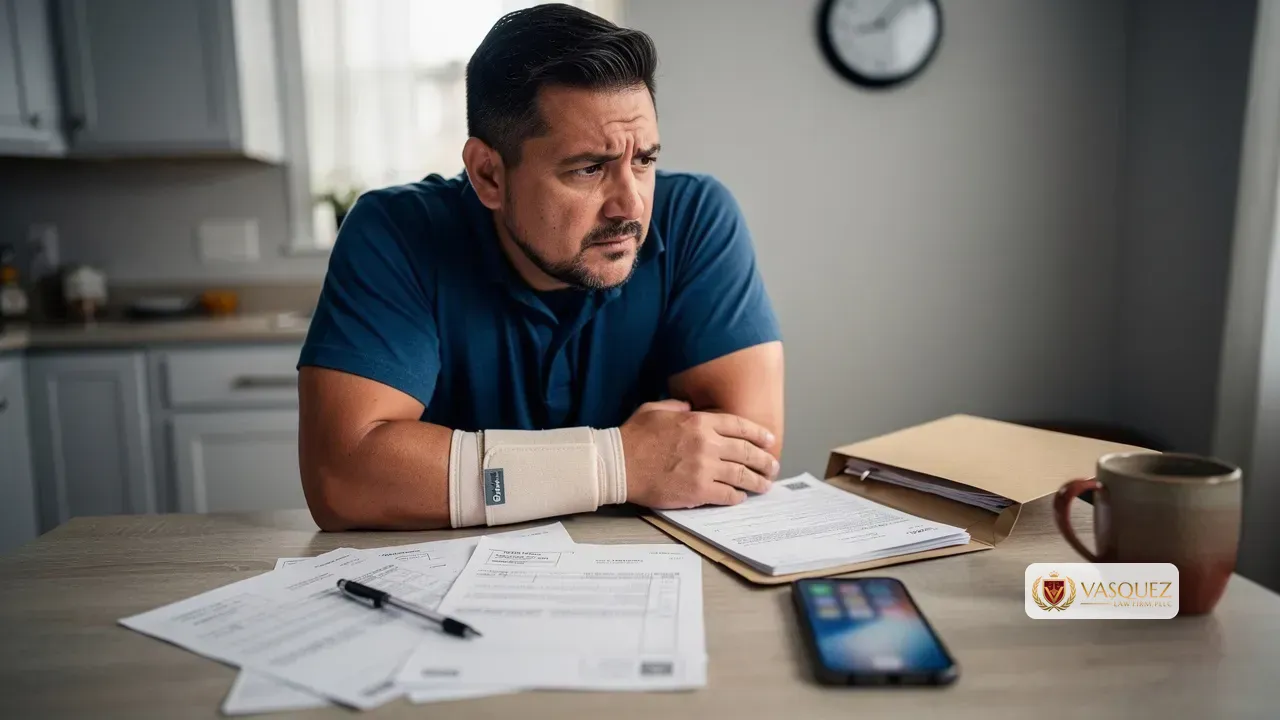
Start an incident-to-document triage
Use this guide as an incident-to-document triage, not as a prediction about a claim. The basic fit is a person hurt in a car accident, truck accident, slip-and-fall incident, or wrongful-death case where another person may have been legally responsible. Whether a North Carolina personal injury claim may apply depends on the facts and applicable law.
The triage produces three linked notes:
- Incident line: date, place, people or organizations involved, the account of what happened, and any report, photograph, message, or witness detail.
- Impact line: medical attention and records, work or daily-life effects, and documents showing those effects.
- Response line: insurance contact, request, offer, release, notice, or other communication, with the date and document attached.
For each line, mark what is documented, what is missing, and what question remains. The point is not to decide responsibility, damages, eligibility, or a deadline. It is to show which fact connects to which record and which issue needs fact-specific review.
A focused map can make an initial discussion more precise without requiring a complete file or a conclusion about the legal result.
Personal injury claims may include car accidents, truck accidents, slip-and-fall incidents, and wrongful-death cases. If your situation involves one of those categories, an injury practice may be a relevant place to ask about your options. That does not establish that you qualify for representation or that another party is legally responsible.
Start with a practical question: Do you want help understanding a potential claim, organizing claim information, or communicating about an insurance matter? If your answer is yes, move through the steps below before deciding whether to submit an inquiry. If your incident falls outside these categories, do not assume that the same review applies.
Trace the possible work from facts to claim steps
A firm's role can be understood by following the evidence through the possible claim path. A personal injury practice may investigate the incident, identify issues surrounding responsibility, pursue an insurance claim, and seek economic and non-economic damages. A North Carolina personal injury lawyer may also send a demand letter and file a lawsuit if an insurer denies the claim or a fair settlement cannot be reached.
The review may connect accident facts with available records, insurer communications, and the question that needs an answer. The appropriate scope depends on your incident, the information available, applicable law, and whether the practice accepts the matter. This sequence explains possible work; it does not predict a result.
We often work with providers and employers to explain how injuries affect your life. We have over 15 years of dedicated legal experience in personal injury cases.
If you are considering an inquiry about a car crash, truck crash, slip-and-fall incident, or wrongful-death case, note the basic facts and ask whether an initial discussion is appropriate. Our stated work concerns the potential claim; it does not determine responsibility, eligibility, case value, or outcome before the facts are reviewed.
Sort the incident facts without deciding liability
Use the incident type as the first sorting step for your records. Personal injury claims may include the following incident types:
- Car accidents: A collision involving a passenger vehicle or another road user.
- Truck accidents: A crash involving a commercial truck or trucking company.
- Slip-and-fall incidents: An injury connected with a fall or similar incident on property.
- Wrongful-death cases: A claim arising from a fatal injury.
For each type, record the date, location, people or businesses involved, and the information you have. The type helps organize the review; it does not answer whether negligence, responsibility, damages, or a filing requirement exists in your case.
Your potential claim also depends on the connection between the incident, your injury, and another party's possible negligence.
Write down the basic connection in plain language:
- What happened?
- What injury or physical effect followed?
- Why do you believe another party may have contributed?
- What information supports that understanding?
Avoid trying to assign a final legal conclusion before the facts have been reviewed. If the event does not fit the incident types listed above, ask about the correct type of legal help rather than assuming this process applies. To make that distinction usable, label each note as (1) directly observed or recorded, (2) reported by another person or document, or (3) an interpretation that still needs checking. Then connect the label to its source and write the narrow question it raises. For example, a photograph may show a condition, a message may describe what someone said, and your explanation of why that condition mattered is an inference. Keeping those layers separate helps the reviewer see what is available without treating an interpretation as an established fact. This is especially useful when accounts conflict or when the incident description changes as more records arrive.

Put health records into the timeline
Use health information as part of the timeline. Keep records of the care you receive and note the dates of visits, instructions, and other documents made available to you. Those records can help show what happened after the incident.
The file does not need to be complete before an initial discussion. Preserve ordinary records as they become available, and do not treat this guide as medical advice.
A basic incident record can give an initial discussion a clearer starting point. Write down the date, general location, people or businesses involved, what you remember, how you were injured, and the steps you took afterward. Keep photographs, messages, notices, and other available materials in their original form when practical.
Relevant documents can help with building a personal injury case. A simple folder can include:
- Medical bills, discharge papers, treatment notes, and appointment information you have received.
- Insurance letters, claim numbers, adjuster messages, and settlement communications.
- Photographs of the scene, vehicles, property condition, visible injuries, or damaged belongings.
- Work information showing missed time or changes connected with the injury.
- Names and contact details for witnesses or other involved parties.
Bring what you have. An incomplete folder should not stop you from asking whether an initial discussion is appropriate. Use the same chronology for health and work effects: place the incident first, then care, restrictions or changes you were told about, missed work or daily disruptions, and the records associated with each point. Do not convert an unanswered medical question into a conclusion about cause or long-term effect. Instead, mark whether the item is a record you received, an observation you made, or a question for a qualified professional. This keeps the file useful for an initial discussion and any later request for clarification while leaving medical judgments to the appropriate provider and legal judgments to case-specific review.
Build the incident-to-document map
Build the map by matching an event to a record and then to a review question. One line can hold each connection:
- Incident: report, photograph, message, or witness detail -> What part of the account does this material clarify?
- Treatment: provider, appointment, bill, instruction, or record -> What care or effect is documented?
- Work and daily life: missed shift, changed duty, household effect, or other concrete disruption -> What record supports the effect?
- Insurance response: claim number, adjuster message, letter, offer, release, or notice -> What was requested, and when?
- Truck involvement: driver or trucking-company information and any available maintenance, braking, or tire material -> What evidence may bear on maintenance or responsibility?
For each line, keep the record beside the question rather than treating the question as answered. After a truck crash, inspection of the truck's braking system and tires may help identify evidence about maintenance and responsibility; the map records that possible lead without assigning fault.
This incident-to-document map gives an initial discussion a bounded starting point. It is not an exhaustive file and does not require a conclusion before the records and unanswered questions are reviewed.
For the timing-and-evidence check, group your information into four sections:
- Incident: date, location, parties, witnesses, report details, photographs, and messages.
- Treatment: providers, appointments, bills, instructions, and records you have received.
- Work and daily life: missed shifts, changed duties, household effects, and other concrete disruptions.
- Insurance and communications: claim numbers, adjuster contact, letters, offers, releases, and deadlines shown on documents.
Do not guess at missing details. Mark an item as unknown, label an estimate clearly, and identify where the underlying document may be found. The records you have can help organize the information for an initial discussion, but you do not need to assemble every possible document before requesting one.
Identify evidence that may change the next question
Responsibility disputes are an evidence question. Note conflicting accounts, a notice from an insurer, or a condition at the scene that may matter. Keep each disputed point next to the photograph, message, report, or other record that may clarify it.
A truck crash may require additional factual review. Inspecting the truck's braking system and tires may help identify evidence about maintenance and responsibility. If a commercial vehicle, driver, trucking company, or maintenance issue is involved, identify those details in your inquiry and preserve the records and photographs you already have.
If a fact remains uncertain, label it as uncertain rather than resolving it in your notes.
Certain facts change the shape of the review without deciding its result. A disputed account makes it useful to keep the competing descriptions and the records connected to each one. Commercial-vehicle involvement makes the truck, driver, trucking company, and available maintenance or scene information relevant to the questions raised. A settlement offer or request for a release belongs with the communication that contains it, along with the date and any response requested. If the injury affects work or daily activities, the related records can show the change in concrete terms without requiring an estimate of a legal loss.
These are signals for what to discuss, not conclusions that another party is responsible or that a claim will qualify. Include the signal in a short inquiry summary and identify the document or fact behind it. Where the supporting material is incomplete, say so plainly. That approach preserves uncertainty while helping an initial discussion address the part of the record that may need closer attention.
A truck accident can involve an insurance claim or lawsuit against the driver or trucking company responsible for the accident, depending on the facts and applicable law. Tell the practice whether a commercial vehicle was involved, whether a company was identified, and whether anyone has contacted you about the crash.
A settlement offer is another fact to flag. We recommend that truck accident victims avoid accepting low settlement offers too quickly because initial offers often undervalue injuries and damages. Before accepting or signing anything, place the offer, release, or related communication in the information you provide for legal discussion. Do not assume that an early payment resolves every issue.
The same organizing step applies when your injury affects work or daily activities: identify the effect, preserve the related documents, and explain what has changed without predicting the amount of any loss. When reviewing an insurance communication, separate what it says from what it asks you to do. Record whether it requests information, presents a payment, asks for a release, or sets a response date; one communication may contain more than one of these. Preserve attachments and identify language you do not understand. This classification does not tell you whether to agree or whether the communication resolves the claim. It tells you what question to raise and which part of the file should be reviewed.
Place possible claim steps in sequence
An insurance response or a demand letter may become part of the discussion, but neither is automatic. The available records, disputed facts, injury information, and applicable legal requirements can affect what happens next. This is not a fixed timetable or a prediction.
A demand letter is part of the possible process, not an automatic result. Whether any particular step is appropriate depends on the facts and the legal assessment of the claim.
A personal injury lawsuit includes discovery, when the parties exchange information, and most personal injury lawsuits are resolved without a trial. That general observation does not predict the route of your matter.
If litigation becomes part of the discussion, organize the documents and communications you have already received. Keep copies of communications and provide accurate information. Ask what stage the matter is in, what information is needed, and which decisions require your attention. Those questions help you understand the next discussion without assuming that your claim will follow a particular route. Discovery also changes the kind of preparation that is useful: rather than collecting only documents that support one account, keep the surrounding communications and identify gaps or inconsistencies. A chronology can show which event a document relates to, while the original file lets the parties check the wording and date. If a document is unavailable, record that fact instead of recreating it from memory. These practices do not determine what information may ultimately be requested or how a matter will proceed; they simply make the known record and its limits easier to explain.
Turn the timeline into verification questions
Do not use the map to calculate a deadline. Instead, make a date ledger with the incident date, treatment dates, notices, reports, insurance communications, offers, releases, and any deadline printed on a document. Put each date beside its source and mark estimates or gaps.
North Carolina claim requirements and timing depend on the incident, the parties involved, the type of claim, and applicable law. The same rule should not be assumed for every car accident, truck accident, slip-and-fall incident, or wrongful-death case. The ledger identifies what needs to be checked for the particular matter; it does not answer that question.
If the account includes possible contribution by the injured person, add that fact to the verification list. North Carolina's contributory-negligence rule makes that fact relevant to an insurance claim or personal injury lawsuit, but the map cannot determine how the rule applies. Keep responsibility as a question tied to the available records. Separate at least three dates when reviewing a notice or communication: when the incident occurred, when the document was created or sent, and when you received or responded to it. Those dates can answer different verification questions, so one should not be substituted for another. Preserve the envelope, email details, attachment, or message thread when available, and note if only a partial copy remains. This does not establish which date controls under North Carolina law; it gives the person reviewing the matter the material needed to check that issue rather than relying on an assumption.
Use the final check to separate what is known from what still needs verification. A short inquiry summary can state the incident type, date and location, parties involved, treatment received, insurance contact, and any offer or notice. Place each date next to the document or message that shows it, and mark estimates or missing records instead of filling gaps. Note the questions that remain about timing, claim requirements, responsibility, or the effect of a communication. The summary can also state whether you want help understanding the possible claim path, organizing records, or communicating about an insurance matter. Keep the original documents with it so the details can be checked against what you received. This summary does not decide the claim; it helps an initial discussion focus on the materials and issues that may affect available options.
Consider cost and settlement questions carefully
Some personal injury practices handle cases on a contingency-fee basis. That does not mean every practice uses identical terms or that every potential claim is handled the same way. Ask about the proposed fee arrangement, case-related costs, payment obligations, and what happens if the representation ends before resolution.
A fee discussion should be specific enough for you to understand what you may owe and when. Do not assume that the phrase contingency fee answers questions about expenses, liens, or a change in representation. Put your questions in writing if that helps you compare the terms being discussed.
A payment or settlement communication also needs context. An advance or partial payment in a bodily-injury or fatal-injury claim does not by itself constitute an admission of liability. That rule does not tell you whether accepting a particular payment serves your interests or resolves other issues.
North Carolina charging-lien questions depend on applicable law and the circumstances; a lawyer should not assert a lien that is not permitted. If another lawyer was involved, representation ended, or a lien has been mentioned, include the related documents and ask how that issue affects the matter.
Put the offer, release, and related communications in the information you provide for review. A payment, offer, or fee term should be discussed in its full context rather than treated as a complete answer by itself.

Use the triage result to request an initial discussion
Once the incident-to-document map shows the facts, records, and questions you want reviewed, you can submit an inquiry form with your name, phone number, and email. It is intended for people near Charlotte who were injured in a car crash, truck crash, slip-and-fall incident, or similar event and want an initial discussion of a potential personal injury claim.
We specialize in personal injury law, including truck accidents. We can investigate a car accident scene, gather evidence, handle communications with insurance companies, and negotiate for a fair settlement. Contacting a personal injury attorney as soon as possible after a car accident can help protect your legal rights and guide you through the claims process.
Your inquiry should identify the incident type, date, location, injury, current insurance contact, and the documents you already have. Mention any truck or trucking-company involvement, disputed responsibility, settlement offer, fee question, or timing concern. This gives the initial discussion a focused starting point without requiring you to predict the legal result.
An inquiry does not establish eligibility, a case value, responsibility, or an outcome. It gives you a direct opportunity to describe what happened and ask whether a fuller discussion is appropriate.
Questions about the evidence-and-timing triage
What does the incident-to-document map do?
It links each important event to the record that may clarify it and to a question that still needs review. It helps separate documented facts, missing material, conflicting accounts, and issues that require fact-specific verification without deciding responsibility or eligibility.
What information belongs on the map?
Include the incident date and location, parties and witnesses, reports, photographs, messages, treatment records, work or daily-life effects, insurance communications, offers, releases, and notices. Mark missing or uncertain information instead of filling gaps.
What if dates or accounts conflict?
Keep both versions, identify the document or message supporting each one, and describe the conflict as a question to verify. Do not choose a version merely because it appears in a later record.
What truck information may be relevant?
Note the driver or trucking-company involvement and any available information about the truck's maintenance, braking system, or tires. After a truck crash, inspecting the braking system and tires may help identify evidence about maintenance and responsibility, but that information does not by itself decide fault.
Can you submit an inquiry before every record is collected?
Yes. Use the information already available, identify what is missing, and include the questions that need attention. An incomplete set of records does not require you to decide the legal result before requesting an initial discussion.
Does submitting an inquiry decide whether you have a claim?
No. An inquiry requests an initial discussion; it does not establish eligibility, responsibility, case value, or an outcome. Deadlines and claim requirements still need to be verified for the particular incident and applicable law.