

Start with the question Cuban adjustment can answer
The Cuban Adjustment Act can provide certain Cuban natives or citizens with a pathway to apply for lawful permanent resident status in the United States when applicable requirements are met. Lawful permanent resident status is commonly called a Green Card. This pathway is possible only after the relevant facts and requirements are examined.
Cuban nationality or citizenship alone does not automatically guarantee eligibility. Your manner of entry, physical presence, immigration history, admissibility, and other circumstances may affect whether you qualify. The right starting point is therefore a fact review, not an assumption that a Cuban passport or Cuban birth makes approval automatic.
Use this guide to organize the decision around four questions:
- Do your nationality or citizenship documents support the category you are considering?
- Have you accumulated the generally required period of physical presence in the United States?
- Do your entry history, prior immigration matters, or admissibility concerns require individualized attention?
- Are you prepared to check the forms, fees, evidence, and procedures that apply when you file?
Those questions can help you identify a plausible next step. They cannot determine your eligibility or predict an immigration result. A filing decision should follow a review of your own record and the current instructions that apply to your case.
Use the first two screening facts: Cuban status and physical presence
Cuban status and physical presence are the first two screening facts to examine if you are considering adjustment under the Cuban Adjustment Act. If you are the principal applicant, you generally must have accumulated at least one year of physical presence in the United States before applying under the Act. That one-year point is a significant screening question, but it is not the entire eligibility analysis.
Start by writing down the facts you know rather than relying on a general impression. Your initial review can include:
- The basis for your Cuban nationality or citizenship and the documents that support it.
- The date or dates on which you entered the United States and the periods you have physically been present here.
- Any departures, returns, or gaps that could affect how you describe your physical presence.
- Whether you are considering yourself as the principal applicant or as a family member connected to a principal applicant.
- Any uncertainty about your entry, prior immigration history, or admissibility.
The physical-presence question asks whether you have accumulated the generally required period before applying. It does not answer how your entry history or other immigration facts will be treated. Keep a simple chronology of your time in the United States, and identify dates you cannot document or remember clearly. A timeline is a preparation tool, not a legal conclusion.
For each period, record the date you entered, the date you left if you departed, the date you returned, and the document or memory supporting the entry. Do not fill a gap by estimating silently. Mark the date as uncertain and explain why it is uncertain so the issue can be addressed directly.
If you have not reached the generally stated one-year point, do not treat that fact alone as a final determination about every possible immigration option. If you believe you have reached it, do not treat that fact alone as proof that you qualify. The nationality, entry, history, admissibility, and procedural questions still need to be considered.
Check what proves nationality or citizenship
Nationality or citizenship evidence is one part of the record relevant to the Cuban Adjustment Act category. The USCIS-derived guidance identifies an unexpired Cuban passport, a nationality certificate, and a citizenship letter as examples of documents related to Cuban nationality or citizenship evidence. Record the document you have and the fact it establishes separately.
A Cuban consular certificate for a person born outside Cuba is not sufficient by itself to establish Cuban citizenship, even if the certificate describes that person as a Cuban citizen. That distinction matters when your proof comes from a birth or consular record rather than from one of the documents identified in the guidance.
Use this evidence check before treating your nationality question as settled:
- Identify whether each document concerns nationality, citizenship, birth, or another fact.
- Note whether a passport is unexpired and whether a certificate or letter identifies the basis for citizenship.
- Separate documents that show your identity from documents that establish the legal fact you need to prove.
- Flag a consular certificate involving a birth outside Cuba for specific review rather than treating it as sufficient on its own.
- Keep a list of missing, expired, inconsistent, or difficult-to-obtain documents.
A document can be relevant without resolving the whole question. If your documents use different names, dates, or descriptions, preserve those differences in your notes instead of guessing which version controls. If you are unsure what a document proves, mark the uncertainty for review. Your evidence file should also show how the documents relate to you. Keep the identifying information consistent across the materials you collect, and note translations or gaps that may need attention before filing. The practical question is not only whether you possess a document, but also what legal fact that document supports and whether another record creates a conflict.
Do not treat Cuban nationality as the whole eligibility analysis
Entry history, physical presence, immigration history, and admissibility are separate parts of the eligibility analysis, even when your Cuban nationality or citizenship is clear. Cuban nationality or citizenship alone does not automatically guarantee eligibility, and the way you entered the United States, the time you have been physically present, your prior immigration history, and admissibility concerns may affect qualification.
These terms point to different factual questions:
- Manner of entry: How did you enter the United States, and what records describe that entry?
- Physical presence: What dates support the period you have accumulated in the United States?
- Immigration history: Have you had earlier applications, immigration documents, notices, or other interactions with immigration authorities?
- Admissibility: Are there legal concerns that could affect whether you may receive the immigration benefit you seek?
The questions overlap, but they are not interchangeable. A strong nationality document does not answer an entry question. A completed period of physical presence does not erase a prior immigration event. A prior document does not automatically establish that you are inadmissible or ineligible either; it identifies a fact that may require review.
Build your review around facts rather than labels. Gather the dates and documents you can identify, describe uncertainty plainly, and avoid characterizing an issue as harmless or disqualifying before it has been assessed. If you have received a notice, submitted a prior application, used a work permit, or communicated with an immigration agency, include that history in the record you prepare. The purpose is to give the legal reviewer a coherent account before a filing decision is made.
Separate what happened from what you think it means. For example, record an entry date, a prior application, or an agency notice before deciding whether that event helps or hurts your case. This prevents a familiar label from replacing the details that may control the analysis. If an event is difficult to explain, include it rather than omitting it from your preparation.
Consider family members separately
If you are the spouse or unmarried child of a qualifying Cuban applicant, you may be eligible for adjustment under the Cuban Adjustment Act even if you were not born in Cuba. Specific eligibility requirements still apply, so a relationship to a Cuban applicant does not make the result automatic.
Family cases require you to separate the principal applicant’s facts from each family member’s facts. For every person who may be included or considered, identify:
- The relationship to the principal applicant.
- Whether the person is being considered as a spouse, an unmarried child, or another possible applicant.
- The person’s own nationality or citizenship documents, entry history, physical presence, and immigration history.
- Any individual admissibility concern or uncertainty.
- The documents that show the family relationship and the documents that address the person’s immigration facts.
Form I-485 may be filed by you if you directly qualify for an immigrant category as a principal applicant or, in some cases, by you as a spouse or child acting as a derivative applicant. That distinction is useful for organizing the questions, but it does not replace an eligibility review. Do not assume that a family member’s case follows every detail of the principal applicant’s case. Prepare a separate factual record for each person and ask how the applicable requirements affect that person.
Create a separate timeline and document list for each family member. Keep the relationship documents with the family record, but do not use the principal applicant’s entry history or immigration documents as a substitute for the other person’s facts. This separation makes it easier to identify which questions apply to the family relationship and which belong to each applicant.
Separate the legal pathway from the filing mechanics
When you are in the United States, adjustment of status is the process used to apply for lawful permanent resident status, commonly called a Green Card. Form I-485 is the application used for that purpose. You must be physically present in the United States to file Form I-485, and additional adjustment-of-status requirements depend on the immigrant category involved.
For a Cuban Adjustment Act matter, keep the legal pathway and the filing mechanics in separate columns of your planning notes. The pathway asks whether the category may apply to you. The filing mechanics ask which form edition, fee, evidence, filing procedure, and supporting materials apply when you submit the application.
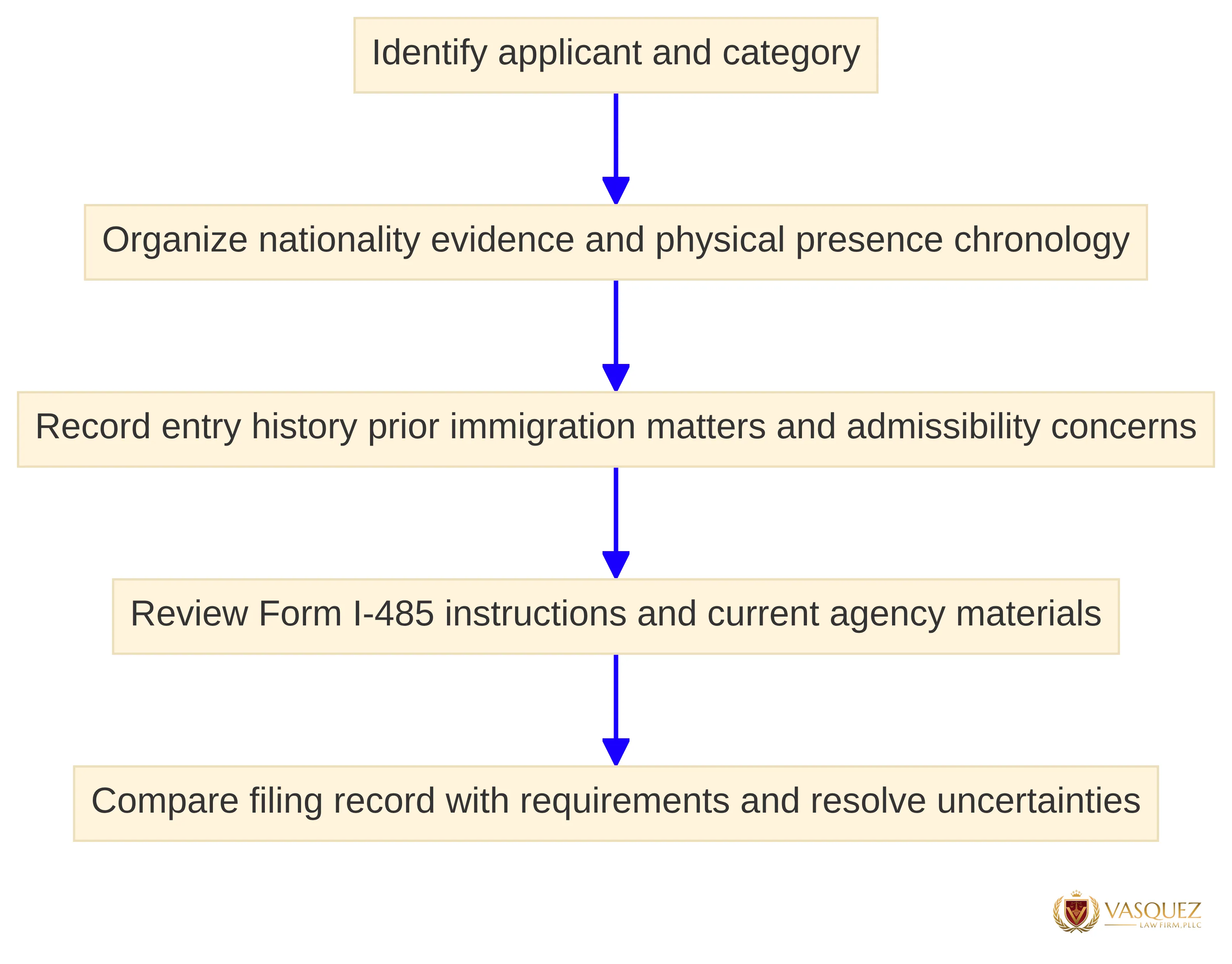
A practical sequence is:
- Identify the principal applicant or possible derivative applicant and the category being considered.
- Organize nationality or citizenship evidence and the physical-presence chronology.
- Record entry history, prior immigration matters, and any admissibility concern that may affect the application.
- Review the Form I-485 instructions and other current agency materials that apply on the filing date.
- Compare the planned filing record with the requirements and resolve material uncertainties before submitting anything.
This sequence is an organizing method, not individualized filing instructions. The fact that you can complete a form does not establish that the category fits your facts. Likewise, finding a category that appears relevant does not establish that the application is ready to file. Keep eligibility questions, evidence questions, and procedural questions visible as separate issues.
Before you treat a packet as ready, identify which part of the packet answers each major question. Your nationality documents should support the nationality or citizenship issue; your timeline should explain physical presence; and your prior records should allow the entry and immigration-history questions to be discussed. If a document does not answer the question you expected it to answer, revise your notes rather than assuming the gap has been resolved.
Build a current-verification checkpoint before filing
Current forms, fees, evidence requirements, and filing procedures should be checked before you file because immigration procedures and agency guidance can change. Form I-485 instructions dated September 18, 2026, direct applicants to read and follow the instructions as written and point applicants to USCIS information about adjustment-of-status eligibility. Use the instructions and agency materials that apply when you prepare the filing rather than relying on an older checklist.
Create a verification checkpoint with these questions:
- Is the Form I-485 edition the one accepted on the date you plan to file?
- What fee applies, and is any fee-related form or exception relevant to your filing?
- What evidence does the current instruction set request for your category and circumstances?
- Where and how must the application be filed?
- Do the current materials address principal and derivative applicants in the way your family plans to apply?
- Have any policy or procedural changes affected the documents or steps you planned to use?
Record the date on which you checked each item and save the version of the instructions you used for your planning. Recheck the items if you delay filing or if a material fact changes. A checklist prepared for another case or an earlier filing date may organize your questions, but it does not establish the requirements that apply to you.
A checkpoint is not a substitute for deciding whether the category fits your facts. It is a pause before filing so that an apparently complete packet is not treated as current without checking the applicable materials. Do not treat a prior applicant’s forms, a general online checklist, or an older explanation as controlling for your filing.
We recommend gathering your documents, staying updated on law changes, and consulting an immigration lawyer when changing immigration policies may affect you. That recommendation is especially practical when your filing depends on a document type, procedure, or interpretation that you have not recently confirmed.
Prepare a focused record for legal review
A focused record gives an immigration lawyer the facts needed to discuss whether Cuban adjustment may be relevant to you. We recommend gathering relevant immigration documents, including green cards, previous visa applications, work permits, and correspondence with immigration authorities. Add the documents and timeline details that relate to nationality, physical presence, entry, family relationships, and prior immigration history.
You can organize the material into five groups:
- Nationality or citizenship: Cuban passports, nationality certificates, citizenship letters, and any document that explains your citizenship basis. Mark a consular certificate involving a birth outside Cuba for specific discussion because it may not be sufficient by itself to establish Cuban citizenship.
- Physical presence: A dated timeline of time spent in the United States, including the dates you know and the periods that need confirmation.
- Entry and immigration history: Entry records you have, prior visa applications, green cards, work permits, notices, and correspondence with immigration authorities.
- Family information: Documents and dates that explain the relationship of a spouse or unmarried child to the principal applicant, together with each family member’s separate immigration facts.
- Questions and uncertainties: A short list of missing documents, inconsistent dates, unclear entries, prior filings, or admissibility concerns.
Label each item by the fact it may help explain. Keep known facts separate from guesses, and identify gaps instead of filling them with assumptions. A complete-looking folder is not the goal; a clear account of what happened, what you can document, and what remains uncertain is more useful for a focused discussion.
Bring the record even if you think a document is unimportant. A prior application or work permit may provide context for your immigration history, while an entry record may affect a separate part of the analysis. The legal significance of each item depends on your circumstances, so use the record to support questions rather than to announce your own result.
Prepare a short opening summary for the discussion. It can state your nationality or citizenship basis, the dates you believe you have been physically present in the United States, how you entered, whether you have filed or received anything from immigration authorities, and the question you need answered. Keep the summary factual and attach the documents that support each point.
Know when general information is no longer enough
General information is no longer enough when a fact in your record could change the category analysis, the evidence needed, or the filing decision. Contact an immigration lawyer for individualized review when you face one or more of these situations:
- Your Cuban nationality or citizenship evidence is incomplete, inconsistent, expired, or based on a consular certificate involving a birth outside Cuba.
- Your physical presence is uncertain, your dates contain significant gaps, or you are unsure whether you have accumulated the generally required one-year period.
- You do not understand how your manner of entry affects the application you are considering.
- You have prior visa applications, green cards, work permits, notices, or correspondence that may require an explanation.
- You are concerned that an admissibility issue could affect your application.
- You are considering a spouse or unmarried child who was not born in Cuba and need to understand that person’s separate requirements.
- You are relying on forms, fees, evidence lists, or procedures that may have changed since you obtained them.
These situations are reasons to seek case-specific review, not findings that you are ineligible. The same document or event can raise different questions depending on its date, context, and connection to the rest of your history. Avoid filing simply to obtain an answer when the filing itself depends on facts you have not yet organized or understood.
We recommend calling a lawyer if you want help with an adjustment-of-status application. A focused inquiry can begin with your nationality documents, physical-presence timeline, entry history, prior immigration records, and the particular question you need answered.
If none of these issues is clear to you, that uncertainty is itself a useful reason to organize your records before filing. You do not need to label the problem as admissibility, ineligibility, or a filing error before asking for review. Describe the event, document, or missing date and let the legal discussion address its significance.
Choose the next step without assuming an outcome
Your next step is to treat Cuban adjustment as an evidence-and-verification question rather than an automatic benefit. Start with the facts that shape the inquiry: your Cuban nationality or citizenship evidence, your accumulated physical presence, your manner of entry, your immigration history, and any admissibility concern. Then separate those eligibility questions from the current Form I-485, fee, evidence, and filing requirements.
A focused record can make the next discussion more useful. Gather the documents you have, prepare a clear timeline, identify gaps without guessing, and mark the questions that could change your filing decision. A qualified immigration professional can assess how your individual facts affect suitability; general information cannot make that decision for you.
We offer assistance through evolving immigration policies, and an individualized review may help you decide whether Cuban adjustment is relevant to your situation before you file.
What should you verify before relying on Cuban adjustment information?
What is the Cuban Adjustment Act?
The Cuban Adjustment Act is a federal law that provides certain Cuban natives or citizens with a pathway to apply for lawful permanent resident status in the United States if they meet the applicable requirements.
How long do I need to be in the United States before applying for the Cuban Adjustment Act?
A principal applicant generally must have accumulated at least one year of physical presence in the United States before applying for adjustment under the Cuban Adjustment Act.
Do I automatically qualify for a Green Card because I am Cuban?
No, being a Cuban native or citizen does not automatically guarantee eligibility. Factors such as manner of entry, physical presence, immigration history, and admissibility may affect qualification.
Can my spouse or children qualify through the Cuban Adjustment Act?
Certain spouses and unmarried children of qualifying Cuban applicants may be eligible for adjustment under the Act, even if they were not born in Cuba, but they must still satisfy specific eligibility requirements.
What documents may I need for a Cuban Adjustment application?
You may need documents such as an unexpired Cuban passport, a nationality certificate, and a citizenship letter to support your application for the Cuban Adjustment Act.
When should I contact an immigration attorney regarding the Cuban Adjustment Act?
You should consider contacting an immigration attorney if you have uncertainties about your eligibility, incomplete or inconsistent documentation, or if you face admissibility issues.
Sources
- Jacksonville Cuban Adjustment Lawyer | Bilbao Law — www.bilbaolaw.com
- Form I-485, Instructions for Application to Register ... — www.uscis.gov
- 23.11 Cuban Adjustment Act Cases. | USCIS — niwaplibrary.wcl.american.edu
- How Immigration Politics 2026 Could Affect Your Future | Vasquez Law Firm
- Green Card Rules in 2026: What You Must Know Now | Vasquez Law Firm