

Start by deciding whether your situation needs individualized review
A green card matter deserves individualized review when your next step depends on facts about your immigration history, category, family relationship, prior filings, or timing. General information can help you recognize the questions to ask, but it cannot determine whether you qualify or which filing path fits your circumstances.
USCIS describes Form I-485, Application to Register Permanent Residence or Adjust Status, as an application used by a person in the United States to seek lawful permanent resident status, commonly called a green card. USCIS also says that adjustment-of-status requirements can vary according to the immigrant category involved. Those two points make the first decision practical: identify the possible basis for your case, then decide whether you need a licensed immigration attorney or accredited representative to examine the details.
Contact an immigration lawyer before taking case-specific action if you cannot clearly answer questions such as these:
- What immigration category might apply to me?
- Am I asking about adjustment of status inside the United States or another process?
- Do my prior entries, applications, status history, or family circumstances affect the path?
- What should I do with a notice, request, denial, or deadline?
- What information would a lawyer need before discussing my options?
USCIS training material says that advice about available immigration options, answers to forms, supporting documentation, or filing timing may be unauthorized when provided by someone other than a licensed attorney or accredited representative. That boundary matters when you are deciding whether informal guidance is enough. If your question asks what you should file, include, answer, or do next, seek qualified case-specific guidance rather than treating a general article as an answer.
Overview
A green card inquiry has four useful parts: identify the possible pathway, separate general information from advice about your own case, organize the facts and documents you already have, and prepare focused questions for a qualified immigration professional.
The pathway matters because USCIS does not describe adjustment of status as a single set of requirements for every applicant. Form I-485 instructions say that additional eligibility requirements vary depending on the immigrant category. USCIS also distinguishes between a principal applicant who directly qualifies for a category and, in some cases, a derivative spouse or child of a principal applicant.
Your preparation does not need to be perfect. Write down what you know, collect available notices and records, and mark facts you cannot confirm. A short, accurate account of your history is more useful for an initial inquiry than guessing at answers or assembling a document pile without knowing what each item relates to.
Use this decision test:
- If you only need the meaning of a term or the location of a current USCIS instruction, start with the relevant USCIS page or form instructions.
- If you need to choose a category, decide how to answer a form, select supporting documents, or determine when to file, seek individualized legal guidance.
- If you received a notice, put the notice and its stated date at the beginning of your inquiry rather than relying on a general explanation.
- If your facts are incomplete, describe the gap plainly and ask what information would help with the review.
Eligibility, filing requirements, deadlines, fees, and likely outcomes depend on your circumstances and current information. Discuss those questions with a qualified professional after providing the facts you know.
Understand why the green card pathway matters
Form I-485 matters because USCIS identifies it as the application used by a person in the United States to apply for lawful permanent resident status, commonly called a green card. USCIS says the applicant must be physically present in the United States to file Form I-485, and it also says that further adjustment-of-status requirements can vary with the immigrant category.
That information gives you a starting framework, not a conclusion about your case. Being physically present in the United States addresses one stated condition for filing Form I-485; it does not, by itself, answer every other question that may affect an application. The category, your immigration history, and the relationship between your facts and the form instructions still need attention.
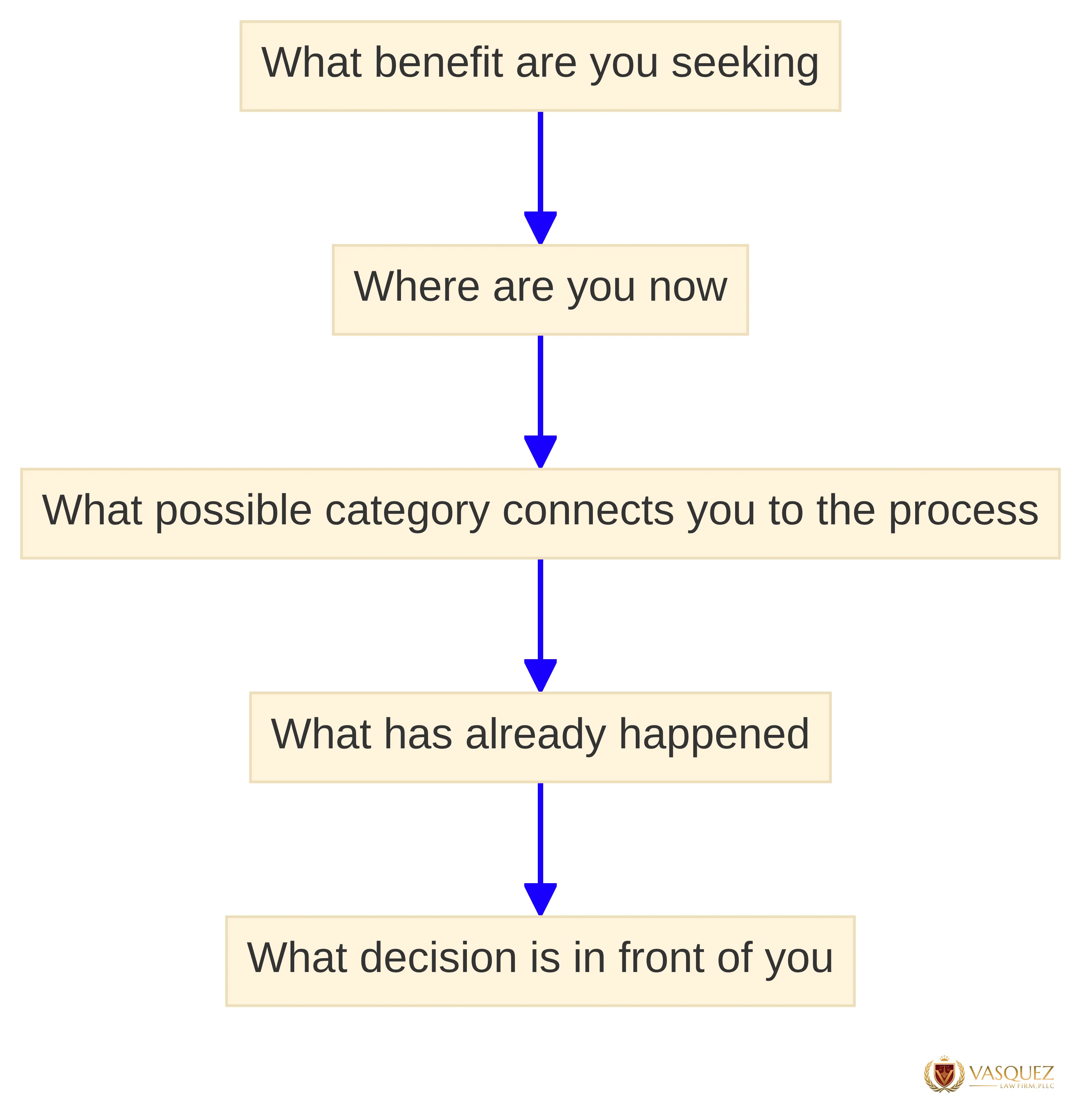
Use the pathway question to organize your inquiry:
- What benefit are you seeking? State that you are asking about lawful permanent resident status, commonly called a green card.
- Where are you now? Explain whether you are physically present in the United States and identify any location or travel facts that may matter.
- What possible category connects you to the process? Describe the family, selection, status, or other fact that led you to consider a green card, without assuming that the category applies.
- What has already happened? Mention prior applications, approvals, denials, notices, entries, departures, or other immigration events as accurately as you can.
- What decision is in front of you? Say whether you need help understanding a possible route, preparing for a filing, responding to a notice, or addressing a concern about an earlier step.
A principal applicant is a person who directly qualifies for an immigrant category. USCIS says that, in some cases, a spouse or child may apply as a derivative applicant. That distinction can affect the questions you bring to a consultation, but it does not establish that you qualify as either type.
If you cannot identify the possible category or explain how your history connects to it, that uncertainty is a practical reason to contact a green card immigration lawyer before relying on a filing plan. Bring the uncertainty itself; you do not need to solve it first.
Use green card categories as conversation starters, not eligibility answers
USCIS categories are useful conversation starters because they help you describe why you are exploring permanent residence. They are not eligibility answers. USCIS lists the Diversity Immigrant Visa Program as a green-card category for people selected in the Department of State’s diversity visa lottery. USCIS also lists the Cuban Adjustment Act for Cuban natives or citizens and, in specified circumstances, their spouses or children.
If one of those descriptions resembles your situation, record the specific fact that led you there:
- If you were selected in the diversity visa lottery, preserve the selection information and note what you know about the related timeline.
- If you are relying on Cuban nationality or citizenship, note your own status and any relationship that you believe may connect a spouse or child to the category.
- If you believe you are a derivative applicant, identify the principal applicant and describe the relationship without assuming that the derivative route applies.
- If your possible basis does not fit these examples, describe the basis in plain language and ask a lawyer which category, if any, should be evaluated.
A category label does not answer questions about your complete history, current status, prior immigration events, or the conditions attached to that category. USCIS says that adjustment-of-status requirements can vary depending on the immigrant category.
Avoid turning a search result, social-media post, or another person’s experience into your own filing plan. A similar label can hide different facts. Instead, tell the lawyer what you know, identify what you do not know, and ask which facts must be reviewed before anyone advises you about forms, supporting documents, or timing.
You can use this short category note in an inquiry:
“I am exploring a green card based on [the fact or category I believe may apply]. I am physically located in [place]. My relevant immigration history is [brief description]. I do not know whether this category applies or what I should file, and I would like an individualized evaluation.”
The note is a way to frame a conversation. It is not a legal conclusion.
Recognize when general information is no longer enough
General information stops being enough when your question asks for a decision about your own forms, options, documents, or timing. USCIS training material says that advising someone how to answer immigration forms, which options may be available, what documentation to include, or when to file may constitute unauthorized legal advice when the advice comes from someone other than a licensed attorney or accredited representative.
That boundary does not mean you must wait until every fact is organized. It means you should identify the point at which your question becomes personal and case-specific. Contact qualified help when you are asking questions such as:
- “Which category should I use?”
- “How should I answer this question on Form I-485?”
- “Which records should I include with my filing?”
- “Should I file now or wait?”
- “Does a prior entry, departure, application, or immigration violation change my options?”
- “How should I respond to this notice?”
You can still do useful preparation before that conversation. Gather the records you have, write down dates as accurately as possible, and separate confirmed facts from estimates. Do not fill gaps by copying someone else’s answers or assuming that a form instruction resolves facts that apply only to your situation.
A focused inquiry is appropriate even when you are at an early stage. State that you are seeking an individualized review, explain the decision you are trying to make, and identify any notice or time concern without guessing at its legal effect. A licensed immigration attorney or accredited representative can decide what advice is appropriate after reviewing the circumstances.
Prepare your pathway and immigration history
Your immigration history is the set of facts that helps a lawyer understand how your possible green card pathway connects to your present situation. Form I-485 instructions distinguish between principal and derivative applicants and state that requirements can vary by category, so a useful inquiry should give enough context for those questions to be identified.
Prepare a private timeline using the facts you know. Include:
- Your current location and whether you are physically present in the United States.
- The category or event that led you to consider a green card.
- Your relationship to any person you believe may be a principal applicant, petitioner, spouse, or parent, when that relationship is relevant to your question.
- Your entries into and departures from the United States, including approximate dates when exact dates are unavailable.
- Immigration applications, petitions, approvals, denials, interviews, notices, or prior advice that you remember.
- Any change in address, name, marital status, or family circumstances that may affect the records you have.
- The question you need answered before taking another step.
A timeline is a preparation aid, not a substitute for legal review. Mark uncertain dates instead of presenting guesses as facts. If you have several possible dates, list each one and explain why you are uncertain. If you do not know the name of a form or category, describe what happened in ordinary language and attach a copy of the notice if you have one.
The category note and the history timeline should answer different questions. The category note explains why you think a pathway may exist. The timeline explains what has happened to you. Keeping them separate makes it easier to notice missing information without turning an assumption into an eligibility determination.
Use a simple three-column format:
| What happened | Approximate date or date range | Record or detail you have |
|---|---|---|
| Entry, departure, application, notice, or family event | Month and year if that is all you know | Passport page, receipt, notice, memory, or other record |
After making the timeline, create a separate question log. Put one question on each line and label it as a category question, history question, document question, timing question, or notice question. This prevents a general concern from being lost among background details. It also helps you explain which answer you need before you take action.
If two records appear to conflict, preserve both and describe the conflict. Do not silently choose the date or spelling that seems more convenient. A difference in a name, entry date, marital status, or prior filing may be relevant to the review, even when you do not know its legal significance.
If a fact could affect what you file, include it in your inquiry even if it feels embarrassing or unrelated. Do not decide on your own that a prior event is harmless or disqualifying. State the event accurately and ask for individualized review.
Gather available documents and notices without assuming a complete checklist
The documents relevant to a green card matter depend on the immigrant category and your circumstances. Form I-485 instructions tell applicants to read and follow the instructions on the application, while USCIS identifies additional requirements that can vary according to the immigrant category.
Before contacting a lawyer, gather what you already have in these groups:
- Identity and travel records: identity documents, passports, visa pages, admission records, or other travel information that relates to your history.
- Immigration records: prior applications, petitions, approval or denial notices, receipts, work or status documents, interview notices, and correspondence from an immigration agency.
- Family or category records: documents that show the relationship or event connected to the possible pathway, such as records relating to a spouse, parent, child, selection, or nationality when relevant to your question.
- Court or enforcement records: records involving an arrest, charge, conviction, immigration court matter, removal proceeding, or other legal event, if any applies to you.
- Current notices: every page of a notice, envelope information when available, and any date printed on the notice.
- Translations or prior submissions: copies of translations, forms, or supporting materials that were previously prepared or submitted, if you have them.
This list is for organizing what you possess. It does not tell you that every item is required, and it does not tell you which item should be submitted. A document can have a different meaning depending on the surrounding facts, so do not omit an event merely because you do not have paperwork for it.
Create a document index rather than sending an unmarked collection. Give each file a plain name, such as “passport biographical page,” “prior receipt notice,” or “court record,” and note whether it is an original, copy, scan, or photograph. Keep the originals unless a qualified professional gives you a specific reason to provide one.
Keep your document index separate from your legal conclusions. The index should say what a file is, when it was created or received if you know, and whether it is complete. It should not label a record as proof of eligibility or describe a notice as harmless or dangerous. Those conclusions depend on how the record fits with the rest of your history.
If a document is not in English, note the language and whether you have a translation. If a page is missing, say which page is unavailable instead of treating the remaining pages as the complete record. If you only have a photograph or scan, keep that version and identify it accurately. These small notes help a lawyer see what is available before discussing what may be needed next.
If you have a notice, place it near the top of your inquiry and describe the date shown on it. Do not assume the date is a deadline until a qualified professional reviews what the notice says. If you cannot obtain a record, write down who issued it, what you remember, and why it is unavailable. Accurate gaps are easier to discuss than invented details.
Ask about representation, communication, and costs
Your first conversation with an immigration lawyer should help you understand what will be reviewed, how communication will work, and what financial questions need to be answered before representation begins. Ask direct questions instead of assuming that every firm handles every matter in the same way.
Questions about the legal work include:
- What facts do you need to evaluate before discussing a possible green card pathway?
- Are you being asked for an initial evaluation, advice about a specific issue, preparation of a filing, or ongoing representation?
- Who would communicate with you about your matter?
- What decisions remain yours, and what work would the firm handle if you retain it?
- What records should you provide for the next stage of review?
- If the facts raise a separate immigration or legal issue, how would that issue be addressed in the evaluation?
Questions about communication include:
- What languages are available for communication?
- How should you send notices or additional records?
- How will you receive updates and requests for information?
- What should you do if your contact information changes?
- Who should you contact if you receive a new notice while the matter is being discussed?
Questions about costs include:
- Is the first conversation an evaluation or a representation agreement?
- What is included in any quoted fee?
- Which services, filings, translations, or other work would be separate?
- How are government filing fees handled?
- When would payment be due, and what would happen if the scope of work changes?
Before the conversation, write a short opening statement that takes less than a few minutes to explain. Name the possible pathway, your current location, the main immigration events in your timeline, the document or notice that concerns you, and the decision you need to make. Then keep the longer timeline and document index available for follow-up questions.
Separate three kinds of money questions: the cost of the initial evaluation, the attorney’s fee for agreed legal work, and government filing fees. Ask which amount each quoted figure refers to and what work it covers. If the proposed work changes after additional facts appear, ask how that change would be explained before you agree to it.
We offer immigration case evaluations and consultations. Our immigration practice serves clients in North Carolina and Florida, and our team is bilingual in English and Spanish. If language affects your ability to explain your history or understand legal questions, state your preferred language at the beginning of your inquiry so communication needs are part of the conversation.
The amount and scope of legal work depend on the matter and the agreement you discuss. Ask for an explanation of the proposed work before deciding whether to proceed, and keep questions about government fees separate from questions about attorney fees.
Compare contacting a lawyer early with waiting for a filing problem
The choice between contacting a lawyer before acting and waiting until a filing problem appears is a choice about when to raise case-specific questions. Neither option allows you to assume eligibility or predict an outcome, but the timing changes what you can bring to the conversation.
| Question | Contact a lawyer before taking case-specific action | Wait until a filing problem appears |
|---|---|---|
| What can you discuss? | Your possible category, history, documents, and the decision you are considering | The filing, notice, response, or concern that has already arisen |
| What should you bring? | A short timeline, available records, category questions, and any uncertainty | The full notice or filing involved, your timeline, and records connected to the problem |
| What is the boundary? | Do not treat the consultation as an eligibility decision until your facts are reviewed | Do not assume that a problem can be resolved by copying general guidance or another person’s answer |
| What is the direct action? | Submit a focused inquiry and ask what information is needed for individualized review | Contact a licensed immigration attorney or accredited representative promptly about the specific issue |
USCIS training material identifies advice about immigration options, form answers, supporting documentation, and filing timing as advice that may be unauthorized when provided by someone other than a licensed immigration attorney or accredited representative. That makes early contact a reasonable choice when your question has moved from “What does this term mean?” to “What should I do in my case?”
Waiting can still be your decision, but do not use waiting as a reason to ignore a notice, preserve no records, or make an irreversible filing choice without understanding the question involved. If a notice or filing problem already exists, put that fact at the beginning of your inquiry and include every page you have.
Contact a lawyer early when you know that the next step depends on facts you cannot evaluate yourself. If you have already filed or received a notice, contact qualified help about that specific document instead of trying to repair the issue from a general summary. Form I-485 requirements can vary by immigrant category, so the category and the history belong in either conversation.
Verify current USCIS information before relying on a summary
Current USCIS information should be the reference point for forms, categories, instructions, and procedures. USCIS's Form I-485 instructions are dated September 18, 2026. USCIS also states that adjustment-of-status requirements vary by immigrant category.
Use a summary to identify questions, then check the current USCIS page and form instructions before relying on a detail. Pay attention to:
- The date or edition shown on the form instructions.
- Whether the page describes the category you are actually considering.
- Whether the information applies to a person physically present in the United States or to a different process.
- Whether the instruction refers to a principal applicant, derivative spouse, or derivative child.
- Whether a notice or instruction gives a specific direction that your general summary did not address.
Record the page title, form name, edition date, and the date you reviewed the information. Save a copy or note the specific passage that raised your question. If a later page appears to differ from an older summary, bring both dates and the precise question to your consultation rather than trying to reconcile the difference from memory.
Do not treat a current page as a substitute for individualized legal advice when the question concerns your own eligibility, form answers, supporting documentation, or filing timing. USCIS lists categories such as the Diversity Immigrant Visa Program and the Cuban Adjustment Act, but seeing a category on a USCIS page does not establish that its conditions fit your facts.
Save the page or instructions you relied on, note the date you reviewed them, and bring the specific passage or question to your consultation. That habit gives you a clear starting point without claiming that a general description resolves your case.
Key Highlights
A green card decision guide is most useful when it helps you choose the next question, not when it pretends to decide the case. Keep these points in view:
- Treat category names as starting points. USCIS lists the Diversity Immigrant Visa Program and the Cuban Adjustment Act among green-card categories, but a category label does not determine whether its conditions fit your circumstances.
- Recognize the advice boundary. Questions about how to answer forms, which options may be available, what documents to include, or when to file call for a licensed immigration attorney or accredited representative rather than informal guidance.
- Prepare facts, not guesses. Bring a short immigration timeline, your possible category, available records, notices, and a list of uncertainties. Do not create a complete checklist by assuming that another person’s documents apply to you.
- Ask practical questions. Discuss the scope of any evaluation or representation, communication languages and methods, documents to provide, attorney fees, government fees, and what happens if the facts change.
- Use current USCIS material. Compare summaries with the current USCIS page and instructions, and note the date of the information you relied on.
- Choose individualized review when the next step is personal. We offer immigration case evaluations and consultations for matters connected to our practice in North Carolina and Florida.
Your inquiry does not need to contain every answer. It should clearly state what you are trying to understand, what has happened, what records you have, and where you need qualified guidance.
Submit a focused inquiry for individualized review
A focused inquiry gives you a practical starting point: state the possible green card pathway, explain where you are in the United States, summarize your immigration history, identify any notice or concern, and list the questions you need answered. Include the records you have without assuming that your collection is complete, and mention whether English or Spanish communication would help.
Eligibility, filing requirements, deadlines, fees, and likely results require review of your circumstances and current information. We offer free immigration case evaluations and consultations, so you can present the facts you have and ask what information is needed for an individualized review.
What should I prepare before contacting a green card immigration lawyer?
What should I prepare before contacting a green card immigration lawyer?
Gather your immigration history, including your current location, any prior applications or notices, and relevant family relationships. Create a timeline of your immigration events and collect any documents that may support your case.
What questions should I ask during my first consultation with an immigration lawyer?
Inquire about the evaluation process, communication methods, what documents you need to provide, and the costs associated with representation. Clarify whether the initial meeting is for evaluation or to establish a representation agreement.
When is it necessary to seek individualized legal advice for my green card situation?
If your questions involve specific decisions about forms, options, or documentation, or if you have received a notice or deadline, it's important to consult a licensed immigration attorney for tailored guidance.
What types of documents are typically needed for a green card application?
Documents may include identity records, immigration history, family relationship evidence, and any notices from immigration agencies. It's important to gather what you have without assuming a complete checklist.
Sources
- Green Card Eligibility Categories | USCIS — www.uscis.gov
- Form I-485, Instructions for Application to Register ... — www.uscis.gov