

Start by identifying which green card process applies
Green card renewal begins by identifying the document and residence category involved, not by choosing a form based only on an expiration date. If you have a regular Permanent Resident Card that needs renewal or replacement, the USCIS Form I-90 process may be the relevant pathway. If you have conditional permanent residence, USCIS identifies Form I-751 as the petition to remove conditions on residence, distinct from routine Form I-90 renewal or replacement.
The word “extend” can create confusion because a green card, an employment authorization document, and conditional residence involve different USCIS processes. Start with the card in your possession and the basis of your residence. If the card is expiring or has expired, do not treat an employment-authorization automatic extension as applying to the card. Read the current USCIS Form I-90 or Form I-751 instructions, as applicable, before preparing payment or supporting documents.
Your location in North Carolina or Florida does not change the need to use the applicable federal USCIS form and instructions. Your first task is to sort your situation into one of these starting points:
- A regular Permanent Resident Card that needs renewal or replacement: review Form I-90 instructions.
- Conditional permanent residence: review Form I-751 information instead of treating the matter as a routine I-90 renewal.
- An employment authorization document: review the separate Form I-765 renewal rules rather than assuming a green card filing applies.
- A complication such as a lost card, a long absence, a criminal issue, removal proceedings, or uncertainty about your residence category: pause before filing and seek advice about the specific facts.
This classification does not decide your eligibility. It keeps you from beginning with the wrong filing pathway.
Do not confuse a green card renewal with an employment-authorization extension
A green card renewal and an employment-authorization extension concern different documents and different forms. USCIS guidance on automatic extensions applies to employment authorization and Employment Authorization Documents renewed on Form I-765 during specified circumstances; it does not establish an automatic extension for a Permanent Resident Card renewal filed on Form I-90.
That distinction matters if you have both documents. An employment authorization notice should not be treated as proof that a Form I-90 green-card renewal has been extended. Likewise, a green card filing should not be used as a substitute for the rules governing an Employment Authorization Document.
Your next step is to name the document you need to renew before you rely on any extension language. For a green card, follow the current Form I-90 instructions if that form applies. For an Employment Authorization Document, review the current Form I-765 rules and the eligibility category shown on the document and related notice. Keep the two filing questions separate in your records and in any request for legal advice.
Verify current USCIS requirements before preparing anything
Current USCIS instructions control the form, filing route, payment details, supporting materials, and filing location that apply when you submit. USCIS directs you to read the Form I-90 instructions first and check the E-Filing Eligibility chart before filing online. The Form I-90 instructions also direct you to use the USCIS website for the most current filing-location information.
Do this before filling out the application:
- Open the current USCIS page for the form that appears to apply.
- Read the complete instructions, not only the form questions.
- Check the eligibility information for online filing if you plan to submit electronically.
- Identify the current payment amount and payment method required for your filing route.
- Note every supporting document, photograph, translation, signature, and mailing instruction that applies to your facts.
- Save a copy of the instructions you used and record the date you prepared the filing.
The exact amount and document list can change, so do not rely on an old checklist or a general internet summary.
Your preparation checklist should come from the current USCIS instructions rather than from assumptions about what every green card holder submits. The online Form I-90 instructions say eligible applicants may complete the form through the USCIS Online Filing page, while the Form I-90 instructions direct you to the current USCIS website for filing information. If online filing is not available for your circumstances, follow the current instructions for the applicable filing route instead of adapting an online checklist.
Use the same version of the instructions when you review your answers, payment, attachments, and mailing steps. A complete-looking packet can still create a problem if it follows an outdated requirement or sends supporting material to the wrong place.
Choose between Form I-90 and Form I-751
Form I-90 is the starting point for a routine renewal or replacement question involving a regular Permanent Resident Card. USCIS’s online instructions describe Form I-90 as the form eligible applicants may complete through the USCIS Online Filing page, and USCIS’s Form I-90 instructions explain that an application is not properly filed until USCIS accepts it.
If Form I-90 matches your situation, use the current instructions to determine the filing route and materials. Do not treat the form name alone as a decision about your eligibility. The form answers a filing question; your particular history may require a different analysis.
Form I-751 is the USCIS petition to remove conditions on residence. USCIS treats that petition as distinct from routine Form I-90 renewal or replacement, so conditional permanent residence should not be handled by simply substituting Form I-90.
For Form I-751, USCIS lists possible supporting materials that include copies of the front and back of the Permanent Resident Card, evidence that the qualifying marriage was entered in good faith, an explanation for a late filing when applicable, and dispositions for criminal charges, arrests, or convictions when applicable. The materials depend on the circumstances described in the current Form I-751 instructions.
If you cannot tell whether your residence is conditional, look at the documents connected to your residence and obtain individualized immigration advice before selecting a form. Do not file both forms merely because the card has an approaching expiration date.
Prepare the information and materials your pathway requires
Form I-90 preparation starts with the information and documents requested by the current USCIS instructions. Gather the identifying details, immigration-document information, address information, signatures, payment, and supporting materials that the applicable version of the form requires. The precise list belongs to the current form instructions, so do not assume that a checklist prepared for another person or an earlier filing will cover your case.
A practical preparation folder can include:
- The current form instructions and the date you used them.
- A working copy of your completed form before submission.
- Copies of the front and back of your current or available Permanent Resident Card when the instructions call for them.
- Copies of supporting documents prepared in the format and language required by the instructions.
- A record of the payment submitted and the filing route used.
- A copy of every document sent or uploaded.
Photographs, translations, and other attachments should be included only in the manner the current USCIS instructions require. Do not add or omit them because a general checklist says they are always necessary.
Form I-751 preparation may require materials connected to the qualifying relationship and the reason for the petition. USCIS lists the front and back of the Permanent Resident Card, evidence of a good-faith qualifying marriage, a late-filing explanation when applicable, and criminal-charge dispositions when applicable among possible supporting materials.
Organize those materials so each document has a clear connection to the form and the circumstances you are presenting. If a late filing, arrest, charge, conviction, separation, or other fact affects your petition, do not reduce it to a routine card-renewal checklist. Use the current Form I-751 instructions and seek individualized advice before submission.
Your personal records should show what you submitted, when you submitted it, and which instructions governed the filing. Keep the application, payment record, attachments, delivery or electronic confirmation, and later USCIS notices together. This record gives you a clear starting point if USCIS asks for additional material or if you need to discuss the filing with an immigration professional.
File the application and preserve every confirmation
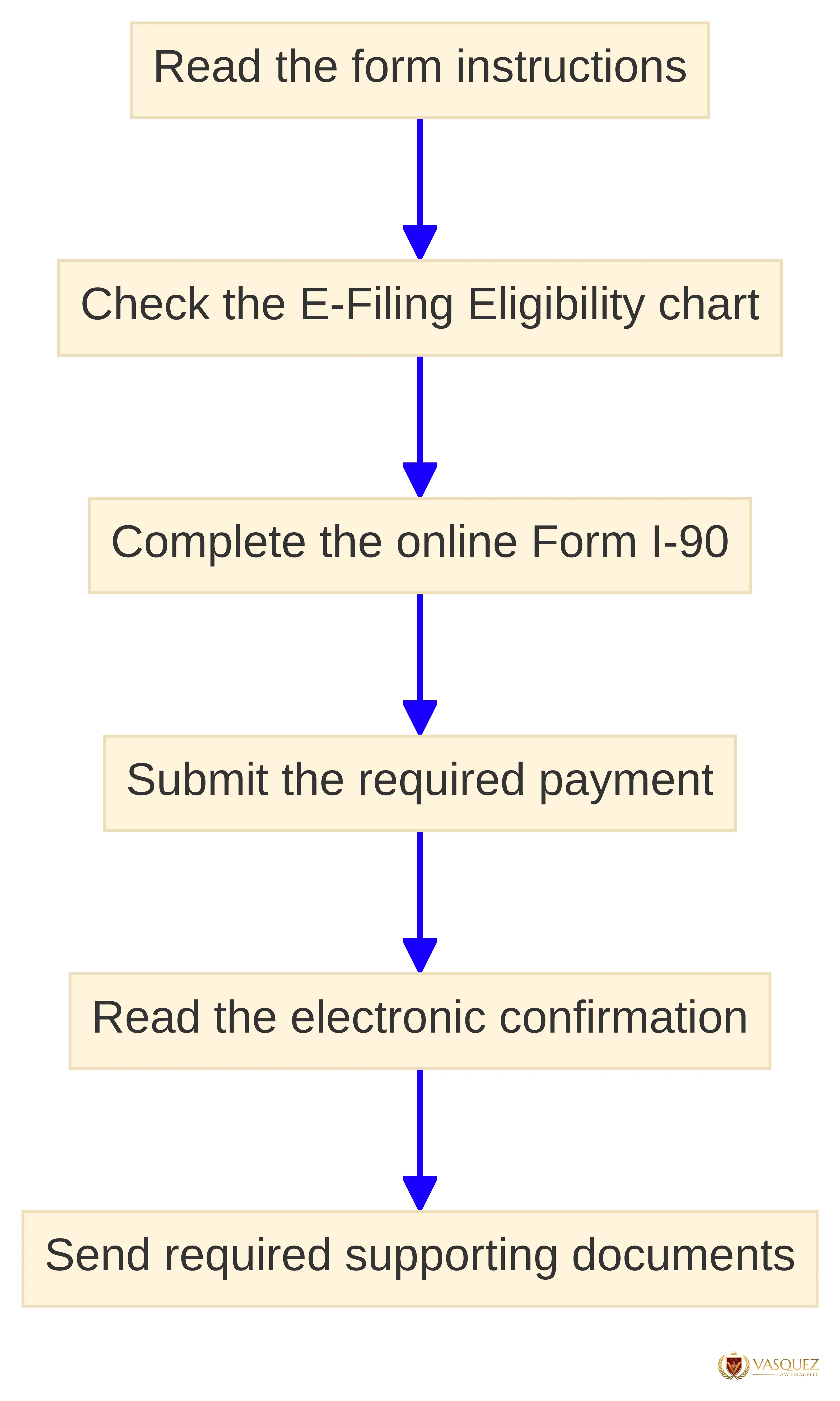
The online Form I-90 sequence begins with the instructions and E-Filing Eligibility chart, followed by completion of Form I-90 through the USCIS Online Filing page when you are eligible. USCIS’s online instructions describe the following order:
- Read the form instructions.
- Check the E-Filing Eligibility chart.
- Complete the online Form I-90 if electronic filing applies.
- Submit the required payment.
- Read the electronic confirmation for the receipt number and any instructions about mailing supporting documents.
- Send required supporting documents to the address listed on that confirmation.
After online payment, USCIS says the electronic confirmation receipt includes a receipt number and identifies where required supporting documents must be mailed. USCIS warns that failing to send required supporting documents to that address may delay or lead to denial of the application.
USCIS acceptance is a separate point from pressing a submit button or sending a packet. USCIS says a Form I-90 application is not properly filed until USCIS accepts it, and USCIS checks an accepted application for completeness. USCIS also says an improperly completed application may be rejected or denied.
Preserve the confirmation, payment record, completed form, attachments, and delivery record in one place. If the online confirmation gives a specific address for supporting documents, use that address rather than a general address found elsewhere. If your filing route or circumstances are unclear, stop before submission and obtain case-specific guidance.
Track the filing and respond to USCIS notices
Your USCIS confirmation and notices provide the records you need to organize a pending filing. USCIS says the online confirmation includes a receipt number and identifies where required supporting documents must be mailed, and USCIS will mail Form I-797C, Notice of Action, after an online Form I-90 filing. USCIS also says it will send an Application Support Center appointment notice if biometric services are required.
Keep the receipt number with your copy of Form I-797C and the submitted application. Use the receipt number when following the current USCIS instructions for a case-status inquiry. Keep every later notice with the same record so you can identify the filing, the notice date, and any response deadline.
A pending filing still requires attention to USCIS notices. Read each notice for the action requested, the address to use, and any date by which you must respond or attend an appointment. If USCIS requests supporting documents, compare the request with your retained copy of the filing before sending a response.
USCIS says the office assigned to your case will adjudicate the Form I-90 application. For current timing information, check USCIS's processing information for the applicable form and any category or office it requests; review the displayed information again before relying on it. Keep your contact information and filing records organized while the case remains pending, and use current USCIS instructions for any status or notice question.
Recognize when routine renewal guidance is not enough
Certain facts mean you should not treat the matter as a routine card renewal. Pause and seek individualized immigration advice if your situation involves:
- Conditional permanent residence or uncertainty about whether your residence is conditional.
- A lost, stolen, damaged, or unavailable card.
- A long absence from the United States.
- An arrest, criminal charge, conviction, or unresolved criminal record.
- Removal proceedings or another immigration case already pending.
- A late filing, a prior denial, or a notice that you do not understand.
- Uncertainty about whether Form I-90 or Form I-751 applies.
These circumstances do not receive a filing strategy from a general guide. They require attention to your documents, history, and the notice or issue affecting you.
Form I-751 includes case-specific material that a routine I-90 checklist does not address. USCIS lists a late-filing explanation when applicable and criminal-charge dispositions when applicable among possible Form I-751 supporting materials. If either issue appears in your history, gather the relevant records and obtain individualized advice before deciding how to file.
An expired card may create a documentation issue, but it does not by itself answer the larger immigration question. The correct next step depends on the residence category, the document involved, and the facts surrounding your case.
No general checklist can promise acceptance, a particular notice, or a particular result. USCIS says an improperly completed Form I-90 application may be rejected or denied, and USCIS instructions control the filing requirements in force when you submit. Use general information to organize your questions, then address case-specific uncertainty before filing.
Gather your documents and decide your next step
Your next step is to identify the document involved, open the current USCIS instructions, and build your filing record before you submit. Use Form I-90 instructions for a routine regular-card renewal or replacement question, Form I-751 information for conditional residence, and separate Form I-765 guidance for an employment authorization document. Preserve the form, payment record, supporting documents, confirmation, receipt number, Form I-797C, and every later notice.
If your residence category, filing history, criminal record, travel history, lost-card situation, or immigration proceedings create uncertainty, a qualified immigration professional should assess your individual suitability and filing options. We offer immigration case consultations and evaluations.
What should I check before filing a green card renewal or extension?
What steps should I take before filing Form I-90 for green card renewal?
Before filing Form I-90, read the current USCIS instructions, check the E-Filing Eligibility chart, and gather all required documents and payment information.
When should I seek individualized legal advice regarding my green card renewal?
You should seek individualized legal advice if you have complications such as conditional permanent residence, a lost or stolen card, a long absence from the U.S., or any criminal issues.
What is Form I-751 and when should it be used instead of Form I-90?
Form I-751 is used to remove conditions on residence for those with conditional permanent residence.
Sources
- Form I-90, Instructions for Application to Replace ... — www.uscis.gov
- 5.1 Automatic Extensions Based on a Timely Filed Application to Renew Employment Authorization and/or Employment Authorization Document During Specified Timeframes — www.uscis.gov
- Instructions for Electronic Filing of Form I-90 (Renew or Replace a Green Card Online) | USCIS — www.uscis.gov
- What Is Form I-9 and How to Complete It in 2026 | Vasquez Law Firm