

H-1B Status Can Lead Toward Permanent Residence Without Becoming a Green Card
H-1B status can coexist with a plan to pursue lawful permanent residence, commonly called a green card. USCIS recognizes this compatibility as dual intent. It describes compatibility between the two pursuits, not the grant of permanent residence.
H-1B status and permanent residence are still different immigration positions. H-1B status is nonimmigrant status tied to the temporary employment framework that supports it, while lawful permanent residence is a separate status. Pursuing a green card does not mean that you already have one, and beginning an employment-based case does not by itself settle when you may file the final residence application or whether that application will be approved.
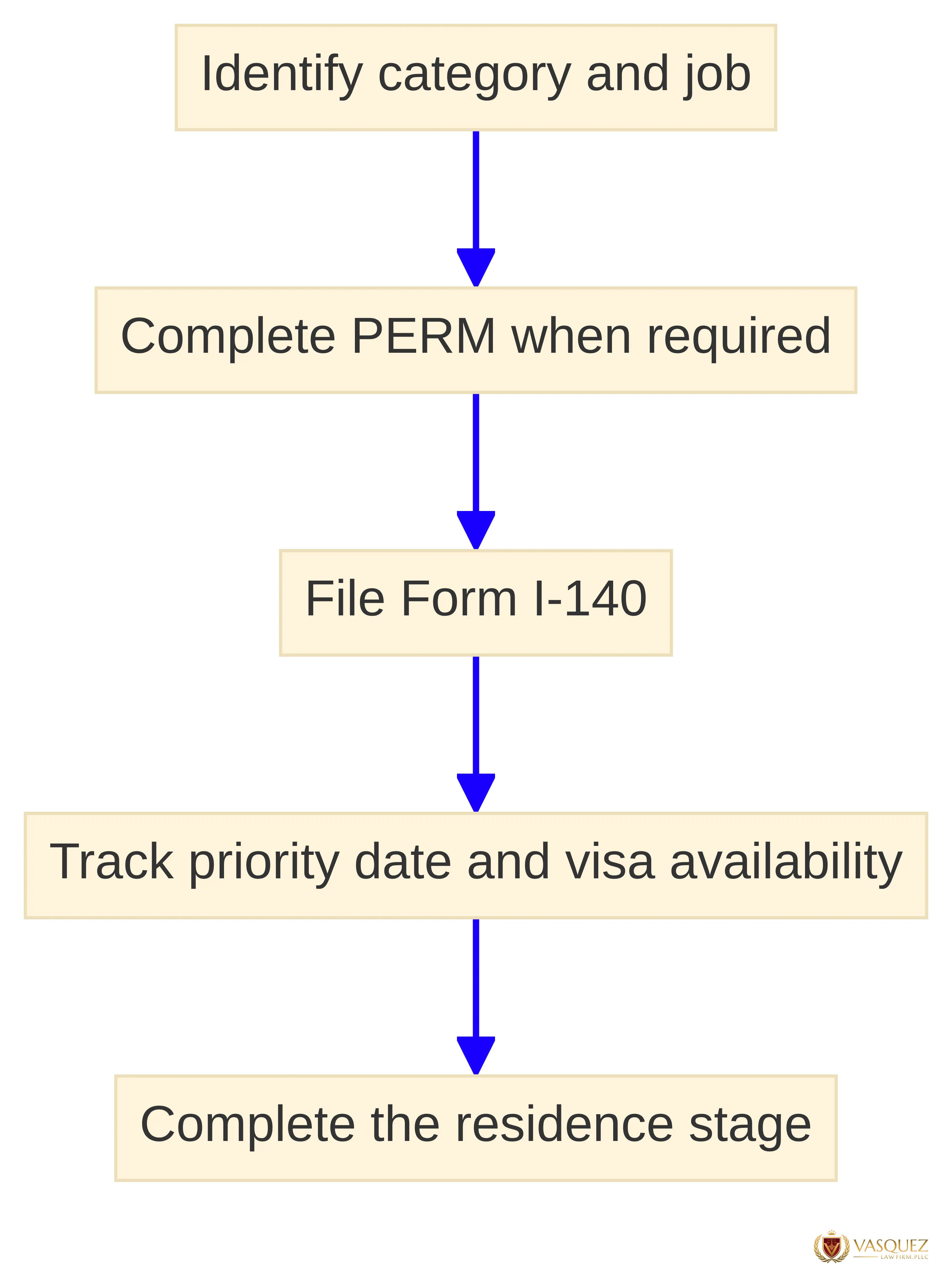
Your planning task is therefore more specific than asking whether an H-1B worker can get a green card. You need to identify the employment-based category, determine whether labor certification is part of that category, track the priority date, watch visa availability, preserve lawful work and stay options, and prepare for the stage that may follow the immigrant petition. The path is coordinated rather than automatic.
The distinction also matters when you make plans around travel, employment, or an approaching H-1B end date. A step toward permanent residence can coexist with H-1B status, but it does not erase the requirements attached to the temporary status or complete the later residence stage. Keep those questions separate from the beginning.
Coordinate the Two Timelines Before Choosing a Next Question
An H-1B worker may pursue lawful permanent residence while maintaining H-1B status under the dual-intent concept. H-1B status and permanent residence remain different legal matters: progress toward a green card does not itself answer whether the person may stay or work under a particular status rule.
A useful review therefore starts with coordination, not with an assumption that one filing resolves the whole case. The green-card track includes the employment-based category, a labor-certification step when the category requires it, Form I-140, the priority date, visa availability, and the residence procedure. The H-1B track includes the validity end date, work authorization, authorized stay, pending requests, and any extension rule that may apply. The two tracks can affect the same decision without becoming the same process.
Use a two-track status checkpoint for each confirmed milestone:
- The case stage identifies what has happened: category review, PERM, Form I-140, or residence-stage preparation.
- The controlling date identifies the timing question, such as DOL acceptance, USCIS acceptance, the H-1B end date, or visa availability.
- The current permission identifies what the person may rely on now, rather than what a pending filing might eventually provide.
- The open question identifies the issue that needs case-specific review before action.
This checkpoint does not decide eligibility or select a strategy. It keeps the green-card milestone and the H-1B consequence beside each other. For example, a category decision may determine whether PERM is part of the route; a priority date may focus attention on visa availability; and an approaching H-1B end date may require separate review of authorized stay and work authorization.
The residence procedure also matters. Form I-485 has its own adjustment-of-status conditions, including physical presence and visa availability at the relevant points. A case using another residence procedure requires separate analysis, so the adjustment points should not be treated as a checklist for every route.
The main planning distinction is simple: a green-card milestone answers a question about permanent residence, while an H-1B rule answers a question about temporary status, stay, or work. The next review should connect those questions without treating one approval, date, or pending request as a substitute for the other.
Use Green-Card Milestones to Check H-1B Status
Use the employment-based milestones as triggers for an H-1B status review. This keeps the necessary pathway background while making the consequence for temporary status the organizing question.
Category and position. The exact route depends on the requested employment-based preference category and the sponsored position. The category determines whether a labor-certification step belongs in the case and which priority-date rule may apply. Identifying the category is therefore both a green-card question and the first point at which the H-1B timeline should be reviewed.
PERM when required. In most cases using PERM, the employer must obtain a certified labor certification from the Department of Labor before submitting the immigrant petition to USCIS. The certification concerns the employer's position and the Department of Labor's determinations about available U.S. workers and the effect of the employment on wages and working conditions. PERM progress does not, by itself, establish the worker's current H-1B permission.
Form I-140. The case then reaches the immigrant-petition stage in the applicable employment-based category. That stage concerns classification for permanent residence. It does not, by itself, answer whether the worker may continue working or remain in H-1B status after a particular end date.
Priority date and visa availability. The priority-date rule depends on the category. When the category requires DOL labor certification, the priority date is generally the date DOL accepts the labor-certification application for processing. When the category does not require that certification, the priority date is generally the date USCIS accepts Form I-140 for processing in the requested category. In a labor-certification case, Form I-140 must be filed with USCIS within 180 days after DOL approves the labor certification to preserve the priority date; otherwise, the labor certification is no longer valid. Visa availability can then affect when the residence stage may proceed.
Residence stage. Adjustment of status through Form I-485 has separate conditions, including physical presence in the United States at filing and immediate visa availability at filing and at the final decision. If the case uses another residence procedure, the adjustment-of-status conditions should not be applied to that route by analogy.
At each milestone, pair the green-card record with a status question. The category and labor-certification stage identify the route. The petition and priority date identify where the permanent-residence case stands. Visa availability identifies whether the residence stage can move forward. The H-1B end date, any pending request, and the applicable permission rule identify a separate temporary-status question.
If the H-1B end date is approaching, do not assume that movement in the employment-based case resolves the status issue. Review authorized stay, work authorization, and any potentially applicable extension rule separately. This milestone-based approach lets the reader identify the next question without treating the employment-based sequence as a substitute for case-specific immigration review.
Understand What PERM Certification Requires
PERM certification is a Department of Labor process that may come before the employer submits an employment-based immigrant petition to USCIS. In most instances involving PERM, the employer—not you—must obtain a certified permanent labor certification for the offered position.
The Department of Labor describes two central determinations for certification:
- There are not sufficient U.S. workers able, willing, qualified, and available to accept the job opportunity in the intended employment area.
- Employing the foreign worker will not adversely affect the wages and working conditions of similarly employed U.S. workers.
These requirements explain why PERM is not simply a form that confirms your H-1B job. The employer must satisfy a labor-market and employment-condition process for the particular job opportunity. Your H-1B approval, current employment, or professional qualifications does not by itself establish that the PERM requirements have been met.
PERM may not be part of every employment-based preference category. The priority-date rule also differs depending on whether the category requires DOL labor certification. Before you plan around a PERM filing, identify the category and ask which employer, position, worksite, recruitment, wage, and timing facts control the case. Those details can change the analysis.
A practical planning record should separate three things: the job connected to the proposed sponsorship, the employer's labor-certification responsibility, and the later Form I-140 responsibility. Keeping those stages separate helps you avoid treating a labor-certification filing as if it were already an immigrant petition or a green card application.
PERM therefore belongs to the employer-sponsored job analysis, not to the assumption that your existing H-1B approval automatically carries into permanent residence. The position, the employer's process, and the category must be considered together. If any of those pieces changes, revisit the planning question before treating the labor-certification stage as settled.
Use the Priority Date to Track Visa Availability
The priority date is the case date used in the employment-based visa-availability analysis, and the date is assigned differently depending on whether the preference category requires DOL labor certification. USCIS identifies these two rules:
- When the category requires DOL labor certification, the priority date is the date the Department of Labor accepts the labor-certification application for processing.
- When the category does not require DOL labor certification, the priority date is the date USCIS accepts Form I-140 for processing to classify you under the requested preference category.
That distinction matters because the date is connected to when an immigrant visa may be available for the next stage. A Form I-140 approval does not mean that an immigrant visa is immediately available in every case. Your planning should therefore track the preference category, the priority date, and the applicable visa-availability information as separate items.
Record the following information as your case develops:
- The employment-based preference category identified for the petition.
- Whether that category requires DOL labor certification.
- The event that establishes the priority date for that category.
- The priority date shown in the relevant case records.
- The visa-availability information that controls whether the next residence filing may proceed.
Do not replace the priority date with the date of your H-1B approval, the date you began working, or the date you first discussed sponsorship. Those dates may matter for other questions, but the accepted priority-date rule depends on the category and the filing event described above.
A useful timeline places the priority date beside, rather than in place of, the petition and residence milestones. That lets you ask whether the category is correct, whether the date was created by the right filing event, and whether visa availability supports the next step. The priority date is a tracking tool, not a promise that the residence application can be filed or approved on a particular date.
Protect the 180-Day Labor-Certification Filing Window
The 180-day filing window applies after the Department of Labor approves a labor certification in a case that uses that certification. USCIS guidance explains that the petitioner must file Form I-140 within 180 days after DOL approval to preserve the priority date; otherwise, the labor certification is no longer valid.
This deadline belongs to the transition from approved labor certification to the immigrant petition. It is not the same as your H-1B expiration date, the date you entered the United States, or the date an employer first discussed permanent sponsorship. Treat the DOL approval date and the Form I-140 filing date as separate records that need to be tracked together.
A useful planning checklist is short:
- Keep the DOL approval notice and its approval date with your immigration records.
- Identify who is responsible for the Form I-140 filing.
- Calculate the 180-day period from the DOL approval date.
- Preserve proof of the Form I-140 filing and the category used.
- Raise any timing uncertainty before the filing window becomes urgent.
The filing window does not answer whether the immigrant petition will be approved or whether an immigrant visa will be available. It protects the validity of the labor certification and the related priority-date treatment when the required filing is made on time. Those later questions remain separate.
Do not treat the 180-day period as a general countdown from the start of sponsorship. It begins with the DOL approval event described above and concerns the filing of Form I-140. If the approval date, filing date, or responsible filer is unclear, resolve that uncertainty before relying on the labor certification for later planning.
Move From Form I-140 to the Final Residence Stage
Petition approval alone does not resolve the requirements for the residence stage. For adjustment of status, USCIS guidance identifies immediate immigrant-visa availability both when Form I-485 is filed and when USCIS makes a final decision. The offered job also remains relevant: USCIS lists the continued existence of the job offered in the Form I-140 with the petitioning employer as one condition in its adjustment-of-status guidance.
Plan the transition by asking four separate questions:
- What employment-based preference category is the petition using?
- What priority date applies to that category?
- Is an immigrant visa immediately available for the filing stage?
- Do the Form I-485 conditions and the offered-job condition fit the facts of the case?
An approved I-140 may be an important milestone, but it does not answer every Form I-485 question. A filing decision should account for the timing of visa availability, your physical presence and admission history, the offered position, and any other facts that affect adjustment eligibility. If those facts are unclear, pause before treating the residence filing as routine.
Keep the petition stage and the residence stage in separate folders or records. The I-140 record should show the category and petition history. The adjustment record must address the conditions attached to Form I-485. This organization does not decide eligibility, but it helps you ask a more precise question about the next filing rather than treating petition approval as the end of the process.
Check Visa Availability Before Treating Adjustment as Imminent
Visa availability is a condition that can determine whether Form I-485 is ready to file and whether the application can reach a final decision. USCIS states that an immigrant visa generally must be immediately available both when Form I-485 is filed and when USCIS makes its final decision.
This requirement changes how you should read an approved petition. Form I-140 approval may establish classification under the requested employment-based category, but it does not by itself establish immediate visa availability. Your priority date must be considered with the category and the applicable visa-availability information.
Use a two-point timing check:
- At filing: Ask whether an immigrant visa is immediately available when you intend to submit Form I-485.
- At final decision: Recognize that availability also matters when USCIS makes its final decision.
The two points are not interchangeable. A filing that appears possible at one point still requires attention to the availability condition at the final decision stage. Keep the category and priority date current in your planning records, and use the applicable USCIS and Department of State visa-availability information when making a filing decision.
This is why an estimated processing timeline cannot replace a visa-availability check. A petition may be approved while the residence filing remains unavailable, or an application may be filed when availability exists while the final decision still requires that condition to be satisfied. Track the status of the visa-availability question separately from the status of Form I-140.
Review the General Conditions for Adjustment of Status
Adjustment of status through Form I-485 has its own eligibility conditions, even when an employment-based immigrant petition is available. USCIS identifies several general conditions, including proper filing of Form I-485, inspection and admission or inspection and parole into the United States, physical presence in the United States when filing, and eligibility to receive an immigrant visa.
USCIS also identifies immediate immigrant-visa availability at filing and final decision as part of the adjustment analysis. These conditions connect the application to both immigration history and the sponsored employment.
Organize your review around the condition each fact addresses:
- Filing: Is the correct Form I-485 being filed properly?
- Entry: Were you inspected and admitted or inspected and paroled into the United States?
- Presence: Are you physically present in the United States when you file?
- Visa: Are you eligible to receive an immigrant visa, and is one immediately available at the required points?
- Job: Does the offered job continue to exist with the petitioning employer?
This list is a planning framework, not an eligibility decision. A yes-or-no answer to one item does not resolve the others. Keep the facts and documents connected to each condition instead of relying only on the existence of H-1B status or an approved I-140.
The questions also show why the same document can matter differently at different stages. An entry record may bear on inspection and admission or parole. A petition record may identify the offered job and category. Visa-availability information may control timing. Assemble the facts by condition so that a missing or uncertain item is visible before you treat Form I-485 as ready.
Plan Before H-1B Validity Becomes Urgent
Your H-1B end date should be treated as a planning deadline, not as a date to notice only after the employment-based case is ready for its final stage. The green card process may involve separate filings, priority-date conditions, visa availability, and adjustment requirements, so an H-1B case can require status planning while the permanent-residence case remains pending.
Start the review well before the end date and place these items on one timeline:
- The current H-1B approval and authorized stay end date.
- Any labor-certification filing, approval, or deadline.
- The Form I-140 filing and its employment-based category.
- The priority date and visa-availability position.
- Any Form I-485 filing or other pending immigration request.
- The date on which you may no longer have work authorization under the current H-1B approval.
The timing of a permanent-residence case does not automatically extend H-1B work authorization. A separate rule may apply to a particular status or extension situation, but the facts and conditions must be examined rather than assumed. If the end date is approaching and the next filing or status basis is uncertain, obtain case-specific immigration guidance before relying on continued employment or stay.
Build the timeline around events, not general labels. For example, record the date of a DOL approval separately from the date of an I-140 filing, and record an H-1B end date separately from the date a different request was submitted. The point is to see which rule is connected to which event before a deadline narrows your options.
An approaching end date can also expose a gap between the residence case and the temporary-status plan. The priority date may not permit the next residence filing, the petition may still be pending, or a request may address stay without authorizing work. Those possibilities call for separate questions rather than one assumption that the permanent-residence case protects every part of your status.
Separate Authorized Stay From Work Authorization
Authorized stay and work authorization are different questions when an immigration request is pending. USCIS explains that a timely filed, nonfrivolous change-of-status request generally provides a period of authorized stay while it is pending, but the request does not authorize work beyond the H-1B end date until the change of status is approved.
That distinction prevents a common planning error. A pending request may affect whether you can remain in an authorized period while the request is considered, but it does not necessarily give you permission to keep working after the H-1B end date. Approval, work authorization, and admission are separate concepts that should not be combined into one assumption.
Use three separate questions for any pending request:
- Does the filing provide a period of authorized stay while it is pending?
- Does the filing authorize employment after the H-1B end date?
- Does the filing provide a basis for admission if you leave the United States?
The answer to the first question does not automatically answer the second or third. USCIS guidance specifically distinguishes authorized stay from work authorization in the change-of-status context. Before you continue working, remain in the United States, or travel based on a pending filing, identify the rule that applies to that particular request and your particular status.
Write the answer to each question beside the filing that supposedly creates the permission. A receipt notice, a pending change-of-status request, an approved status, and separate employment authorization can have different effects. Keeping the labels separate helps you avoid using proof of a pending filing as if it were proof of work authorization or a travel document.
Treat AC21 Extensions as Conditional Planning Points
The cited AC21 guidance describes a conditional extension-of-stay rule under section 106(a). Under that guidance, USCIS grants extensions of stay in one-year increments until a final decision is made on specified labor-certification, employment-based immigrant-petition, immigrant-visa, or adjustment-of-status matters, subject to the conditions in the guidance.
The rule should be treated as a planning point rather than an automatic answer to every H-1B expiration concern. Its application depends on the underlying labor-certification, immigrant-petition, immigrant-visa, or adjustment matter and on the conditions attached to the guidance. You cannot determine the result only by saying that a green card case exists.
When evaluating whether this kind of extension may matter, organize the facts around the pending case:
- Is there a labor-certification matter, and what is its status?
- If the labor certification was approved, was the related immigrant petition filed within the required validity period?
- Is there an employment-based immigrant petition, immigrant-visa matter, or adjustment application covered by the rule?
- What final decision would end the extension described in the guidance?
- What is the current H-1B end date and work-authorization position?
The AC21 guidance also reflects why early planning matters. A conditional extension can depend on the exact procedural posture of the case, while your employment and stay questions may have immediate consequences. Use the rule as one part of a documented status strategy, not as a substitute for reviewing the underlying filings and conditions.
Keep the extension question tied to the specific case record. The existence of a labor certification, I-140, immigrant-visa matter, or adjustment application is only the starting point for the analysis described in the guidance. Record the filing status, relevant dates, and final-decision conditions before relying on a possible one-year extension.
H-1B Status-Planning Checkpoints
The H-1B-to-permanent-residence review is easiest to use when each green-card milestone is paired with its separate status question:
- H-1B status is not permanent residence. An H-1B worker may pursue permanent residence while maintaining H-1B status under the dual-intent concept, but the two legal matters remain distinct.
- The category determines the route. The employment-based preference category indicates whether PERM is required and which priority-date rule applies.
- PERM and Form I-140 answer different questions. In most PERM cases, the employer must obtain DOL certification before the immigrant petition is submitted to USCIS. The petition stage concerns immigrant classification; it does not by itself resolve the H-1B end-date question.
- The priority date does not equal visa availability. The applicable date depends on the category, and an immigrant visa generally must be immediately available at the required points for adjustment of status.
- Adjustment has its own conditions. General review includes proper Form I-485 filing, inspection and admission or parole, physical presence at filing, eligibility for an immigrant visa, and visa availability at filing and final decision.
- A pending request and work authorization are separate questions. A timely filed, nonfrivolous change-of-status request does not authorize work beyond the H-1B end date until the change of status is approved.
- AC21 planning is conditional. The cited guidance describes one-year extensions of stay in specified circumstances until a final decision on specified matters, subject to that guidance's conditions.
A practical status note can place four items beside each milestone: the event that occurred, the controlling date, the permission or requirement at issue, and the unresolved question. This format helps distinguish a permanent-residence development from a rule that affects temporary stay or work.
The resulting decision path is not a prediction of eligibility or approval. It is a way to identify which record and which status rule require individualized review next.
Choose the Next Review Question From Your Current Stage
Begin with the H-1B timeline, then connect it to the most advanced confirmed green-card milestone. The purpose is to identify the next review question, not to select an eligibility theory or filing strategy.
If no employment-based category has been identified: Determine which preference category the employer is considering and whether that category requires PERM. The category choice affects the pathway and the priority-date rule, so a sponsorship discussion alone does not establish the next filing or a priority date.
If PERM is being considered or is pending: Confirm the employer's labor-certification stage and, when the category requires DOL certification, track the date DOL accepts the application for processing. At the same time, keep the H-1B end date and current work authorization under separate review.
If PERM has been approved: Record that milestone and confirm what petition-stage question comes next. An approved labor certification is not the same as an approved immigrant petition, a visa-availability determination, or a resolution of the H-1B timeline.
If Form I-140 is pending or approved: Record the requested category and the applicable priority date, then review visa availability. Petition status alone does not establish that the residence stage can proceed or that the H-1B end-date question has been resolved.
If Form I-485 is being prepared: Review proper filing, inspection and admission or parole, physical presence in the United States at filing, immigrant-visa eligibility, and visa availability at the required points. Keep the adjustment review separate from the question of what permits work or stay under H-1B rules.
If the H-1B end date is approaching: Review authorized stay, work authorization, pending requests, and any potentially applicable extension rule as separate issues. A timely filed, nonfrivolous change-of-status request does not authorize work beyond the H-1B end date until the change of status is approved. The cited AC21 guidance also describes conditional one-year extensions in specified circumstances, so the underlying facts and conditions require individualized review.
When two milestones overlap, the nearest controlling date or permission question should receive attention first. A category decision may determine whether PERM belongs in the route; a priority date may make visa availability the immediate issue; and an approaching H-1B end date may make work authorization or authorized stay the immediate issue. This order keeps a later green-card milestone from obscuring a separate status concern.
Know When General Information Needs Case-Specific Review
Case-specific immigration review may be appropriate when the next decision depends on facts that a general pathway cannot resolve. Consider individualized review when:
- You do not know which employment-based preference category fits the proposed job and employer.
- You are unsure whether PERM is required or what the labor-certification stage means for the case.
- A DOL approval date is approaching, or you are uncertain whether Form I-140 was filed within the 180-day period.
- The priority date, category, or visa-availability information does not clearly show whether Form I-485 may be filed.
- Your entry history, physical presence, immigrant-visa eligibility, or other adjustment condition is unclear.
- The offered job or petitioning employer may no longer match the Form I-140 information.
- Your H-1B end date is approaching while a labor certification, I-140, I-485, change-of-status request, or other immigration matter remains pending.
- You need to know whether a pending filing permits continued employment, only authorized stay, or neither.
- You are considering travel while a status or adjustment matter is pending and do not know whether the filing provides a basis for admission.
These situations are not predictions about eligibility or approval. They are signals that the answer turns on documents, dates, procedural posture, or facts that must be matched to the governing rule. Bring your notices, approval records, filing receipts, priority-date information, H-1B end date, and employment details to the discussion so the questions can be framed around the actual case.
Current USCIS and Department of Labor requirements should be checked before filing because the applicable forms, instructions, and procedures may change. A case-specific review is especially useful when a deadline or work-authorization question cannot wait for a general explanation.
You can make that conversation more focused by separating known facts from open questions. Put confirmed filing dates and notices in one list, uncertain dates or permissions in another, and identify the decision that cannot safely wait. This preparation does not determine the result, but it gives the review a clear starting point.
Prepare for the Next H-1B-to-Green-Card Planning Conversation
Your next planning conversation should begin with a clear record of whether a timely filed, nonfrivolous change-of-status request is pending and how it affects stay or work: it generally provides authorized stay while pending but does not authorize work beyond the H-1B end date until the change of status is approved. That record turns a broad question into a focused review of the stage you have reached and the decision in front of you.
The central boundary is simple: general information can explain the pathway, but a qualified immigration professional must decide individual suitability, filing strategy, and the effect of your specific history and documents. Use the stage map to organize your questions, preserve time-sensitive records, and identify where the general framework stops applying without a case-specific assessment.
What Should an H-1B Worker Review Before Seeking Green Card Guidance?
What is the 180-day rule for labor certification in the green card process?
In cases requiring labor certification, the employer must file Form I-140 within 180 days of the Department of Labor approving the labor certification to preserve the priority date.
How does visa availability affect the adjustment of status process?
An immigrant visa must be immediately available both when filing Form I-485 and when USCIS makes a final decision on the application. This means tracking priority dates and visa bulletin updates is essential.
What should I consider as my H-1B validity period approaches its limits?
As the H-1B end date nears, it's important to review your current status, any pending immigration requests, and whether you need to seek an extension or change of status to maintain lawful presence.
When is it appropriate to consult an immigration attorney during the H-1B to green card process?
Consulting an immigration attorney may be appropriate if you are unsure about the employment-based preference category, labor certification requirements, or if your H-1B status is at risk.
Sources
- Visa Availability and Priority Dates | USCIS — www.uscis.gov
- Memorandum — www.uscis.gov
- Green Card for Employment-Based Immigrants | USCIS — www.uscis.gov
- Permanent Labor Certification (PERM) | Flag.dol.gov — flag.dol.gov