

Why car-accident settlement timing varies
A car-accident settlement may take weeks or months, and a claim that enters litigation can take significantly longer. There is no single timeline that applies to every injury claim because the accident, the injuries, the people or entities involved, and the way the claim progresses all affect what happens next.
A clear-liability claim involving limited injuries may move faster than a claim involving serious injuries, disputed fault, several potentially responsible parties, or a continuing medical evaluation. The length of your claim is therefore better understood as a sequence of stages than as a fixed deadline.
This article uses general United States information. A general timeline cannot determine a state-specific filing deadline, procedural requirement, or the outcome of your claim. Use the stages below to identify what has happened, what remains pending, and what question needs attention next.
One published general timeline places the immediate aftermath at about 0–2 weeks, initial claim filing at about 2–4 weeks after the initial investigation, insurer investigation and evaluation at about 1–3 months, and negotiation at about 1–6 months. Those ranges are estimates, not promises, and you should not add them together as though every claim follows the same uninterrupted schedule.
Medical treatment may continue while the insurer reviews the claim, and negotiations may begin only after some questions about fault or injury have been addressed. Use the ranges as orientation, then compare them with the actual event currently holding your claim.
What a settlement resolves—and what it does not
A car-accident settlement is an agreement that resolves the dispute without a trial. Settlement and litigation are different paths, so the time estimate changes when negotiation ends and court involvement begins.
A settlement timeline measures the time needed to investigate, evaluate, discuss, and resolve a claim. It does not guarantee that an insurer will accept responsibility, make an offer you accept, or resolve the matter by a particular date. It also does not tell you whether a specific offer reflects the full value of your claim.
That distinction matters when you are deciding what to do next. A long period before an agreement may reflect medical treatment, a fault investigation, missing records, or negotiation. It may also mean the claim has moved toward litigation. Identify the actual stage before treating the passage of time as an answer.
One selected source describes most personal-injury cases as settling out of court and generally taking less time than cases decided by a court, but that description does not guarantee an out-of-court result or a shorter timeline for your claim. If negotiations stop producing progress, ask what remains unresolved and whether the next step is continued negotiation or litigation.
A settlement also differs from an informal promise that the claim will be resolved. The parties must reach an agreement that addresses the dispute. Until that happens, the claim remains in investigation or negotiation, even if an insurer has discussed possible payment.
The stages from accident to settlement
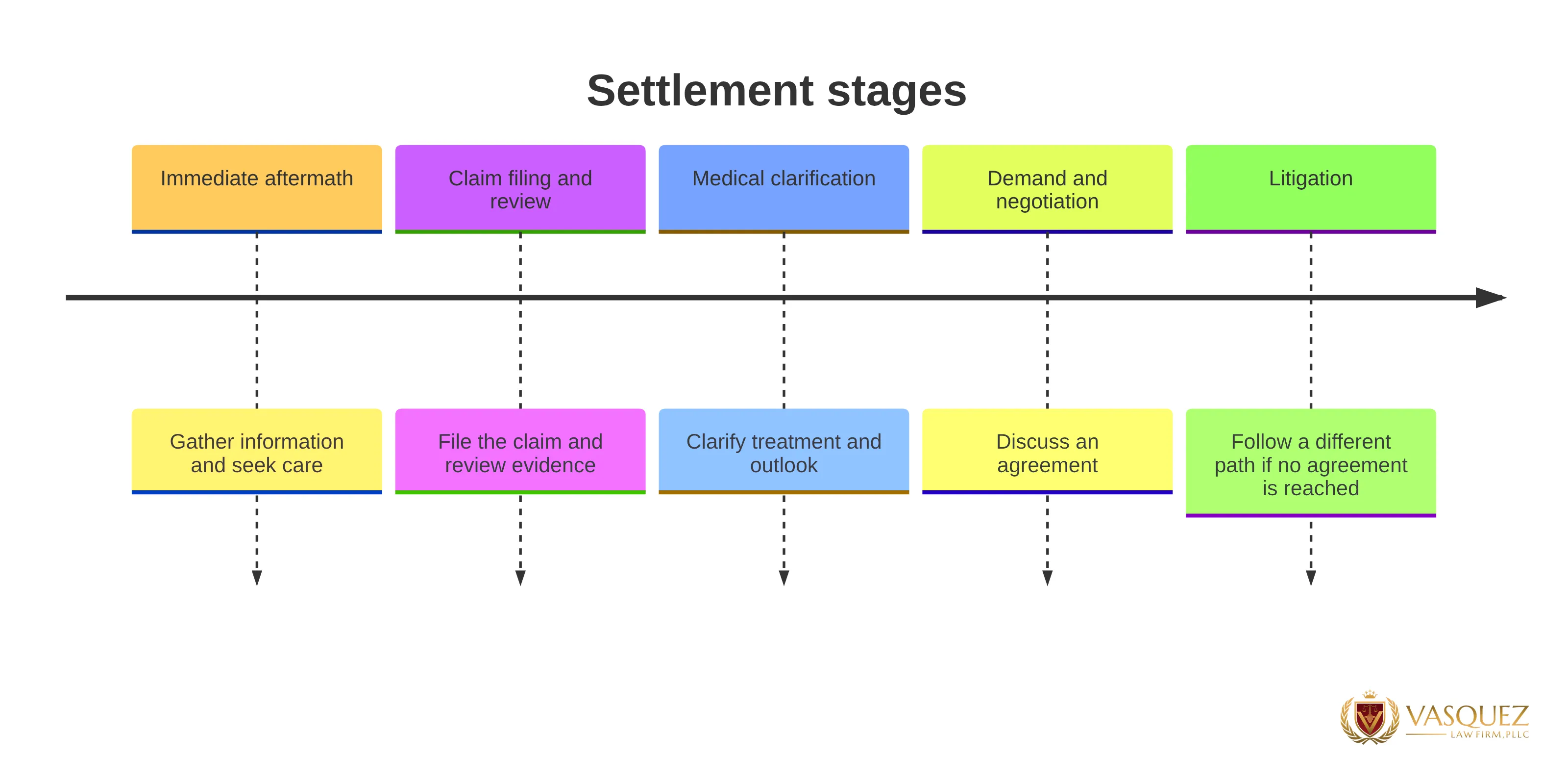
The settlement process usually becomes easier to understand when you separate it into four working stages:
- Immediate aftermath: You gather available information, seek medical care, and notify the insurer. One general timeline places this stage at about 0–2 weeks, but your circumstances may differ.
- Claim filing and review: The claim is filed, and the insurer investigates the accident, evidence, damages, and liability. One general timeline places filing at about 2–4 weeks after the initial investigation and review at about 1–3 months.
- Medical clarification: Treatment and medical evaluations help clarify the injury and its longer-term outlook. This stage may extend the timeline when your condition is still being assessed.
- Demand and negotiation: The parties discuss whether they can reach an agreement. One general timeline places negotiation at about 1–6 months, although it may take more or less time.
These stages can overlap. A claim may return to an earlier question when new medical information appears, an insurer requests more records, or the parties disagree about fault. If no agreement is reached, the claim may move from negotiation to litigation rather than simply continuing on the same schedule.
To place your claim on this timeline, write down the last completed event instead of counting only the days since the accident. Then ask which item is holding the claim in its current stage: medical information, evidence, fault, the identity of a responsible party, an insurer response, or negotiation. That question gives you a more useful next step than a general promise about how long the entire matter should take.
For example, a claim may have been filed but still remain in review because the insurer is assessing liability. Another claim may have completed the review but remain in medical clarification because treatment or the longer-term outlook is still developing. Naming the stage prevents you from treating every delay as the same problem.
Stage 1: Gather information, seek care, and notify the insurer
The immediate aftermath of a car accident begins the information-gathering process. One general timeline places this stage at about 0–2 weeks and includes gathering evidence, seeking medical treatment, and notifying the insurance company.
Your first timing question is not “When will I receive a settlement?” It is “What information and medical evaluation are still needed to understand the claim?” Evidence about the accident can affect the later liability review, while medical care can affect how the injury and its longer-term effects are evaluated. If either area remains unclear, settlement discussions may not be ready for a reliable assessment.
Keep a simple record of what you have done and what remains pending. Note when the insurer was notified, what information was provided, and whether medical providers or other sources still need to supply records or evaluations. The record gives you a concrete basis for follow-up.
The process can slow when the claim is waiting for information from medical providers, police, or experts. If you are still in this first stage, focus on identifying those pending items and keeping track of requests rather than treating the 0–2-week estimate as a deadline.
Stage 2: File the claim and begin the insurer’s review
After the initial investigation, the claim moves toward filing and insurer review. One general timeline places initial claim filing at about 2–4 weeks after the initial investigation. That estimate describes a general sequence, not a required deadline for every claim.
The review stage can include examining evidence, assessing damages, and determining liability. One published timeline places that investigation and evaluation at about 1–3 months. The insurer may need to examine what happened, how the injuries relate to the accident, and who may be responsible before meaningful negotiation can begin.
A claim can remain in review even when you have already submitted information. The remaining question may concern fault, the extent of the injury, the identity of another responsible party, or a record that has not arrived. Ask which question is still open and what event would move the claim forward.
Disagreement about fault and the involvement of multiple potentially responsible parties can delay settlement while liability is investigated. If the insurer has not explained what remains under review, request a clear status update and record the response. If the answer continues to center on a disputed fact, that is a reason to consider whether you need legal help understanding your options.
A useful follow-up separates three questions: what information has been received, what information is still missing, and what decision depends on that information. The answers can show whether the claim is waiting on an outside record, an internal evaluation, or a disagreement that negotiation alone may not resolve.
Stage 3: Let medical treatment clarify the claim’s value
Medical treatment and evaluation may extend the settlement timeline because the full value of an injury claim may not be calculated until your medical condition and longer-term outlook are clearer. A claim involving continuing care cannot always be evaluated in the same way as a claim involving injuries whose effects are already understood.
One selected source identifies maximum medical improvement as a milestone before the full value of a personal-injury claim is calculated and a demand is made. Whether that milestone applies to your claim, and when it occurs, depends on the circumstances. Medical timing can affect negotiations in two ways. The claim may need additional records to describe the treatment already provided, or the parties may need a clearer view of the injury’s longer-term effects before discussing value. Either situation can make the negotiation stage later than the first insurer contact.
While treatment continues, use specific questions to understand the timing:
- What medical information is still needed to evaluate the injury?
- Is the claim waiting for a provider’s record or an evaluation?
- Is the longer-term outlook still being assessed?
- Has the claim reached the point at which a demand can be prepared?
These questions separate a medical-evaluation delay from an insurer communication delay. They also help you avoid judging the claim only by the number of weeks since the accident. The timing of treatment and the timing of negotiation may not match.
Keep treatment information and insurer communications organized together. If a medical provider, police department, or expert has not supplied a needed record, note that specific item rather than describing the entire claim as inactive.
Stage 4: Demand and negotiate toward an agreement
Once the claim has been investigated and the injury information is sufficiently clear for the matter to be evaluated, the parties may move into demand and negotiation. One general timeline places negotiation at about 1–6 months. That range is an estimate; negotiations may take more or less time depending on the claim.
Negotiation is not a single event. It is the period in which the parties consider whether they can resolve the dispute without trial. The time can lengthen when the parties disagree about fault, the injury’s effects, the responsible parties, or the amount that would resolve the claim. A short negotiation period does not guarantee a favorable result, and a longer one does not by itself show that the claim is failing.
Use the negotiation stage to identify the unresolved issue rather than waiting for an unexplained end date. Ask whether the next discussion concerns liability, medical information, damages, or the terms of a possible agreement. If the parties reach an agreement, the dispute is resolved without trial. If they cannot agree, the claim may proceed to litigation, which creates a different timeline.
A negotiation update is more useful when it identifies an event instead of only a future date. Record whether the next event is a response to an offer, delivery of a record, discussion of fault, or decision about further negotiations. If no one can identify the next event, follow up on the missing explanation before assuming that the delay has a predictable end.
What can slow the claim or keep it moving
Several factors can change the pace of a car-accident claim:
- Accident complexity: A minor accident with clear liability may resolve faster. A more complex accident may require a longer investigation.
- Injury severity and treatment: Serious injuries, continuing treatment, medical evaluations, and uncertainty about long-term effects can extend the timeline.
- Fault disputes: Conflicting accounts, reports, or other information can require more investigation before the parties can negotiate from the same set of facts.
- Multiple potentially responsible parties: Identifying and evaluating more than one responsible person or entity can add disagreement and delay.
- Records and evaluations: Waiting for medical providers, police, or experts can slow the claims process.
- Negotiation progress: A claim moves toward resolution when the parties can address the issues separating them. Prolonged disagreement can keep it in negotiation longer.
- Litigation: If negotiation fails, court backlogs can affect the litigation timeline.
These factors do not produce a formula. They help you ask a more precise question: what unresolved issue is controlling the next stage?
A clear-liability claim may move faster, but “clear” depends on the available information and the parties’ positions. Likewise, a delay may reflect a legitimate need for medical or liability information, or it may reflect a dispute that requires attention. Separate the reason for the delay from the fact that time has passed, then choose your follow-up around that reason.
You can also distinguish a missing item from a disagreement about an item. Waiting for a police report is different from disputing what the report means. Waiting for medical records is different from disagreeing about the injury’s effect. That distinction helps you direct your question to the part of the process that is actually slowing the claim.
One way to apply this distinction is to compare the latest communication with the stage it belongs to. If the insurer is waiting for a medical record, the next meaningful event is receipt or review of that record; the issue is an outside information gap. If the record has been received but the parties disagree about what it shows, the issue is evaluation or negotiation. If the insurer has made an offer but has not explained the basis for it, the issue is not simply elapsed time: it is a question about the information or position supporting the offer. These examples do not establish that an insurer acted improperly or indicate what a claim is worth. They show why a useful follow-up asks what decision is pending and what information that decision requires.
A claim can also appear active without moving toward agreement. New requests, repeated exchanges, or continued treatment may show activity while leaving the central dispute unresolved. Conversely, a period with no new message may reflect a pending outside record, but it may also call for a status inquiry. Compare the last completed event with the next expected event, and ask who controls the gap between them. This creates a more specific way to assess progress without converting a general range into a deadline.
When insurer activity warrants careful follow-up
Some legal sources describe low offers and delay tactics as possible pressure tactics. That description does not establish that every insurer or claim involves those practices. It does give you specific activity to track when the process seems stalled.
Follow up carefully when:
- the insurer repeatedly requests information without explaining the decision it needs to make;
- the claim remains unresolved while fault or medical issues are not clearly identified;
- a low offer appears before the injury’s longer-term effects are understood; or
- negotiations continue without a clear explanation of the issue separating the parties.
These signs do not determine whether an insurer acted improperly or what your claim is worth. They show when a general “the claim is still under review” answer may not be enough for you to understand the next step.
Keep a dated record of requests, responses, offers, and unanswered questions. Ask what information is still needed, who is reviewing it, and what event will follow. A follow-up record should distinguish a request you answered from a request that remains unexplained. Preserve the date of each communication and the question it was supposed to resolve. That record can help you explain whether the problem is a missing document, a disputed fact, a low offer, or a negotiation that has stopped moving.
After agreement: paperwork, payment, and the limits of the available timeline
The general ranges above describe the path toward an agreement. They do not give you a universal timeframe for the steps that follow an agreement, including any remaining paperwork or payment process. Treat the post-agreement stage as a separate set of questions rather than assuming that the earlier negotiation range controls it.
Before considering the matter complete, identify what remains to be done:
- What document or action is still required?
- Who must complete or provide it?
- When should you expect the next communication or payment step?
- What event confirms that the settlement process has finished?
The answers depend on the claim and the agreement. If you are unsure whether a proposed resolution addresses the issues in your claim, pause and obtain advice suited to your facts before treating the matter as finished.
Do not use the date of an agreement to answer a question about the date of payment unless the agreement or the responsible party provides that information. The settlement timeline and the post-agreement process are related, but they are not the same stage.
If negotiation fails, litigation adds steps and uncertainty
Litigation can involve additional legal and court-related steps, and its timeline can become significantly longer than a negotiated settlement.
Court backlogs can affect the timing after a claim enters litigation. The length also depends on the issues in dispute and the jurisdiction handling the matter. General settlement ranges cannot predict how long a particular lawsuit will take.
The practical decision point is whether negotiations are still addressing a live issue or whether the parties have reached an impasse. Ask what disagreement remains, whether another negotiation step is planned, and what litigation would mean for your claim. State-specific procedures and deadlines require advice tied to the jurisdiction rather than reliance on a national estimate.
A claim does not become a lawsuit merely because it takes longer than a general estimate. Conversely, a long delay should not be treated as proof that negotiation will eventually succeed. Use the current activity—investigation, medical evaluation, negotiation, or court involvement—to determine which question needs an answer now.
If litigation is being discussed, ask whether the matter has actually entered a court process or remains in pre-suit negotiation. That distinction changes the timing questions you need to ask. A national estimate cannot replace the procedures and deadlines that may apply in the jurisdiction handling your matter.
A practical checklist for checking where the claim stands
Use this checklist to turn a general timeline into a current status check:
- Name the current stage. Decide whether you are gathering information, waiting for the claim review, continuing medical evaluation, negotiating, or dealing with litigation.
- Record the last completed event. Write the date of the last request, submission, medical update, insurer response, offer, or negotiation.
- List what is still pending. Separate missing medical records, police information, expert evaluations, liability information, and responses from the insurer.
- Identify the disputed issue. Note whether the disagreement concerns fault, the number of potentially responsible parties, the injury, damages, or the terms of a possible settlement.
- Check the medical picture. Record whether treatment and evaluation are continuing and whether the longer-term outlook remains under assessment.
- Separate negotiation from litigation. Ask whether the parties are still discussing resolution or whether the matter has entered a court process.
- Write three follow-up questions. Ask what is pending, who controls it, and what event should happen next.
- Mark the point for legal help. Consider a consultation when you cannot identify the delay, fault is disputed, the insurer’s activity concerns you, or negotiations have stopped moving.
The checklist does not calculate the value of your claim or predict its result. It gives you a short record of the facts and timing questions to take into a follow-up conversation.
Use the completed checklist in order, beginning with the last event rather than the accident date alone. If the last event was a records request, identify the record and the person or organization expected to provide it. If the last event was an offer, identify whether the next issue is the amount, liability, medical information, or another term.
If you cannot place the claim in one of the stages, write down the last clear communication and the unanswered question. Early legal advice may help when the claim’s status, the insurer’s activity, or the effect of a disputed fact is difficult to interpret.
When early legal help may be useful
Early legal help may be useful when the claim involves a disputed version of the accident, multiple potentially responsible parties, serious or continuing injuries, missing records, unclear insurer activity, or negotiations that are not producing a clear next step. These circumstances can affect the timeline and the questions you need answered.
That recommendation does not promise a particular settlement time or outcome. It identifies a point at which claim-specific guidance may be more useful than a general timeline.
Timing alone is not the only reason to seek help. The nature of the unresolved issue matters more than a calendar number. A shorter claim with disputed fault may need focused attention, while a longer claim may be moving normally because medical evaluation is still underway.
Before seeking help, organize the information you already have:
- the accident date and a short description of what happened;
- the current medical-treatment status;
- communications and requests from the insurer;
- any disagreement about fault or other responsible parties; and
- the last event in the claim process.
This information helps you explain whether you need help understanding an early investigation, an insurer review, a medical-value question, negotiation, or a possible move toward litigation. It also gives you a focused way to describe what has already happened instead of asking only for a prediction about the total timeline.
How a personal-injury lawyer may support the claims process
For a car-accident injury claim, we can investigate the accident scene, gather evidence, handle communications with insurance companies, and negotiate for a fair settlement. We can also handle communications and negotiations with the at-fault party’s insurance company after a car accident.
Those services correspond to several points in the timeline: information gathering after the accident, communication during insurer review, and negotiation after the claim is evaluated. They do not create a fixed settlement schedule. The timing still depends on the accident, the injuries, the parties involved, and how the claim progresses.
If you are deciding whether to seek this type of support, describe the stage you are in and the issue holding the claim there. We recommend early legal advice to help protect your options after a car accident, particularly when you do not know whether the next step is more investigation, continued treatment, negotiation, or litigation.
A useful discussion can begin with the timeline record from the checklist. Bring the last communication, the pending request, the medical-status question, or the negotiation issue that is keeping you from identifying the next event. That keeps the conversation focused on the claim’s current position rather than on an unsupported promise about its eventual result.
Use the claim’s current stage to choose your next step
A car-accident settlement timeline is easier to assess when you identify the stage instead of waiting for one universal number. Gather the available information and track medical care at the beginning. During review, find out whether the open question concerns evidence, damages, or liability. During negotiation, identify what separates the parties. If no agreement is possible, recognize that litigation follows a different and potentially longer path.
Use the checklist to record what happened last, what remains pending, and what question needs an answer. A qualified professional must decide whether legal advice or representation fits your facts and jurisdiction. We can investigate the accident scene, gather evidence, communicate with insurers, and negotiate for a fair settlement as part of the support we offer for car-accident injury claims.
Sources
- Insurance Company Tactics To Deny And Devalue Injury Claims — www.richardsonlawfirmpc.com
- Car Accident Settlement Process and Timeline - FindLaw — www.findlaw.com, 2017-03-23
- Understanding Delays in Car Accident Settlements | Stuart M. Kerner P.C. — yourbronxlawyers.com
- Why Is My Car Accident Settlement Taking So Long? — naqvilaw.com
- Personal Injury Case Timeline: What to Expect From Start to Settlement — nicoletlaw.com
- How Long Does a Car Accident Settlement Take? | M&N Law — m-n-law.com
- 7 Steps You Must Take at a Car Accident Scene in 2026 | Vasquez Law Firm