
Start with the decision a hit-and-run creates
A hit-and-run creates more than one legal question at the same time. You may need to deal with immediate safety, an injury or damaged vehicle, an insurance claim, information that could help identify the other vehicle, and the possibility that law enforcement will examine what happened. A hit-and-run generally involves a driver leaving a crash without stopping to provide contact information or assist injured people.
The first decision is not whether you have a winning claim. The first decision is which problem requires attention now. Safety and reporting come before evaluating compensation. Information preservation comes before trying to reconstruct every legal consequence. If a traffic or criminal allegation may involve your own conduct, that question must be kept separate from your effort to address damage or injury.
North Carolina’s framework makes the reporting question fact-dependent. The state’s crash-report instructions list a fatality, a nonfatal personal injury, at least $1,000 in total property damage, or any property damage to a seized vehicle as reportable-crash criteria, subject to stated trafficway and stabilization conditions. For a reportable accident, North Carolina law requires the driver involved to notify the appropriate law-enforcement agency immediately by the quickest available means.
This guide gives you a practical order for handling those questions without deciding liability, coverage, deadlines, damages, or defense strategy.
Understand what a hit-and-run means in practical terms
A hit-and-run is a crash followed by a driver leaving without stopping to provide contact information or assist injured people. The label describes the departure from the scene; it does not, by itself, answer who caused the collision, whether you can recover money, what insurance may apply, or whether anyone will face a traffic or criminal allegation.
You may be dealing with a hit-and-run even when the damage appears minor at first. You may also have uncertainty about whether the other vehicle made contact, whether a witness saw the full event, or whether the departing driver can be identified. Those facts affect the questions you should ask next, but they do not let a general guide decide your case.
The practical meaning changes depending on your position in the incident. If another driver left after striking your vehicle, your immediate concerns may include reporting, documenting the available information, and understanding insurance options. If someone alleges that you left or failed to report a crash, the focus may include your conduct, what you knew, the condition of the scene, and any communication with law enforcement.
North Carolina’s reporting rule applies to a driver involved in a reportable accident, not only to a driver who believes another person was at fault. That is why you should avoid treating the words “hit-and-run” as a complete legal conclusion. Record what happened in plain language, identify the questions that remain open, and separate your own account from assumptions about the other driver.
The source does not resolve the facts of your incident.
Your useful next step is to identify which facts are known, which facts are disputed, and which facts may be documented by someone else. That simple separation helps keep an insurance conversation from becoming a substitute for a response to possible traffic or criminal exposure.
Protect people and the scene before evaluating legal options
Safety at the accident scene comes before legal analysis. The North Carolina Department of Insurance advises you to stop in a safe place and move the vehicle if necessary to prevent further damage or keep traffic from being blocked.
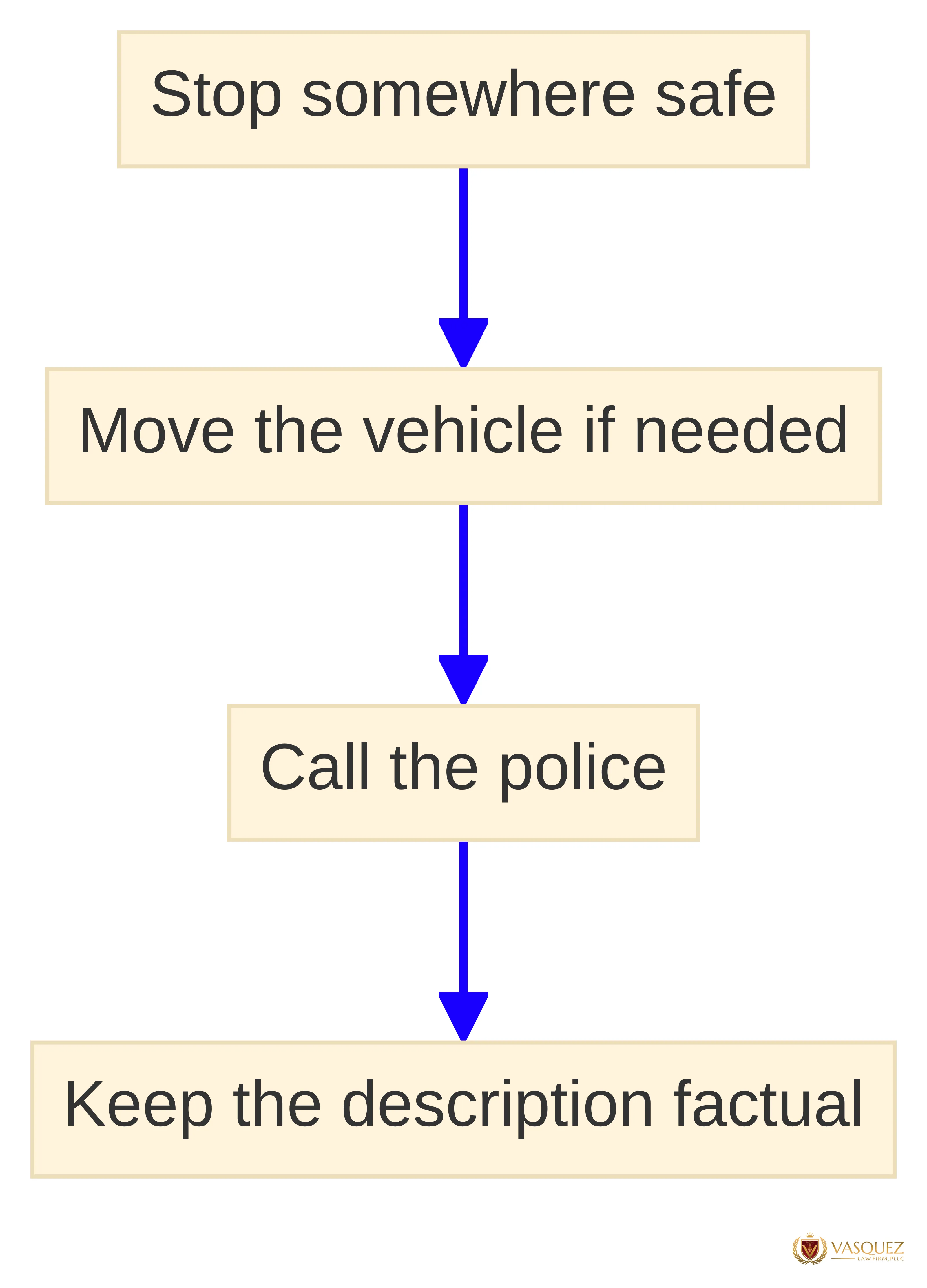
Use that guidance as a sequence:
- Stop somewhere safe.
- Move the vehicle if leaving it in place could cause further damage or block traffic.
- Call the police, particularly when the crash involves injuries or a hit-and-run.
- Keep your description of events factual and separate from guesses about fault.
The sequence matters because a safe location gives you a better setting for communicating with law enforcement and preserving information.
Police notification is a specific North Carolina Department of Insurance recommendation for accidents involving injuries or a hit-and-run. It is not a substitute for the separate statutory question of whether the crash was reportable under North Carolina law. The reportable-crash criteria and the notice requirement should be considered together, not treated as interchangeable rules.
If you are still at the scene, explain that the other driver left and provide the information you have. If you are no longer at the scene, preserve the account you gave, the time you made the report, and any report information you received. Keep the description accurate. Do not fill gaps with certainty.
The location of the crash can affect which law-enforcement agency receives notice. North Carolina law generally identifies the city or town police department when an accident occurs in a city or town, and the State Highway Patrol, sheriff’s office, or another qualified rural police agency when it occurs outside one.
The Department of Insurance separately advises calling the police after an injury or hit-and-run. You do not need to decide the final legal characterization before making a factual report.
Report the accident and understand North Carolina’s reportable-crash framework
North Carolina’s reportable-crash framework starts with the kind of harm or damage involved. The North Carolina DMV crash-report manual lists these criteria:
- A fatality.
- A nonfatal personal injury.
- At least $1,000 in total property damage.
- Any amount of property damage to a vehicle that has been seized.
The manual also states that the crash must occur on a trafficway, or after the vehicle runs off the roadway but before events are stabilized, for the reportable-crash framework to apply. These are reporting criteria, not a decision about fault or the value of an injury claim.
North Carolina law requires a driver involved in a reportable accident to notify the appropriate law-enforcement agency immediately by the quickest available means. In a city or town, the statute generally points to the local police department. Outside a city or town, it generally points to the State Highway Patrol, sheriff’s office, or another qualified rural police agency.
The word “immediately” makes timing part of the reporting question. A delayed report may raise questions that a general article cannot answer, including what happened, what you knew, why the delay occurred, and whether the crash met the reportable criteria. If those questions concern your conduct, seek individualized legal guidance rather than relying on a general timeline.
The $1,000 property-damage threshold is not a universal answer for every crash. The North Carolina DMV manual describes it as total property damage and places it alongside the other reportable-crash criteria and conditions. You should not assume that an initial repair estimate, a visible scratch, or your first impression settles whether the crash is reportable.
Write down what you know about the damage and preserve documents you already receive. If the vehicle is later inspected or repaired, keep the estimates, invoices, and communications together. Those materials can help distinguish what was visible at the scene from what was determined later, without requiring you to make a legal conclusion.
A police report and a legal consultation serve different purposes. Calling the police addresses the immediate reporting and investigation process, while an attorney discussion can help you evaluate how the facts may affect injury, property-damage, insurance, traffic, or criminal questions. The North Carolina Department of Insurance specifically advises calling the police when an accident involves injuries or a hit-and-run.
Do not wait for an insurance conversation to replace the required or recommended report. Do not assume that filing a report decides who is liable. Preserve the report number or other identifying information you receive, then use it as one part of a fuller account.
Preserve information that may explain the crash or identify the vehicle
Information from the scene can matter even when the other driver is not identified immediately. The North Carolina Department of Insurance advises collecting the other driver’s name, address, phone number, license plate number, driver’s-license number, insurer, and policy number when available.
In a hit-and-run, you may have only part of that list. Preserve every identifying detail you already have instead of discarding it because it feels incomplete. Keep the exact spelling, numbers, descriptions, and wording available to you. Do not convert an uncertain observation into a definite identification.
Witness information can provide another account of what happened. The North Carolina Department of Insurance advises obtaining witnesses’ names, addresses, and telephone numbers after an accident.
Create a simple witness list with the information you have. Include people who saw the collision, saw the other vehicle leave, or arrived close enough to describe the scene. Label your own recollection separately from a witness’s account. That distinction helps you present information clearly without claiming that a witness observed more than the witness actually observed.
A useful incident file contains the materials that already exist about the crash. Place the following items together:
- The law-enforcement report number or reporting information.
- Names and contact details for witnesses.
- Any identifying information about the other vehicle or driver.
- Insurance communications, forms, and policy materials available to you.
- Repair estimates, invoices, and records describing damage.
- A dated account of what you remember and what remains uncertain.
The crash-report manual treats injury and property damage as part of the reportable-crash framework, while the Department of Insurance identifies witness and insurance information as useful post-accident material. Keep the file organized; do not edit original communications or rewrite records to make them sound more certain. An effective way to organize it is to mark each item by source: your own observation, a witness account, an insurer communication, a repair record, or a law-enforcement record. Also note when you received or created it. This does not prove what happened, but it makes the gaps easier to identify. For example, a witness contact and a repair estimate answer different questions; keeping them together preserves the connection without treating either one as a complete account of the crash. Leave original files unchanged and place explanations in separate notes.
Preserving information does not require you to prove the other driver’s fault. It means keeping available facts in a form that you can explain later. The Department of Insurance warns against agreeing to forget an accident because hidden damage, unknown injuries, or later litigation may arise.
You can respond to that concern without making a claim about the final outcome: keep records, avoid casual agreements that erase the event, and ask focused questions when an insurer or another person asks you to close the matter.
Do not close the matter before injuries or damage are clear
Injuries and vehicle damage may not be fully clear during the first conversation after a crash. That warning does not establish that you have an injury claim or predict what a claim is worth. It gives you a practical boundary: do not treat a quick conversation, an early estimate, or an initial absence of symptoms as a complete resolution. Keep the incident information and communications together while the facts develop.
A premature agreement can make later questions harder to evaluate. Before you agree that the matter is finished, identify what has actually been addressed:
- Whether the vehicle damage has been inspected.
- Whether any injury concerns have been documented.
- Whether the crash was reported and whether you have the report information.
- Whether the insurance process has been explained to you.
- Whether you understand what a proposed payment or statement would resolve.
The Department of Insurance’s caution supports preserving the matter rather than making an uninformed agreement. An attorney can evaluate the effect of a specific document or communication only after reviewing its terms and the facts.
Your first impression is not the same as a legal assessment. A damaged vehicle may need an inspection, and an injury question may require information that is not available at the scene. The Department of Insurance also advises contacting your insurance agent with questions or concerns about the claims process because the agent may help with required forms and documents.
Keep that insurance contact separate from a decision about whether you need legal guidance. An agent can be a source of claims-process information; an attorney discussion addresses legal questions that depend on the incident’s facts.
Separate compensation and insurance questions from traffic or criminal exposure
A hit-and-run can place two different tracks in front of you. The first track concerns injury, vehicle damage, insurance, and possible compensation. The second concerns whether anyone may face a traffic or criminal allegation based on leaving, failing to report, or another part of the incident. Those tracks can overlap, but one does not answer the other. A damaged vehicle does not establish who is legally responsible. An insurance claim does not resolve a potential allegation about conduct at the scene. A police report does not determine the value of an injury or property-damage claim. Keeping the tracks separate also helps define the materials for the next conversation. A claim-related question may call for damage records, injury information, policy materials, or claim communications. A conduct-related question may call for the chronology of your actions, the report made, and communications with law enforcement. These categories can overlap because they arise from the same event, but they should not be collapsed into one conclusion. Organizing them separately lets you explain what each document is meant to show and which question remains unresolved.
Insurance questions usually require you to identify the policy, the claim process, and the information the insurer is requesting. The North Carolina Department of Insurance advises contacting your insurance agent with questions or concerns about the claims process, and the agent may help with required forms and documents.
We recommend reviewing your insurance policy or consulting an attorney to understand your options after a crash involving an uninsured driver. That recommendation does not establish that a particular coverage applies. The policy language, the facts, and the applicable law must be evaluated together.
Traffic or criminal exposure raises different questions from compensation. North Carolina’s reporting framework asks whether the crash met stated criteria and requires immediate notice for a reportable accident. The DMV manual identifies injury, fatality, specified property damage, and stated roadway conditions as part of that framework.
If your own actions are being questioned, do not assume that an insurance statement is the right place to explain every legal issue. Separate the materials and conversations: keep claim documents in one group, law-enforcement communications in another, and obtain individualized guidance before making conclusions about your obligations or possible defenses.
An attorney may be contacted for different reasons depending on which track is causing the uncertainty. You may want help understanding insurance options after an unidentified or uninsured driver leaves. You may also need help separating your right to pursue a claim from a question about whether law enforcement could view your conduct as a violation. We consider contacting a personal-injury attorney as soon as possible important for protecting legal rights and navigating the claims process after a crash.
That contact does not promise compensation, representation, or a favorable result. It creates an opportunity to discuss the facts before you treat an unresolved question as settled.
Identify the circumstances that may justify contacting an attorney
The need for an attorney depends on the facts and the consequences you may face. Contacting an attorney may be a reasonable next step when:
- You have an injury or substantial vehicle damage and the other driver has not been identified.
- You are trying to understand whether your own insurance policy may respond to the loss.
- An insurer is asking for information you do not understand or is disputing an aspect of the claim.
- The crash may have involved a reportable injury or property-damage threshold.
- Someone is questioning whether you stopped, reported, or otherwise complied with an obligation after the crash.
- The facts are disputed, or you do not know which account of the incident is accurate.
The Department of Insurance separately advises contacting an insurance agent about claims-process questions and required forms.
The seriousness of a potential outcome is one reason to avoid waiting for perfect certainty. An unidentified driver, unclear insurance coverage, physical injury, significant damage, or a disputed account can make the next step harder to identify. Timely contact does not mean you have decided to file a lawsuit or that an attorney will accept the matter. It means you can present the facts while records, communications, and questions are still identifiable.
The type of uncertainty should guide the type of conversation. Ask an insurance agent about the mechanics of submitting forms and documents when your question is about the claims process. Seek legal guidance when the question involves potential responsibility, a disputed account, a reportable crash, possible traffic or criminal exposure, or the meaning of a proposed agreement.
North Carolina’s immediate-notice rule applies to a driver involved in a reportable accident. If that rule may concern your own conduct, do not use a general checklist as a substitute for advice based on your facts.
Your decision to contact an attorney does not require you to know the legal label for the incident. You can begin with a factual description: where the crash occurred, what you remember, what the other driver did, what information you preserved, whether the crash was reported, and what communications followed. Keep the purpose of the conversation clear. You are asking for individualized guidance, not asking a general article to decide liability, coverage, damages, deadlines, or strategy.
Use the right insurance and communication next step
An unidentified or uninsured driver creates a policy question, not an automatic coverage answer. The policy language and incident facts determine what can be evaluated.
You may also contact your agent about the claims process, required documents, or forms. Keep the two questions distinct: “How do I submit this information?” is different from “What legal options or coverage may apply?”
Your communications should remain accurate and measured. You can say that you are preserving the information and evaluating the matter without accusing anyone or promising an outcome. Do not guess about the other driver’s identity, the value of damage, or the cause of an injury. Mark uncertainty clearly and correct factual mistakes when you discover them. Keep a simple communication log with the date, the person or organization contacted, the subject, documents requested, and what you provided. This log is not a substitute for the original messages. It gives you a neutral index for locating them and helps distinguish a request for claim-processing information from a question about responsibility, coverage, or potential exposure. If a later conversation raises a different issue, you can identify what was already said without assuming that an earlier statement resolved the new question.
The right communication path depends on the problem in front of you. Use the insurance-agent route for questions about forms and claims-process steps. Use an attorney discussion for disputed facts, potential responsibility, injury or property-damage options, unclear policy questions, or possible traffic or criminal consequences. The Department of Insurance and Vasquez Law Firm support these separate next steps for their respective concerns.
Do not treat contacting one professional as a conclusion about the other issue. You may need both kinds of information.
Know what general information cannot decide
General information cannot decide whether your crash was reportable without the facts required by North Carolina’s framework. The state’s DMV manual lists fatality, nonfatal injury, at least $1,000 in total property damage, or any damage to a seized vehicle, along with stated trafficway and stabilization conditions. North Carolina law then requires immediate notice by the quickest available means for a driver involved in a reportable accident.
A general checklist cannot determine how those criteria apply to your incident. It also cannot decide whether a delay, disputed account, or incomplete report changes your legal position.
General information cannot determine liability, compensation, insurance coverage, deadlines, damages, or defense strategy. A hit-and-run description explains what the term generally means, but it does not establish who caused the collision or what remedy is available. Those statements identify reasons to obtain case-specific guidance, not a predicted result.
General information cannot replace the documents and facts in your own file. The Department of Insurance advises preserving witness and insurance information, contacting an agent about claims-process questions, and not agreeing to forget an accident when hidden damage, unknown injuries, or later litigation may arise.
Use a general guide to organize your questions. Use the actual report, policy, communications, repair records, and witness information to frame the next conversation.
Prepare the facts for a focused attorney discussion
A focused attorney discussion starts with a clear chronology. Prepare a short account using the facts you know and label uncertainty instead of filling gaps. Include:
- When and where the crash occurred.
- What you observed about the other vehicle and its departure.
- Whether anyone was injured or whether property damage was visible.
- When and how the crash was reported.
- The law-enforcement agency contacted and any report information received.
- Witness names and contact details.
- Insurance information, claim communications, and documents requested.
- Any statement, payment proposal, or request that you agree to close the matter.
The reporting obligation, witness information, insurance materials, and warning against forgetting the accident are all identified in North Carolina materials.
Your document packet should separate original records from your own notes. Keep the police-report information, witness contacts, insurance communications, policy materials available to you, repair estimates, invoices, and injury-related records in one place. The North Carolina Department of Insurance identifies witness and insurance information as useful after an accident, and the DMV manual identifies injury and property damage as part of the crash-reporting framework.
Do not discard a document because it seems unfavorable or incomplete. Do not alter an original communication. Add a separate note explaining what you think it means and what you want to ask.
Your questions should match the uncertainty you need to resolve. You might ask:
- What facts matter to the injury or property-damage question?
- What insurance information should be reviewed?
- Does the reporting history raise a separate issue?
- What should you do with a request for a statement or agreement?
- Which records or witness accounts should be preserved?
- Is the issue primarily a claim, a possible traffic or criminal matter, or both?
We recommend reviewing your policy or consulting an attorney after a crash involving an uninsured driver, and we consider prompt attorney contact important for protecting rights and navigating the claims process. The Department of Insurance also advises contacting an insurance agent about claims-process questions and required documents.
A good initial discussion does not require a perfect file. Start with the chronology, identify what you have, and say what you do not know. The purpose of preparation is clarity. It is not to prove the case before anyone reviews it or to decide the legal result on your own.
Choose your next step based on the legal fork
Your next step should follow the unresolved question. If the crash is still an immediate safety or reporting matter, move to safety and contact the appropriate law-enforcement agency as required or directed. If the concern is documentation, preserve the report information, witness contacts, insurance materials, and damage records. If the concern is a claim, policy question, disputed account, injury, vehicle damage, or possible traffic or criminal exposure, prepare the facts for individualized legal guidance. North Carolina’s reporting rules, the Department of Insurance checklist, and our guidance on prompt attorney contact support keeping these decisions separate.
A qualified attorney must evaluate your individual situation, including the facts, documents, applicable law, and any communications already made. No general article can decide liability, coverage, deadlines, damages, or defense strategy for you. Use the decision fork to identify the question that needs attention, then take the next step that addresses that question.
What should I gather before contacting a hit-and-run accident attorney?
What should I do immediately after a hit-and-run accident?
First, ensure safety by moving to a safe location if necessary. Document the scene by collecting information about the other vehicle, witnesses, and any available evidence.
How do I report a hit-and-run accident in North Carolina?
In North Carolina, you must notify the appropriate law enforcement agency immediately after a reportable accident. This typically involves calling the local police department if the accident occurred in a city or town, or the State Highway Patrol or sheriff's office if it occurred outside of one.
What information should I collect after a hit-and-run accident?
You should gather the other driver's name, contact information, license plate number, driver's license number, and insurance details if available. Additionally, collect names and contact information of any witnesses.
When should I consider contacting a hit-and-run accident attorney?
Consider contacting an attorney if you have injuries or significant vehicle damage, if the other driver is unidentified, or if there are disputes regarding the accident details or insurance claims.
How can I preserve evidence after a hit-and-run accident?
Preserve evidence by documenting the scene with photos, keeping a record of your account of the incident, and maintaining any communications with witnesses or law enforcement.
Sources
- Charlotte Hit-and-Run Car Accident Lawyer- 24/7 Assistance — bpcounsel.com
- 20‑166.1. Reports and investigations required in event of ... — www.ncleg.gov
- North Carolina Crash Report Instruction Manual — connect.ncdot.gov
- After an Accident | NC DOI — www.ncdoi.gov