

Start by separating general information from case-specific guidance
Choosing whether to contact an immigration lawyer starts with a simple distinction: general information can help you prepare, but it cannot decide what applies to your circumstances. Your immigration history, current status, entries and exits, family or employment information, prior filings, notices, and documents may change the questions that need attention. Use general information to organize those facts and identify what you need to ask.
A consultation may make sense when you need help understanding which green card pathway to discuss, what information belongs in that discussion, or how to approach a filing responsibility. You do not need to arrive with a perfect explanation. You do need to describe the facts as accurately as you can, separate what you know from what you are unsure about, and avoid treating a general article as an eligibility decision.
This guide gives you a decision path for seeking legal help. It does not determine whether you qualify, tell you which filing strategy to use, predict approval, set a fee, or supply a case deadline. The practical goal is narrower: help you decide whether to make an inquiry and help you use your first conversation well.
You can begin with three questions: What do you want to discuss? Which facts or documents relate to it? What do you need someone to explain before you take another step? If you can answer those questions in plain language, you have a useful starting point even if you do not know the name of the possible immigration category.
Overview
A green card legal-help decision becomes easier when you work through the issue in a deliberate order. Start with the kind of help you need, then prepare facts and questions before choosing how to contact a firm. The purpose of this order is to keep preparation separate from a legal conclusion.
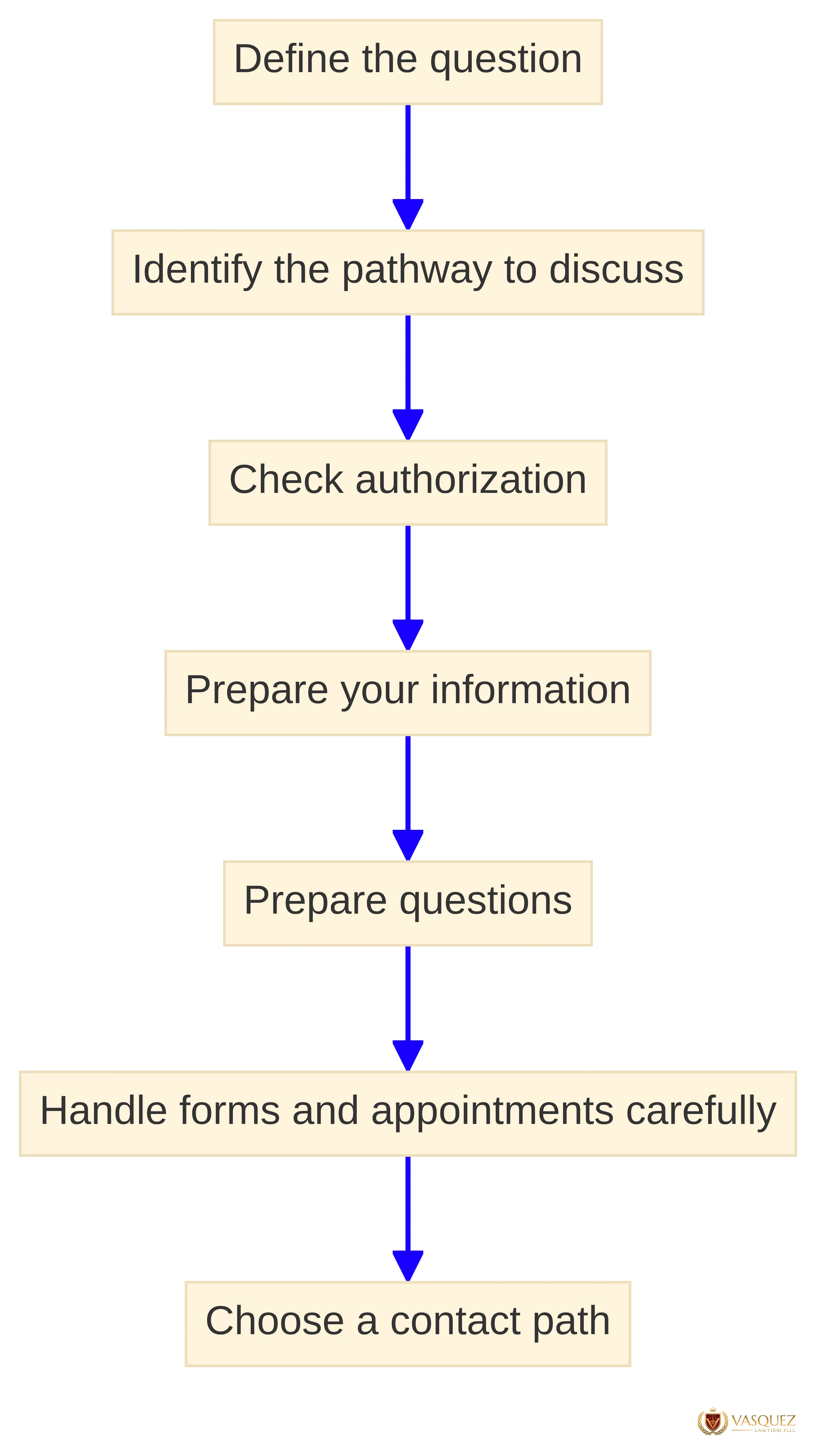
Use this sequence:
- Define the question. Decide whether you need general information, help organizing a matter, or advice about facts that only a professional can assess.
- Identify the pathway to discuss. USCIS groups green card eligibility into categories, so the facts behind your possible category matter.
- Prepare your information. Gather a clear timeline, relevant notices, filing history, family or employment details that relate to the matter, and your language needs.
- Prepare questions. Ask what the consultation can address, what information is missing, and what responsibilities would follow from any filing.
- Handle forms and appointments carefully. If Form I-485 and biometrics become part of your matter, accuracy and attendance carry specific responsibilities described by USCIS.
- Choose a contact path. Submit a focused inquiry that tells the firm what you need to discuss rather than attempting to resolve every legal issue in the first message.
This order keeps two decisions separate. First, decide whether professional help would make the next step clearer. Second, decide whether the available contact path gives you a practical way to ask for that help. Neither decision requires you to promise that you qualify or that a particular result will follow.
Before sending an inquiry, review your preparation for four basic qualities:
- Specific: Your message identifies the green card issue rather than saying only that you need immigration help.
- Accurate: Dates, names, and events are presented as you remember them, with uncertainty marked clearly.
- Focused: The main question is easy to find, even if your history includes other concerns.
- Usable: The firm can see how to contact you and what communication support you may need.
A focused inquiry is not a substitute for case review. It is simply a way to begin a conversation with enough context for the next question to be clear.
What a green card lawyer may help you clarify
A green card lawyer may help you turn a broad concern into a set of case-specific questions. You can use a first conversation to ask what facts matter, which documents need attention, and what you should understand before taking a filing step. Frame these as questions about your circumstances, not as assumptions that a particular application is available.
The conversation may be organized around several topics:
- The possible basis for the matter. Ask which facts the lawyer needs in order to discuss the green card category that may relate to you.
- Your history. Ask how prior immigration filings, entries, departures, notices, or other events should be described and what records may help explain them.
- The paperwork under discussion. Ask which forms or supporting materials are relevant to the next conversation, rather than collecting every document without a plan.
- Uncertainty in your account. Ask how to handle a date, name, status, or event that you cannot confirm. A clear statement that you are unsure is more useful than a confident guess.
- Your responsibilities. Ask what you would need to review, sign, attend, or report if you proceed with a filing or appointment.
- Communication. Ask how to raise language needs, accessibility needs, or a preference for written explanations.
You can make the discussion more productive by bringing a short summary instead of sending a long, unstructured story. Put the main question at the top, list the dates you know, identify the records you have, and mark the points that need clarification. Keep copies of the summary for your own reference, and do not alter a document merely to make the timeline look cleaner.
A lawyer cannot responsibly assess your individual situation from a keyword, a single document, or a short description that leaves out material history. If your first inquiry is brief, use it to identify the subject of the matter and request a conversation. Save the detailed explanation for the process the firm uses to gather and evaluate your information.
The first conversation can also help you identify the next information you need to locate. For example, you may learn that a date needs supporting records, that two documents describe the same event differently, or that a question cannot be answered until your prior filing history is reviewed. Write down those follow-up items instead of trying to resolve them from memory.
Why the relevant green card pathway matters
The relevant green card pathway matters because the facts that support one USCIS category may not be the facts that matter in another. Before you choose documents or describe your goal, identify the possible basis you want to discuss and keep that basis separate from a conclusion that you are eligible.
USCIS publishes green card eligibility categories. Its listed categories include certain people paroled into the United States as Lautenberg parolees and a category for certain people born in Canada who have at least 50% American Indian blood and maintain their principal residence in the United States. Those examples show why a personal fact can matter: a category may depend on a particular history, document, or condition. They do not establish that either category applies to you.
Use the possible pathway as an organizing question:
- What fact makes you think this pathway may relate to you?
- What document or record supports that fact?
- What part of your history remains unclear?
- What question do you need a lawyer to answer before you take the next step?
If you do not know the category name, describe the event or relationship that led you to seek a green card. A plain description is enough to begin the inquiry; guessing a legal label can create confusion.
Do not select a pathway because its name sounds familiar or because another person's case followed it. Similar goals can arise from different histories, and a general category description cannot account for every fact in your situation. Bring the underlying facts to the consultation and let the case-specific discussion address what they mean.
Organize records around facts rather than around a category name you have chosen yourself. A notice, identity document, travel record, family document, or prior application may help explain your history, but its relevance depends on the question being examined. Label what the document appears to show and separately note what you still need explained.
Verify who is authorized to give immigration advice
Authorized help is a separate question from legal knowledge. Before you rely on advice about your immigration matter, identify who is giving it and whether that person has the authorization described by USCIS.
USCIS provides resources about immigration scams. Review those resources when deciding whom to contact.
When you begin a conversation, ask clear identification questions:
- Who will provide the immigration legal advice?
- Is that person an attorney or an accredited representative?
- If the person is an accredited representative, does the representative work for a DOJ-recognized organization?
- How should you send documents and explain sensitive facts?
- What should you do if someone offers a conclusion without asking about your history?
These questions do not decide whether the advice is correct. They help you distinguish a lawful source of immigration legal advice from a person who may only be offering general information.
Do not improve your chances by leaving out an inconvenient event or changing a date. Give an authorized professional a complete and accurate account so the issue can be addressed directly.
Keep the name and role of the person you speak with in your notes, along with the questions you asked and the answers you received. If more than one person communicates with you, record who explained the legal issue and who handled administrative communication. Clear notes help you avoid confusing general information with advice about your circumstances.
Prepare your circumstances, documents, and language needs
Your circumstances, documents, and language needs form the working material for an initial inquiry. You do not need to send every paper you own at once, but you should be ready to explain the facts that led you to seek help and identify the records you already have.
Prepare a short fact sheet with these headings:
- Your goal: Explain that you want to discuss a green card matter and state the question that brought you to the firm.
- Your timeline: List the dates and places you know for entries, departures, filings, notices, marriages or family events, employment events, or other facts that relate to your question.
- Your records: Note which identity documents, immigration records, notices, prior applications, translations, or other papers you have. Do not label a document as sufficient merely because it appears relevant.
- Uncertainty: Mark missing dates, inconsistent spellings, lost records, and events you remember only generally.
- Contact preferences: State the language in which you communicate most comfortably and whether you need an interpreter, translated explanation, accessible format, or a particular method of contact.
A preparation list is not a filing checklist. Its immediate use is to help you answer questions consistently and show what still needs attention. Keep the original condition of each record, make a note when a copy is incomplete or difficult to read, and do not create a replacement explanation that makes an uncertain fact appear settled.
Language needs belong in the first inquiry, not as an afterthought. You can write your main question in the language you understand best, ask what language options are available for the conversation, and identify any term that needs plain-language explanation. If a family member helps you communicate, say that clearly and make sure you understand what you are being asked to confirm or sign.
Keep the first summary focused. A useful opening might identify your location, the green card issue you want to discuss, the main dates involved, and the specific question you want answered. Add sensitive details that could change the discussion, but avoid sending unrelated legal problems that make the central issue harder to identify.
Use a simple preparation file with separate sections for your timeline, notices, prior filings, identity records, family or employment records, and questions. Add a short note whenever a record is missing or difficult to read. The file is a communication aid: it helps you locate facts and explain gaps without turning your own organization into a conclusion about the case.
Questions to bring to a green card consultation
Questions to bring to a green card consultation should help you understand the next conversation, not force a conclusion before your facts are reviewed. Write them down in advance so uncertainty, language needs, and practical responsibilities are addressed rather than forgotten.
Use questions such as these:
- Which facts in my history should we discuss first?
- Which possible green card category should we examine, and what makes that category relevant to my facts?
- What information is missing before you can discuss my situation more specifically?
- Which records would help explain the dates, names, status, or events I described?
- Are there inconsistencies in my account that I should explain directly?
- Which forms or notices should I bring to the conversation?
- What should I understand before I sign or submit anything?
- If a biometrics appointment becomes part of the process, what responsibility would I have for attending and reviewing my information?
- How should I handle a document that is missing, unclear, or not in English?
- What language or communication arrangements should I request?
- What is the next question you need me to answer?
Separate questions about the law from questions about the working relationship. Legal questions address the facts, category, paperwork, and responsibilities in your matter. Practical questions address how to communicate, how to send records, who will explain the next step, and what information the firm needs before it can discuss your situation. Keeping those groups separate makes it easier to notice an unanswered legal issue.
After the conversation, write down the answers in plain language and mark anything you still do not understand. Do not treat a general explanation as a personal conclusion if the lawyer said more facts or records are needed. Your notes should help you remember what was discussed and what question remains open.
If you have many questions, put the ones that could change the direction of the discussion first. Start with your history, the possible basis for the matter, prior filings or notices, and any fact you are worried about leaving out. Move administrative questions about communication and document delivery to a separate list so neither group disappears.
Review form accuracy and appointment responsibilities carefully
Form accuracy and appointment responsibilities deserve separate attention because signing an immigration form and attending a required appointment are actions tied to your own information. If Form I-485 becomes part of your matter, read the applicable instructions and ask about any point you cannot understand or answer accurately.
USCIS says that a Form I-485 applicant attending a biometrics appointment must sign an oath affirming that the applicant authorized the information, reviewed and understood the information submitted with the application, and provided information that was complete, true, and correct at the time of filing. Treat that as a review responsibility, not as a reason to guess at an answer or copy an old answer without checking whether it remains accurate.
USCIS warns that missing a required biometrics appointment can result in denial of the Form I-485 application. For applicants and dependents appearing before an immigration judge, missing the appointment without good cause may also result in an abandonment finding and denial of other USCIS applications. If an appointment is scheduled, read the notice, record the date, and raise any conflict or uncertainty through an appropriate legal or official channel rather than simply ignoring it.
Before you sign or submit a form, create a review pause:
- Read each answer instead of relying only on a preparer’s explanation.
- Compare names, dates, addresses, and immigration history with your records.
- Mark an answer that is incomplete, uncertain, or inconsistent.
- Ask what a question means before you choose an answer.
- Keep a copy of what you submitted and the notices connected to it.
- Record any appointment date in a place you will check.
This review process does not tell you which answer belongs in your form. It gives you a way to identify questions before you sign. If a form asks about a fact you cannot reconstruct, describe the uncertainty to the professional assisting you instead of turning a memory gap into a definite statement.
Treat every notice as a document to read and preserve. Note the agency named on it, the matter it concerns, the date shown, and any action it asks you to take. Do not assume that a notice can be understood from its title alone; bring unclear language and questions about its effect to the consultation.
Organize copies without assuming every original is required
Document organization should distinguish between having a readable copy, knowing where an original is, and knowing whether an original is required. Those are different questions, and treating them as interchangeable can make your preparation harder.
USCIS instructs Form I-485 applicants to submit legible photocopies of requested documents unless the instructions require an original. USCIS also notes that it may request an original during processing. Follow the instructions that apply to the document and form at issue; do not send an original merely because it seems more persuasive.
Create a simple document system:
- Put each document in a category that matches the question it may help explain.
- Scan or copy pages so the text, stamps, signatures, and dates can be read.
- Keep a list showing whether you have an original, a copy, a translation, or no record.
- Record the document’s language and any name or date variation.
- Keep your personal copy separate from anything you send.
- Bring uncertain or incomplete records to the consultation instead of discarding them.
A well-organized folder does not prove eligibility and does not replace legal review. Its immediate purpose is to let you locate information, compare documents, and explain what is missing. Let the applicable instructions and case-specific discussion determine what should be submitted.
An index can keep the folder usable. Give each item a plain description, such as a notice date or document type, and note whether the pages are complete and readable. If two records contain different spellings, dates, or addresses, keep both and flag the difference rather than choosing the version that seems more convenient.
Account for location and communication needs
Your location and communication needs belong in the first inquiry because they affect how you explain the matter and how the firm can communicate with you. Include where you live, where relevant events occurred, and the method and language you prefer for follow-up.
Location is more than a mailing detail. It can help organize the timeline of your residence, travel, employment, family events, or contact with an agency. If you have moved, list the places and approximate dates as clearly as you can. If you are unsure about a date, label it as approximate rather than presenting it as exact.
Communication preferences can be specific. You may need:
- A conversation in English or Spanish, or another language you understand better.
- An interpreter or a translated explanation of legal terms.
- Written follow-up because spoken instructions are difficult to retain.
- A particular phone, email, or other contact method.
- A way to explain sensitive information privately rather than through a family member.
- Accessible documents or additional time to review written material.
State these needs plainly in your inquiry. You do not need to defend a language preference or wait until a form is confusing. Also tell the firm if another person helps you communicate, who that person is, and whether you need the conversation directed to you.
Communication planning does not determine which service or category applies to you. It gives the firm a clearer way to receive your facts and gives you a better chance to understand the questions, documents, and responsibilities discussed.
Choose a communication method that lets you discuss sensitive facts privately when possible. Tell the firm if another person has access to your phone, email, or mail, or if you need messages sent in a particular way. Clear instructions at the beginning can prevent avoidable confusion later.
Know what this guide cannot determine
This guide cannot determine your green card eligibility, the category that applies to your history, the form you should file, the evidence you must submit, the filing fee, the processing time, or the likely result. Those conclusions depend on facts that a general guide cannot examine in your place.
Keep these boundaries in view:
- A category description is not an eligibility decision.
- A document that appears relevant is not automatically sufficient.
- A completed form is not automatically accurate.
- Submitting an inquiry requests information about green card immigration assistance; it does not determine eligibility, guarantee approval, or promise a particular result.
- A general explanation is not a filing strategy.
- A language preference does not remove the need to understand what you review and sign.
- A clear inquiry does not guarantee a particular response or result.
If you cannot answer a question, do not fill the gap with a guess. Write down the uncertainty, identify the record that might clarify it, and include the issue in your inquiry. If a notice, deadline, prior filing, or personal history makes the matter difficult to describe, say that directly rather than reducing it to a label that may not fit.
You have enough information to make a contact decision when you can state three things: the green card issue you want to discuss, the main facts or documents connected to it, and the question you need help answering. You do not need to solve the legal issue before you ask for assistance.
Pause before sending an inquiry if your message promises an outcome, hides a material fact, or treats another person's experience as proof of what will happen to you. Replace the prediction with a question about your own history. That keeps the conversation open to the facts that need review.
Use the Vasquez Law Firm inquiry form to begin the conversation
We offer immigration case consultations and evaluations, and we provide a free evaluation for immigration legal matters. Prepare a short description of your green card question, the facts you know, the records you have, and the language or communication support you need.
When you are ready to send the inquiry, include your name, phone, and email, then describe the matter in focused terms. State what you want to discuss and identify any uncertainty that may affect the conversation. That gives us a clear starting point without asking a general guide or a short message to decide your case.
Before submitting, check that your contact details are accurate, your main question is easy to find, and your message identifies any communication need. Keep your own copy of what you send so you can refer to it during the next conversation.
What should I prepare before submitting an inquiry?
What information should I prepare before contacting a green card immigration lawyer?
Before contacting a lawyer, gather relevant facts such as your immigration history, any notices or documents you have, and a clear timeline of events related to your case.
How can I verify if someone is authorized to give immigration legal advice?
You can verify authorization by ensuring that the person is an attorney or an accredited representative working for a Department of Justice-recognized organization, as stated by USCIS.
What should I include in my inquiry to Vasquez Law Firm?
In your inquiry, include your name, phone number, email, a brief description of your green card issue, and any specific questions or uncertainties you have.
What are the responsibilities associated with attending a biometrics appointment for Form I-485?
At a biometrics appointment for Form I-485, you must sign an oath affirming that the information provided is complete and accurate.
What documents should I organize before my consultation with a green card immigration lawyer?
Organize documents such as identity records, immigration notices, prior applications, and any other relevant paperwork that may support your case.
How can I communicate my language needs when contacting a lawyer?
Clearly state your preferred language for communication in your inquiry and mention if you require an interpreter or translated materials.
What should I do if I have uncertainties about my immigration history?
If you have uncertainties, note them clearly and bring them up during your consultation so the lawyer can help clarify those points.
Sources
- The Unauthorized Practice of Immigration Law — www.uscis.gov
- Green Card Eligibility Categories | USCIS — www.uscis.gov
- Form I-485, Instructions for Application to Register ... — www.uscis.gov
- What Is Form I-9 and How to Complete It in 2026 | Vasquez Law Firm
- How Family-Based Green Cards Work in Raleigh in 2026 | Vasquez Law Firm