
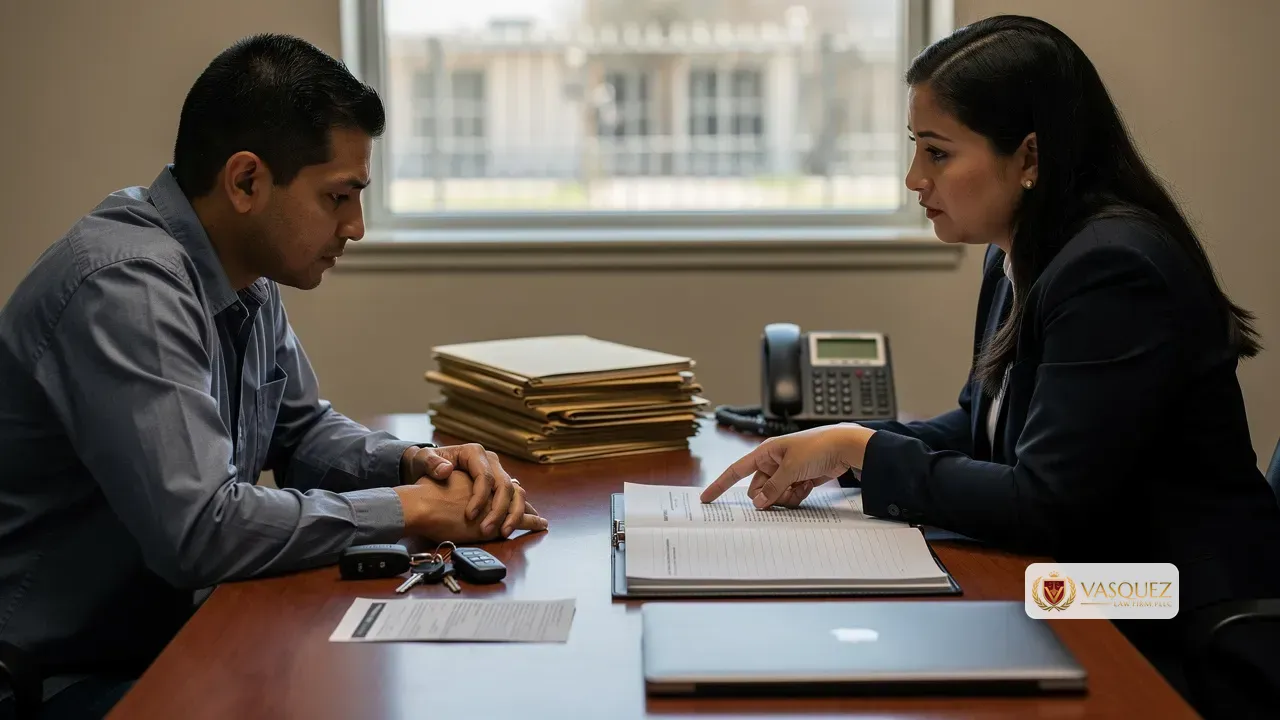
Start with the detention decision, not a prediction
When ICE detains you or a family member, the first decision is whether to seek case-specific legal help—not whether you can predict release, bond, or the final immigration result. Those facts cannot be evaluated reliably from a general article.
An immigration attorney may review the detention posture, possible bond issues, relevant evidence, court documents, and possible removal defenses. Vasquez Law Firm states that its attorneys help clients navigate detention proceedings, bond requests, and removal defenses.
You can still take useful steps before legal review. Separate the work into two tracks:
- Immediate information gathering: identify where your family member is detained, collect available notices and documents, record important names and dates, and preserve reliable contact information.
- Attorney-led review: assess what the available facts may mean for detention, bond, evidence, court filings, communication, and possible defenses.
This separation keeps you from treating an official locator, a general web page, or a family conversation as a legal conclusion. It also gives an attorney a clearer starting point.
Separate immediate information gathering from legal strategy
Immediate information gathering answers basic questions about location, identity, and available records. It does not decide which immigration option applies. Start with the facts you can obtain without guessing:
- Record the detained family member’s full name as it appears on available paperwork.
- Gather any immigration notices, court papers, prior applications, work or identity documents, and criminal-court records that your family already has.
- Write down the last known date and place of arrest or transfer.
- Record the names and contact details of relatives, friends, employers, or other people who may have relevant documents or information.
- Preserve every message, letter, notice, and envelope connected to the detention or an immigration court matter.
A nonprofit guide points families to the ICE detainee locator, ICE regional-office contacts, and the Executive Office for Immigration Review’s case-status tools after a detention. Check the official sites for current access details. ICE also says its public portal provides legal-orientation materials, immigration information, resources for detained parents, language-assistance information, and tools for certain case and contact tasks.
Legal strategy answers different questions: whether a bond request may be available, what evidence may matter, whether a court notice requires attention, what forms may be appropriate, and whether a removal-defense issue deserves review. Those questions depend on individual facts. Do not turn the location of a detention facility or the existence of a court record into a prediction about release or relief.
Attorney-led work can organize the facts into a legal review. We can assist with detention systems, bond motions, and coordinating family communication when a family member is detained.
You do not need to solve those legal questions before making contact. Your job at the first stage is to preserve accurate information and avoid actions that could change the situation before you receive case-specific guidance. An attorney’s job is to examine the facts, identify the questions that require legal analysis, and explain which next steps fit the matter being reviewed.
First establish who is detained and where
Your first practical task is to establish the detained family member’s identity and location using reliable information. A detention location may affect how your family communicates, where documents are sent, and which records an attorney needs to request or examine. Start with the official tools rather than relying only on an old message or an assumption about where a transfer occurred.
A nonprofit guide identifies the ICE detainee locator as a resource families can use after someone is detained and also identifies ICE regional-office contacts and EOIR case-status tools. ICE says its portal includes tools for checking immigration court hearing information and updating an address with ICE, along with legal-orientation materials and information about language assistance.
Create a short location record with these fields:
- the full name used in the search;
- any identifying number shown on available immigration paperwork;
- the date and place where you last knew your family member was held;
- the facility or office listed in an official result;
- the date and time you checked the information; and
- the name of the official tool or office that supplied the result.
The record is for organization, not proof that a legal option exists. Facility information and access procedures can change, so use current official information when you need to make contact or send records. If you cannot locate your family member or do not understand a result, preserve the search details and ask an immigration attorney to help interpret the next question rather than filling the gaps with assumptions.
When a result changes between searches, keep both dated results instead of overwriting the first one. Note whether the difference comes from a changed location, a spelling or identifying-number issue, or an unresolved search result; do not select an explanation without support. This record helps an attorney distinguish confirmed information from a point that still needs verification and shows what your family already tried.
Your family should also separate detention-location information from court-status information. A nonprofit guide identifies the EOIR hotline and online case tracker as tools for checking an immigration court case after detention. A court-status entry does not by itself explain what a notice means, what response may be required, or whether a defense is available. Save the result, the notice, and any stated hearing information for case-specific review.
If your family member has received papers with unfamiliar terms, do not discard them because they appear routine. Put each document in date order, keep the complete page set, and note how the document was received. A complete record gives an attorney a better basis for discussing what has happened and what requires attention.
Use official and nonprofit tools for orientation
Official and nonprofit tools can help you orient your family after a detention. Use them to locate information, identify the next question, and preserve a record of what you found. Use them as starting points, not as substitutes for legal analysis of your family member’s facts.
ICE says its public-facing portal serves people in detained and non-detained removal proceedings. ICE describes the portal as including:
- a virtual law library with legal-orientation and federal-agency materials;
- short immigration videos about agency practices, immigration proceedings, reporting obligations, and voluntary removal;
- resources for detained parents;
- information about free language assistance;
- tools for certain address updates and immigration-court hearing information; and
- information about contacting a consular official concerning travel documents.
A nonprofit guide separately points families to the ICE detainee locator, ICE regional-office contacts, and EOIR’s case-status hotline and online tracker. The guide advises checking official sites for current access details.
Use a simple three-column note while you work:
| Tool or office | What you found | What still needs legal review |
|---|---|---|
| Detention locator | Facility or no result | Whether the location affects communication or next steps |
| Court-status tool | Case-status information or a hearing entry | What the notice means and what response may be required |
| ICE or EOIR information page | General instructions or contact information | Whether the instruction applies to your family member’s facts |
This table is an organizing aid. It does not establish eligibility, guarantee access to a particular process, or tell you what a judge or agency will do. Save the date of each search because online information and access pathways may change.
Preserve the documents and facts a lawyer may need
Your document packet should show the facts that may matter to detention, bond, court, and removal-defense review. A bond judge may want written evidence rather than relying only on verbal assurances. Examples can include family members’ birth certificates or green cards, pay stubs, proof of residence, support letters, and proof of rehabilitation; the appropriate evidence depends on the case.
Gather what you can lawfully access and label each item clearly. A practical packet may include:
- immigration notices, court notices, and detention paperwork;
- identity and family-relationship records available to you;
- records showing where the family member lives;
- employment or income records that are already available;
- letters from family members, employers, clergy, or friends when relevant;
- records connected to prior immigration applications or court matters; and
- a dated timeline of arrests, transfers, applications, hearings, and communications.
Do not create documents, alter records, or ask someone to provide information they cannot support. If a document is incomplete, keep it with a note explaining what is missing. An attorney can help assess which information is useful for the particular case.
Do not assume that a family member’s informal translation satisfies a proceeding’s requirements. Keep the original-language document, identify the language, and ask what type of translation is required before submitting anything.
Gathering records while your family member is detained can be difficult. A family member or attorney may help collect documents and identify useful evidence; an attorney may also help with bond-document translation. Give the attorney a clear inventory even if the packet is incomplete. A short explanation of what you could not obtain can be more useful than an unmarked gap.
Use this document checklist before sending or describing the packet:
- Identity: names and spellings used in available records.
- Location: the facility or office shown by your latest reliable search.
- Timeline: detention, transfers, notices, hearings, and prior filings.
- Family: relationships and records that may show family ties.
- Residence and work: available proof of where your family member lives and works.
- Court and immigration history: notices, applications, orders, and prior case information.
- Language: the language of each document and any translation already available.
- Questions: the two or three issues your family needs explained first.
This checklist helps you prepare an organized handoff. It is not a universal evidence list, and an incomplete packet should not prevent you from seeking legal help.
For each item, add a short note about the fact it may document, who supplied it, and what remains uncertain. That creates an evidence map without requiring your family to decide whether a document proves a bond or removal-defense issue. Keep versions that show different dates or information, label the difference, and let the attorney assess why the records do not match.
Treat communication barriers as a reason to organize early
Communication conditions can affect how quickly information moves between your family, an attorney, a detention facility, and a court. The ACLU reported that, among the 173 facilities for which it had information, 24.3% provided some form of electronic mail or messaging access; availability can vary by facility and may change.
The ACLU also reported attorney concerns that delayed legal mail at 11 facilities contributed to repeated requests for extensions, missed court filing deadlines, or observed missed deadlines by detained people because of mail-system difficulties. The reported conditions covered specific facilities and do not establish what communication will be available in your family member’s facility.
Plan for more than one communication route where official information makes one available. Keep a current list of:
- facility mailing and visitation instructions;
- the names and phone numbers of family contacts;
- the attorney’s contact information once representation begins;
- relevant court or agency contact details; and
- the dates when notices were received or communications were attempted.
Save delivery confirmations, returned mail, call records, and messages. If a notice or legal document arrives late, preserve the envelope and record the date you received it. That information may help an attorney understand the sequence of events.
Language access is another part of organizing communication. ICE says its public portal includes information about free language-assistance services. Use that information to identify the available language-assistance question, but do not assume that a general resource explains how interpretation will work for a particular call, visit, filing, or hearing.
Choose one family contact to maintain the shared timeline when possible. That person can record who was contacted, what information was received, and what remains unanswered. This reduces conflicting accounts and gives an attorney one organized point of reference without preventing other family members from contributing documents or facts.
Add the preferred language and the best way to reach each person to that timeline. If a communication is misunderstood, record the uncertainty rather than paraphrasing it as a confirmed instruction. The family can then bring the exact question, the attempted contact, and any language-access concern to counsel together.

What an immigration attorney may review
An immigration attorney may review several connected parts of a detention case rather than focusing on a single form or phone call. We can help review how detention, bond, and possible removal-defense questions relate to the individual facts.
That work may involve the following questions:
- Detention posture: What records explain where your family member is held and what proceedings are pending?
- Bond questions: Is there a bond issue that requires review, and what evidence may be relevant to it?
- Evidence: Which family, residence, employment, rehabilitation, or other records should be organized for the matter?
- Forms and filings: Which forms or written submissions, if any, need attention based on the case facts?
- Court representation: What notices, hearings, or court communications need to be addressed?
- Removal-defense issues: Which facts may require review under immigration law, without assuming that a defense is available?
- Family communication: How should information and documents move between the detained family member, relatives, and counsel?
These are areas of assistance, not promises about eligibility, release, or a case result.
Your attorney conversation should connect the legal questions to the facts you have preserved. Tell the attorney about difficult facts as accurately as you can, including prior arrests, prior immigration proceedings, and documents you do not understand. Withholding a fact can leave the review incomplete; guessing can create a different problem.
Ask the attorney to identify which question comes first. Your goal is not to leave the conversation with a prediction. Your goal is to understand the issues that require action, the records that support review, and the limits of what can be decided from the available information.
If two records or accounts conflict, preserve both and identify the conflict instead of choosing the version that seems most favorable. Note when each account was created and who provided it. The conflict itself may be important to the review, while a clear record of its source helps separate a confirmed document from information that still needs verification.
Why bond and evidence questions require case-specific review
Bond questions require more than knowing that a bond process exists. A bond judge may want written evidence, including proof of family ties, residence, employment, support, or rehabilitation. The appropriate evidence depends on the case.
That distinction matters when your family is deciding what to collect. A document can be relevant without being sufficient, and a missing document does not automatically determine the result. Your family should preserve available records, identify what is missing, and let an attorney assess how the information fits the particular bond question.
A detained person may not need to pay the bond personally, and someone with lawful U.S. status may pay it, but release does not occur until the bond is paid. Current case-specific rules should be confirmed. Do not make financial arrangements based only on a general explanation or assume that payment alone resolves every immigration issue.
Written evidence also has practical conditions. Completeness and organization can affect whether an attorney can use a document in the way your family expects.
Gathering evidence while detained can be difficult. Family members or an attorney may help collect documents and assess what evidence is useful. Start with records you can obtain without delay, but keep your inventory open. If your family finds a birth certificate, lease, pay stub, support letter, or other potentially relevant record, label it and place it in the timeline rather than deciding on your own that it proves a legal point.
A general article cannot determine whether bond is available, what amount may apply, whether a judge will accept a particular record, or whether release will occur. Those questions belong in a review of your family member’s actual detention and immigration facts.
Recognize situations that warrant prompt legal contact
Prompt legal contact makes sense when detention has already occurred, when a document may affect rights or departure, or when communication problems could interfere with a court-related matter. Contact an immigration attorney promptly when any of these situations applies:
- You or a family member is in ICE custody. Organize the location, documents, timeline, and family contacts.
- ICE has provided a document for signature. A Vasquez Law Firm guide advises consulting an attorney before signing ICE documents, particularly documents involving voluntary departure or waivers of rights.
- Your family has received a court notice or is concerned about a filing date. The ACLU reported attorney concerns that delayed legal mail at 11 facilities contributed to extension requests and missed deadlines in the facilities covered by its report.
- You cannot establish where your family member is detained or cannot interpret the available status information. Use the official tools described above, preserve the result, and bring the unresolved issue to an attorney.
- Your family is trying to decide what evidence or records to use for a bond-related question. The bond guidance says written evidence may matter and that the appropriate evidence depends on the case.
These triggers do not predict the outcome. They identify circumstances in which waiting for a general answer can leave an important fact, document, or communication problem unaddressed.
A Vasquez Law Firm guide says people may remain silent about their birthplace, how they entered the United States, and their immigration status. The same guide advises consulting an attorney before signing ICE documents, especially documents concerning voluntary departure or waivers of rights.
Use that guidance as a reason to pause before answering or signing when you need legal review. Do not provide false information or present false documents. Preserve the document, note what was requested, and seek advice about the specific situation.
Prepare for the first attorney conversation
Your first attorney conversation will be more focused if you can explain the detention timeline and identify the records already in your possession. You do not need a perfect packet before you reach out. Prepare a concise summary and say clearly which facts are confirmed, which facts are uncertain, and which documents you have not been able to obtain.
Use this preparation sequence:
- Write a one-page timeline. Include detention, transfers, notices, hearings, prior immigration filings, and relevant criminal-court events as accurately as you can.
- Identify the current location. Record the official search result, the date you checked it, and any facility or office contact information.
- List the documents you have. Include immigration papers, court notices, identity records, family records, residence records, employment records, and support letters when available.
- Describe communication. Note calls, messages, letters, attempted contacts, language needs, and any delay in receiving documents.
- Write the immediate questions. Put the most time-sensitive document, court concern, detention-location problem, or bond question first.
- Disclose difficult facts. Include prior applications, prior proceedings, arrests, convictions, departures, or other facts that may affect legal review instead of assuming they are unrelated.
Our immigration lawyers can help with evidence preparation, necessary forms, and court representation. The attorney still needs accurate facts from you to understand what kind of review is required.
Bring an evidence inventory, even if the inventory shows gaps. Mark each item with its source, date, language, and whether it is an original or a copy.
Ask focused questions such as:
- What detention and court questions should be reviewed first?
- Which facts could change the analysis?
- Which documents should be translated, and what kind of translation is required?
- What information is missing from the current packet?
- What should the family preserve while the review continues?
- How should the family communicate with the detained person and share new documents?
The goal of these questions is clarity about the work ahead. Do not ask an attorney to promise a result from a short summary. Ask what can be determined now, what requires additional records, and what action should happen next.
Know what this guide cannot determine
This guide cannot determine whether your family member qualifies for bond, what bond amount may apply, whether release will occur, or which removal defense may be available.
This guide also cannot determine whether a particular document is sufficient evidence, whether a translation meets the requirement for a specific proceeding, or whether a current payment rule applies to your family member’s bond situation. Guidance on immigration bonds says written evidence may be required, documents generally must be in English or include a certified translation, and current case-specific rules should be confirmed.
Official tools have a narrower function. ICE says its portal provides orientation materials, language-assistance information, and tools for certain case and contact tasks. Those tools can help you find information and frame questions, but they do not replace review of the complete detention and immigration record.
Use the boundary as a practical rule: treat general information as orientation, treat every document as something to preserve, and treat an unresolved legal question as a reason to seek case-specific review. Do not convert a general statement into an answer about your family member’s eligibility, deadline, release, or defense.
Before you rely on any next step, ask whether you have identified the correct person and location, preserved the complete document, recorded the date you received it, and separated confirmed facts from assumptions. If any answer is no, make that gap part of your attorney conversation. A clear account of what you know and do not know is more useful than a confident conclusion built from incomplete information.
What to keep in one detention record
Build a detention record: track key dates, the person's current or last known location, when the ICE detainee locator or an EOIR case-status tool was checked, attempts to communicate, notices received, documents in hand, and unanswered questions. Use that record to give a lawyer the known facts and identify what still needs case-specific review.
We help clients navigate detention proceedings, bond requests, and removal defenses. We can help prepare evidence, file necessary forms, and represent individuals in court. We can also assist with family communication when a family member is detained.
For the first conversation, organize a timeline, the detention location, notices, available documents, communication record, and unanswered questions. A qualified immigration professional must determine what legal options and next steps fit the specific facts. Use the information you have organized to begin that focused conversation.
Questions families often have before contacting an immigration attorney
What should I gather before contacting an immigration attorney for ICE detention?
Before reaching out to an attorney, collect the detained person's full name, any immigration notices or court papers, the last known date and place of arrest, and contact details of relatives or friends who may have relevant information. Preserve all messages and documents related to the detention.
How can an immigration attorney assist with ICE detention matters?
An immigration attorney can help navigate detention proceedings, prepare evidence, file necessary forms, represent individuals in court, and assist with bond requests and removal defenses.
What are the immediate steps to take if a family member is detained by ICE?
Start by establishing the detained person's identity and location using official tools like the ICE detainee locator. Gather relevant documents and maintain a record of all communications and notices received.
When is it important to contact an immigration attorney promptly?
Contact an attorney promptly if you or a family member is in ICE custody, if you receive a document from ICE for signature, if there is a court notice or filing date, or if you cannot determine the detained person's location.
What types of evidence may be needed for a bond hearing?
Evidence for a bond hearing may include proof of family ties, residence, employment, support letters, and rehabilitation records. The specific evidence required can vary based on the case.
What should I do if I cannot locate my detained family member?
If you cannot locate your family member, use the ICE detainee locator and preserve the search details. If the information is unclear, consult an immigration attorney for assistance.
What are the communication challenges I might face when a family member is detained?
Communication can be affected by delayed legal mail, limited electronic access in detention facilities, and language barriers. It's important to keep a record of all communications and maintain contact information for family and legal representatives.
Sources
- Understanding Immigration Bonds — www.theadvocatesforhumanrights.org
- How to Protect Your Rights During ICE Arrests in... | Vasquez Law Firm — vasquezlawnc.com, 2026-02-27
- Without Access to Counsel, Detained Immigrants Face Increased Risks of Prolonged Detention and Unlawful Deportation | ACLU — www.aclu.org
- Attorney Information and Resources — www.ice.gov
- What to Do if You Are Arrested or Detained by Immigration — www.nilc.org
- How Federal Immigration Cases Work in Charlotte NC in 2026 | Vasquez Law Firm
- What Happens After Immigration Arrests in Orlando in 2026? | Vasquez Law Firm
- How ICE Enforcement Works in Orlando in 2026 | Vasquez Law Firm
- How ICE Impacts Your Immigration Case in Orlando in 2026 | Vasquez Law Firm