

When a Deportation or Removal Matter Requires Prompt Attention
A deportation or removal matter deserves prompt attention when you receive a Notice to Appear, receive an immigration-court notice, or learn that you or a family member is in ICE custody. These events do not determine whether you can remain in the United States, but they signal that you should preserve the available information and seek case-specific review rather than rely on a general explanation.
A Notice to Appear, also called Form I-862, is the charging document the Department of Homeland Security uses to begin removal proceedings after serving it and filing it with the immigration court. You may face deportation proceedings if you are not lawfully present or if you are accused of violating a requirement of your lawful status. The document, your immigration history, and the current status of your case all matter.
A removal concern can also arise before you understand exactly which proceeding applies. A letter, hearing notice, custody event, or contact from an immigration agency may leave you unsure about what happens next. That uncertainty is a reason to organize the facts, not a reason to guess about eligibility or wait until the paperwork becomes harder to reconstruct.
Your first task is to identify the event that needs attention and preserve the related records. Use this short triage list:
- A Notice to Appear: Keep every page and note how and when you received it.
- A court notice: Record the hearing information and retain the notice with the rest of your immigration papers.
- ICE custody: Collect the person's identifying information and begin checking the available custody resources.
- An uncertain situation: Write down what happened, when it happened, and which documents you have before requesting a legal review.
Removal defense generally involves representation and advocacy for someone facing deportation, and many cases involve proceedings before an immigration judge. If your situation fits one of these categories, treat organizing the facts and seeking advice as the immediate next step.
Do not discard a document because it seems repetitive, difficult to translate, or unrelated to the latest event. Older applications, prior notices, and records of earlier contact with immigration authorities may change the questions that need to be reviewed.
What Removal Defense Generally Involves
Removal defense generally involves representation and advocacy while you face deportation or removal from the United States. Many cases involve appearing before an immigration judge in immigration court, where you may need to respond to the government's allegations and present the facts relevant to your case.
Some people in immigration court can ask for a form of relief from removal that would allow them to remain in the United States. The form of relief, if any, depends on the facts and legal posture of your case. A general description cannot tell you whether a particular option is available to you.
In practical terms, removal defense is not a single form or outcome. It is a case-specific legal process that may require an attorney to examine the documents that started the proceeding, your immigration history, the procedural status of the matter, and facts that may affect the legal questions. Your task before an initial discussion is to make those facts and records easier to understand.
The terms used for immigration proceedings can affect the questions you need to ask. EOIR explains that deportation and exclusion proceedings are generally similar to removal proceedings but can differ significantly in burden of proof, available forms of relief, and custody. EOIR also describes its information as a general guideline and directs parties to review the laws and regulations that apply to their proceedings.
Use that distinction as a decision point:
- If you have a court document: Bring the complete document to an attorney and ask what proceeding it identifies.
- If you have a removal concern but no notice: Prepare your immigration history and explain the event that caused the concern.
- If you are unsure what the document means: Do not choose a legal strategy based on its title alone; request a review of the document and your facts.
Removal defense is therefore more than learning a definition. It is the process of connecting your notices, history, and present case status to the legal questions that apply to you. Ask for an explanation of the proceeding in plain language, but do not assume that a familiar term carries the same meaning in every case.
How to Identify a Notice to Appear and Other Court Notices
A Notice to Appear is a written document identified as Form I-862, and DHS uses it as the charging document to begin removal proceedings after serving it and filing it with the immigration court. We explain the Notice to Appear in those terms because recognizing the document helps you separate a charging document from other immigration correspondence.
Look at the heading, form number, issuing agency, and instructions printed on each document you receive. Keep all pages together, including pages that appear repetitive. If a family member gives you a photograph or scan, preserve that copy and ask for the complete document if any page is missing. Do not assume that a notice is unimportant because you do not understand its legal language.
The form number alone does not answer every question about your case. The date of service, the filing information, the hearing information, and later court communications may all matter. Bring the complete document rather than describing only the first page.
An immigration-court notice may contain hearing information, while a Notice to Appear begins the removal proceeding. The immigration court sends correspondence, including hearing notices, using the latest contact information provided for the case. That makes every court notice worth preserving, even if you already have an earlier document.
Create a document folder, digital or paper, with these sections:
- Charging documents: Put the Notice to Appear and every page attached to it together.
- Court correspondence: Add hearing notices and later letters in the order received.
- Delivery records: Keep envelopes, email messages, photographs, or scans that show how the document reached you.
- Questions: Write down unfamiliar terms and anything that appears inconsistent across documents.
Bring the folder to an initial discussion. An attorney can then evaluate the actual paperwork instead of relying on a description from memory. If a page is missing, mark the gap clearly and identify who provided the copy or when you noticed that it was incomplete.
Why Hearing Attendance and Current Contact Information Matter
Attendance at an immigration-court hearing matters because failing to appear can lead to an order of removal when the required notice and removability elements are established, subject to limited exceptions. A case may also continue without you if you fail to appear. The result depends on the circumstances described in the governing rules and the notice in your case.
Treat a hearing notice as an action item, not as a document to set aside. Record the date and location exactly as printed, keep the notice accessible, and ask for legal guidance if you cannot understand the instructions or believe the information is wrong. Do not assume that missing one hearing automatically resolves the case in your favor or that a later notice can be ignored.
If you already missed a hearing, write down the date, explain why you did not attend, and preserve any proof connected to the circumstances. Do not replace a missed appearance with a guess about what the court did. The actual court record and the facts surrounding the missed hearing need review.
Current contact information matters because the immigration court uses the latest address, telephone number, or email information provided for correspondence. The court notice says that missing or incorrect contact information on a Notice to Appear must be updated with the immigration court within five days of receiving that notice, and later changes must also be reported within five days. Check the current official instructions for your case before acting.
Use this sequence when your contact information changes:
- Compare the information on the notice with your current details.
- Preserve the notice that contains the missing or incorrect information.
- Follow the current official procedure for updating the immigration court.
- Keep proof of what you submitted and when you submitted it.
- Tell your attorney about the change and provide copies of the relevant records.
The five-day instruction applies to the circumstances described in the court notice. Your case documents and current official instructions control the details. Keep copies of any confirmation, receipt, or submission record with the rest of your court papers.
What Families Can Do When Someone Is in ICE Custody
ICE custody creates a separate information problem because your family may need to locate the person while also preserving the immigration history and court records. ICE says its Online Detainee Locator System may provide the detention facility and the Enforcement and Removal Operations office responsible for the case. The system does not include everyone, including juveniles, and a newly detained person may not appear immediately.
ICE also says that locator information may be up to eight hours old and recommends contacting the facility to confirm that the person is there. A missing search result therefore does not by itself establish that the person is not in custody. Record the time of each search, save any result, and use the facility or office information shown by the system when available.
Use the person's identifying information exactly as it appears on available documents. Differences in spelling, former names, or missing identifying details can make it harder to connect a search with the correct person, so preserve every version you find rather than silently changing it.
A family custody plan should focus on identification, confirmation, and legal contact:
- Gather the person's full name and the identifying details shown on available immigration documents.
- Collect copies or photographs of notices, prior applications, and court correspondence.
- Use the detainee locator when appropriate, while accounting for its stated limits and possible delay.
- Contact the listed facility to confirm the person's location when the locator provides one.
- We recommend calling a lawyer if you or a family member is taken into ICE custody.
Do not discard older notices because a new custody event has occurred. The detention information and the person's prior immigration records may both be relevant to the initial discussion. Note who searched, when the search occurred, what result appeared, and which facility or office was contacted.
A family member can also prepare a short written timeline while another person gathers documents. Keep the roles separate if that makes the work easier: one person can track custody information, while another collects notices and prior filings. The goal is a clear starting record for case-specific review.
Information an Attorney May Review During the Initial Discussion
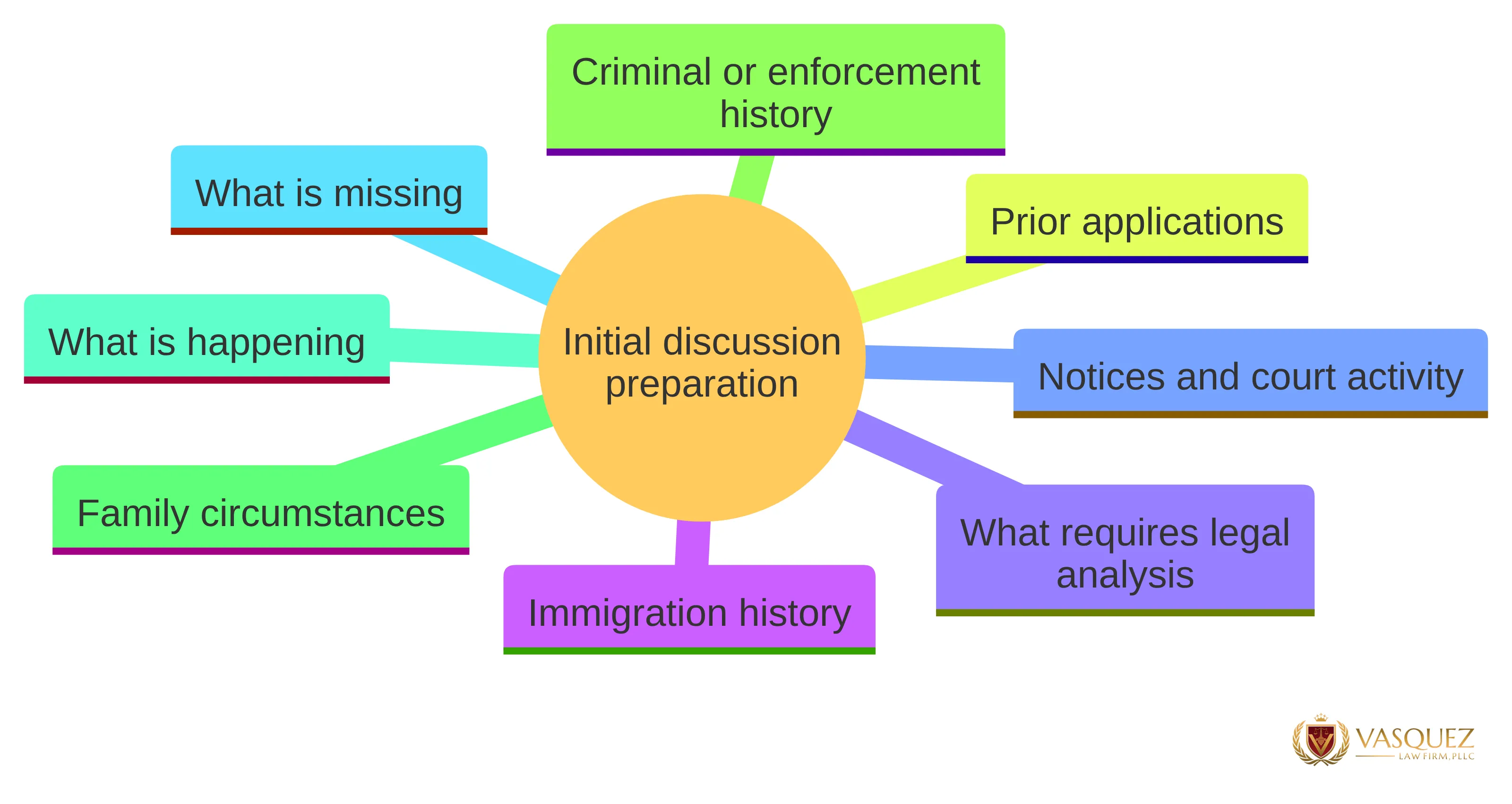
These categories help you explain the case in a usable order, but they do not predict whether a particular form of relief is available.
Prepare a short account of each category:
- Immigration history: Describe entries, departures, prior immigration status, and any previous contact with immigration agencies as accurately as you can.
- Notices and court activity: List every notice you received, every hearing you remember, and any event you believe changed the case.
- Prior applications: Identify applications or petitions you filed, whether someone filed them for you, and any approval, denial, request, or withdrawal you remember.
- Criminal or enforcement history: Give the dates and locations you know, identify the agency involved if you know it, and provide paperwork rather than relying on a label.
- Family circumstances: Explain close family relationships, caregiving responsibilities, and other facts you want the attorney to consider.
Separate facts you know from facts you are trying to reconstruct. Mark an item as unknown instead of filling a gap with a guess. If your family remembers the same event differently, preserve both accounts and identify who provided each detail.
Your questions should connect the documents to the present case. Ask which proceeding the notice identifies, what information appears incomplete, what records the attorney needs next, and which facts require confirmation before any legal option can be assessed.
A useful initial discussion also includes the event that brought you to seek help. Explain whether you received a notice, missed or are worried about a hearing, learned about a custody event, or discovered an older immigration problem. The explanation should include dates when you know them and uncertainty where you do not.
Some people in immigration court may ask for relief from removal, but what may be available depends on the individual case. Use the discussion to identify the questions that require legal analysis, not to force your circumstances into a general category.
You can organize your questions under three headings:
- What is happening: Which proceeding, agency, or court notice is involved?
- What is missing: Which document, date, or fact needs to be located or confirmed?
- What requires legal analysis: Which possible options, risks, or procedural steps depend on your complete history?
This structure keeps the conversation focused without turning general information into a prediction about your case.
Documents, Dates, and Details to Gather Before Contacting an Attorney
The documents for an initial discussion should show your notices, immigration history, court communications, and any event that may affect the case. Gather what you already have; do not delay a request for help because your file is incomplete.
Use this preparation list:
- Notice to Appear, including every page and attachment.
- Immigration-court hearing notices and other court correspondence.
- Prior immigration applications, decisions, receipts, or agency letters.
- Records showing changes to your address, telephone number, or email when those changes relate to court communication.
- Documents connected to detention, enforcement, or prior contact with immigration authorities.
- Criminal-case records or other official paperwork you have, rather than a summary based only on memory.
- Documents that explain family relationships or caregiving responsibilities when those facts are part of your concern.
Keep the papers in the form in which you received them and make a separate copy or scan for your working folder. Label each copy with the date you obtained it. If you cannot obtain a document, write down what you remember about it and who may have a copy.
Do not alter an original document to make it easier to read. If you need to translate or summarize it for your own use, keep the original beside the translation or summary.
A one-page timeline can make the initial discussion more focused. Write the date, event, document, and person or agency involved for each entry. Include the date you received the Notice to Appear, the dates printed on court notices, address changes, prior applications, custody events, and any hearing you attended or missed.
Add a second page for identifying details exactly as they appear on the documents. Include spelling variations, former names if they appear in the file, and the contact information you currently use. Do not guess a date or rewrite a document to make the timeline look complete. Mark uncertain information as uncertain and bring the underlying record for review.
Your preparation has a practical purpose: it gives the attorney a clear starting point and shows which records still need to be located. It does not replace review of the full facts or current law.
Before contacting an attorney, check that your folder includes:
- A short description of the event that prompted you to seek help.
- A list of the documents you have and the documents you know are missing.
- The dates you know, with uncertain dates clearly marked.
- Your current contact information and any recent change relevant to court correspondence.
- Questions about the proceeding, the notices, and the information that needs further review.
This checklist is an organizing tool. It is not a determination that every item applies to your case.
Official Resources for Checking General Immigration Information
The ICE Portal provides general immigration information and resources through a public-facing website. ICE says the portal includes legal-orientation materials, federal immigration-agency references and forms, videos about immigration processes and court obligations, resources for detained parents, and information about free language assistance.
The ICE Portal also includes information about updating an address with ICE, checking immigration-court hearing information, and contacting a consular official about travel documents. Use the portal to locate general instructions and relevant agency materials, then preserve what you find with your case records. Portal information does not determine which legal option applies to your facts.
Treat information from the portal as a starting point for questions and recordkeeping. Write down the page or resource you used and the date you viewed it so you can explain what information guided your next question.
The Department of Justice publishes a pro bono legal-service-provider list for immigration-court locations, and the DOJ page identifies itself as updated in October 2026. That list can help you identify organizations associated with the relevant immigration-court location when you need to explore available legal-service information.
EOIR describes its procedural information as a general guideline and says parties should review the laws and regulations applicable to their proceedings. Check the date and instructions on any official page you use, especially for court communication, custody information, or filing-related questions. Use official resources to orient yourself and organize questions; use case-specific legal review to assess your situation.
Keep the official resource separate from your legal file. Save the document or page information that relates to your question, but do not assume that a general form, video, or list answers the legal issues raised by your own notices and history.
What This General Guide Cannot Determine
This general guide cannot determine whether you are eligible for a particular form of relief, whether a notice was properly served, whether a missed hearing has a specific legal consequence in your case, or which strategy should be used. Some people in immigration court may ask for relief from removal, but the available relief depends on the individual case. Deportation and exclusion proceedings can also differ from removal proceedings in burden of proof, available relief, and custody.
The guide also cannot supply a case-specific deadline or predict whether you will remain in the United States. Those questions require the actual documents, your immigration and enforcement history, the location and status of the proceeding, and the law that applies when your matter is reviewed.
A general explanation can help you recognize the need for attention and organize your materials. It cannot replace analysis of the facts that make your situation different from another case. Treat each unknown as a question to raise, not as permission to assume that two cases have the same answer.
Use the limits as a decision boundary rather than as a reason to wait. If you have a Notice to Appear, a hearing notice, a custody concern, or a possible missed hearing, preserve the records and request a review. If your contact information changed, follow the current official instructions that apply to your case; the court notice describes five-day reporting requirements for specified circumstances.
A clear question and a complete set of available records give the next discussion a more reliable starting point.
You can move forward even when your file is incomplete. Identify what you have, list what is missing, explain what happened, and ask which information needs attention first. That approach keeps the next step practical without making a legal conclusion that the available facts cannot support.
Prepare Your Information and Request Case-Specific Review
Your next step is to preserve the notice or custody information, write down the key dates, gather your immigration history and related records, and explain what you need reviewed. A qualified immigration attorney must decide whether a particular legal option or representation fits after reviewing your facts and the current law.
We offer legal help for immigration cases and provide a free evaluation. We invite you to consult with an immigration attorney for a free case evaluation.
Sources
- List of Pro Bono Legal Service Providers Table of Contents — www.justice.gov
- Notice of [See Official Notice] Hearing — www.justice.gov
- The Removal System of the United States: An Overview - American Immigration Council — www.americanimmigrationcouncil.org
- Attorney Information and Resources — www.ice.gov
- 6.2 - Deportation Proceedings and Exclusion Proceedings — www.justice.gov
- Removal Defense | Immigrant Legal Resource Center | ILRC — www.ilrc.org
- ODLS Brochure — www.ice.gov
- 3.2 - Commencement of Removal Proceedings — www.justice.gov
- What You Need to Know About This Week in Immigration... | Vasquez Law Firm
- How Families Quickly Find Immigration Detainees | Vasquez Law Firm
- How ICE Impacts Your Immigration Case in Orlando in 2026 | Vasquez Law Firm