

Start with the decision an NIW pathway creates
An EB-2 National Interest Waiver pathway creates a two-part decision: first examine whether you may fit the underlying EB-2 classification, then consider whether the proposed endeavor and supporting record justify pursuing a waiver strategy. That order matters because USCIS guidance explains that you must first qualify for the underlying EB-2 classification before USCIS considers National Interest Waiver eligibility.
The phrase National Interest Waiver green card can make the process sound like a single application with a single answer. Treat it as a sequence of questions instead:
- Do your education or qualifying experience provide a plausible EB-2 foundation?
- What work or proposed endeavor would the petition ask USCIS to evaluate?
- What facts and documents connect your background to that endeavor?
- Would filing on your own behalf change the way you plan the case?
- What later green card step would still require separate review?
This guide helps you organize those questions. It does not decide whether your credentials satisfy the law, whether your proposed endeavor meets the applicable standard, or whether approval is likely. Those conclusions depend on your specific education, work history, proposed work, immigration history, and supporting evidence.
The practical value of this order is that it separates a threshold classification question from a later waiver question. If your education or experience requires further analysis, you can identify that issue before spending time describing a proposed endeavor that depends on an unresolved EB-2 foundation. If the foundation appears plausible, you can then focus on whether your proposed work and documents form a coherent waiver presentation.
A sensible next step is not to count credentials in isolation. Start by separating the EB-2 foundation from the waiver analysis, then prepare a clear account of your proposed endeavor and the documents that support each part of the discussion.
Separate the EB-2 classification from the waiver
The EB-2 classification and the National Interest Waiver request are connected, but they are not the same question. USCIS guidance states that a petitioner must first demonstrate qualification for the underlying EB-2 visa classification before establishing eligibility for a National Interest Waiver.
The first question is therefore foundational: what recognized EB-2 basis could apply to you? The accepted USCIS guidance identifies an advanced degree and an exceptional-ability route as subjects in the evaluation. The advanced-degree route receives specific attention here, while exceptional ability is another route within the EB-2 classification to examine.
The second question concerns the waiver request. A waiver analysis asks how your proposed endeavor and evidence should be presented for the request being made. It is not a substitute for the underlying classification. A strong explanation of your future work cannot repair an unresolved question about whether you first fit EB-2.
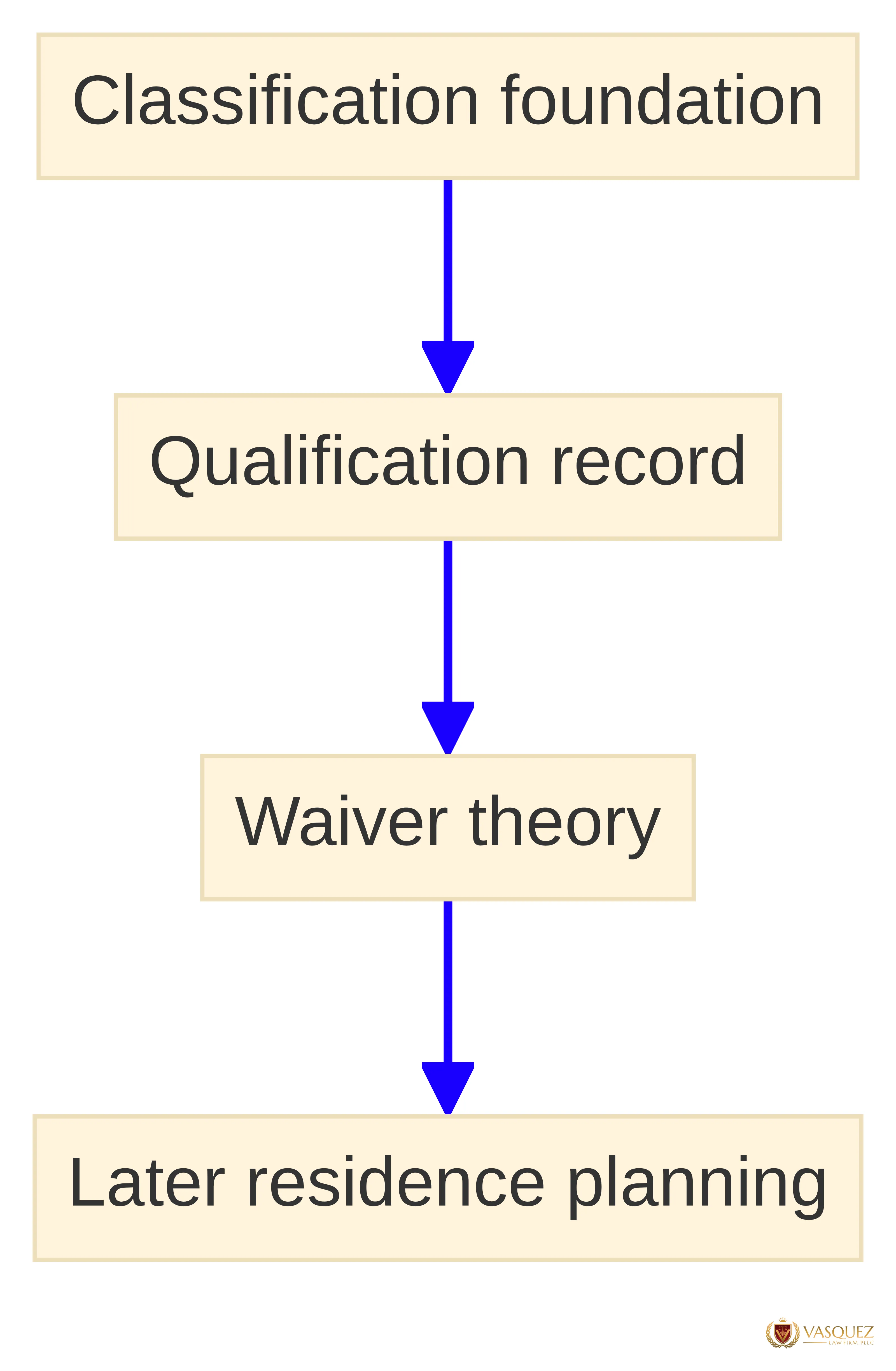
Use the distinction as a working map:
- Classification foundation: identify the EB-2 basis you would ask USCIS to recognize.
- Qualification record: collect the education, degree-equivalency, and specialty-experience information relevant to that basis.
- Waiver theory: explain the proposed endeavor and organize the evidence that supports the request.
- Later residence planning: treat the eventual green card step as a separate procedural question.
Your documents may touch more than one part of this map, but the legal questions should remain distinct. For example, a degree record can be relevant to the EB-2 foundation and to the explanation of your professional field. It does not, by itself, resolve the waiver analysis. Likewise, a project description can explain your proposed work without proving that you meet the classification that must come first.
This sequence also prevents a common planning error: treating a compelling professional story as proof of every legal requirement. Begin with the EB-2 foundation, and do not move to a waiver conclusion until that foundation has been examined.
Identify the general EB-2 foundation to examine
The underlying EB-2 foundation begins with the qualification category you may rely on. USCIS guidance defines an advanced degree as a U.S. academic or professional degree, or a foreign equivalent degree, above a bachelor’s degree. That definition makes the degree itself, the level of the degree, and the treatment of a foreign credential relevant questions for your evaluation.
USCIS guidance also states that a U.S. bachelor’s degree or foreign equivalent followed by at least five years of progressive experience in the specialty may be treated as equivalent to an advanced degree. The word progressive matters to the analysis. A work history should be examined for its relationship to the specialty and for how responsibility or experience developed over time, rather than reduced to a job-title count.
Use these questions to prepare the foundation discussion:
- What degree or degrees have you earned, and where were they awarded?
- If a degree was earned outside the United States, what information explains its equivalency?
- What specialty does your education relate to?
- If you rely on a bachelor’s degree plus experience, how does your experience relate to the specialty?
- What dates, employers, positions, and responsibilities show the progression of that experience?
- Are there gaps, changes in field, inconsistent titles, or translation questions that need explanation?
These questions are preparation points, not a complete eligibility checklist. Meeting the education or experience descriptions above does not by itself establish qualification for the underlying EB-2 classification. It also does not supply a complete current account of every EB-2 criterion. Keep that boundary visible when you review your background.
Build the foundation as a chronology. Start with education, then place relevant positions in date order, naming the specialty and responsibilities associated with each role. Note where a position changed, where duties expanded, and where your work moved into a different field. A clear chronology allows the professional evaluating your case to distinguish a missing document from a missing qualification and a change in career direction from a simple difference in job title.
The foundation should be written as a factual chronology, not a sales pitch. List your education, specialty, and experience in an order that lets a professional compare the record with the applicable classification requirements. If the foundation remains uncertain, resolve that question before investing your planning around the waiver theory.
Define what self-petitioning changes—and what it does not
Self-petitioning changes who may file the National Interest Waiver petition, but it does not erase the qualification analysis. That possibility can change the practical starting point for your planning. Instead of building the entire discussion around a specific employer’s sponsorship, you may examine whether your own qualifications, proposed endeavor, and supporting record can be presented in a petition filed on your behalf. The relevant question becomes how your record supports the request, not merely whether an employer is willing to initiate it.
Self-petitioning does not mean that every applicant can use the pathway. It does not turn a degree into an advanced degree, make unrelated experience progressive experience in the specialty, or answer the separate questions raised by your proposed endeavor. It also does not guarantee approval or remove the need to analyze your immigration history and later green card step.
Separate the practical effect from the legal effect:
- Practical effect: you can evaluate a case structure that is not centered on a particular employer filing for you.
- Legal boundary: you still must first establish the underlying EB-2 classification before the waiver request can be considered.
- Planning consequence: your evidence plan should connect your qualifications and proposed endeavor rather than rely on an employer’s name alone.
Self-petitioning also does not make the proposed endeavor optional. You still need a clear account of the work you want to pursue and the relationship between that work and your background. The absence of a specific sponsoring employer may change how you describe the case, but it does not eliminate the need for a focused record.
If self-petitioning is the reason you are considering this route, write that reason down as a planning question. Then test it against your EB-2 foundation and the evidence available for the work you propose.
Use the proposed endeavor as the organizing question
The proposed endeavor should organize the waiver discussion because USCIS guidance addresses how the agency evaluates the requested waiver and how exceptional ability must relate to the endeavor proposed as part of the request. Your professional identity alone is not a complete description of the work you are asking USCIS to evaluate.
Describe the endeavor in practical terms. Explain what you propose to do, the field or specialty involved, the work you would carry out, and the connection between that work and your education or experience. Keep the description specific enough that the supporting documents can be matched to it. A broad statement such as wanting to help the economy or advance a profession gives you little structure for deciding which evidence belongs in the record.
Use a short planning outline:
- Work: What activity, project, service, research, or professional work are you proposing?
- Field: Which specialty or area does that work involve?
- Role: What would you personally do within the endeavor?
- Connection: Which parts of your education and experience relate to that work?
- Proof: Which documents show your background, plans, and ability to explain the endeavor clearly?
This outline is not a substitute for the complete legal standard. It is a way to keep your case discussion coherent and to identify questions that need professional review. The proposed endeavor should not be written as a promise of results that you cannot document. It should describe the work you intend to pursue and the facts that explain why your background belongs in that discussion.
Separate the endeavor from general descriptions of your occupation. Your occupation may include several kinds of work, while the proposed endeavor should identify the particular work you want evaluated. That distinction helps you decide whether a résumé entry, project record, employment document, or other material actually belongs in the explanation.
If your proposed work has changed over time, preserve that history rather than presenting inconsistent versions without explanation. Note what you originally planned, what you now propose, and why the current description is tied to your education and experience. If you cannot describe the endeavor without switching between unrelated occupations or goals, pause before assembling a large packet. Narrow the description to the work you can explain, then identify the evidence that supports that description.
Build an evidence story instead of a document pile
An NIW evidence record should let each document answer a defined question. USCIS filing procedures advise petitioners who submit substantial documentation to separate each evidence category according to the regulatory classification the evidence is intended to satisfy and to use clear coversheets identifying each category. Organization is therefore part of how you present the record, not a cosmetic task after the legal analysis.
Start with an evidence map rather than a box of documents. For every item, write four short entries:
- Document: What is the item?
- Fact: What does it show about your background or proposed endeavor?
- Purpose: Which requirement or evaluation question is it intended to address?
- Location: Where will the reviewer find it in the index and packet?
The map can reveal problems before filing. A degree record may show education but not explain how a foreign credential relates to the proposed specialty. A résumé may list positions but not show how experience progressed. A project description may describe future work but not connect that work to your background. Those are different questions, and the documents should not be treated as interchangeable.
Use the map to separate facts from conclusions. A letter may describe your work; it does not automatically prove every legal point you want to make. A publication, project record, or employment document may support a particular factual statement without deciding the waiver analysis. Keep the explanation beside the document so the intended use is clear.
A coherent record has a visible path: your EB-2 foundation, your proposed endeavor, the relationship between your background and that endeavor, and the reason the evidence is being offered. If a document has no defined purpose, place it in a question list rather than adding it automatically. If a central question has no supporting document, identify that gap for professional review.
Read the map as a chain rather than as an inventory. The first link should identify the EB-2 foundation. The next should describe the proposed endeavor. The remaining links should explain how your background and documents relate to the questions being evaluated. When two documents appear to say different things about your dates, role, specialty, or plans, mark the difference instead of choosing the version that sounds more favorable.
A longer packet is not automatically a clearer packet. A document belongs in the working file because it answers a defined question, supplies necessary context, or identifies an issue that needs explanation. That discipline makes it easier to discuss both strengths and unresolved points without confusing volume with support.
Use a three-pass review before treating the map as ready. In the first pass, record only what each document says, without inferring a legal conclusion. In the second, assign the document to the specific question or category it is meant to address and note the relevant page or date. In the third, compare the document with the chronology and proposed-endeavor description. Mark any mismatch in names, dates, roles, specialties, or plans for explanation. This process gives each document a defined job while preserving uncertainty where the record does not answer the question. It also helps separate a missing document from a missing explanation: if the fact appears but its significance is unclear, the issue may be one of organization or legal analysis; if the fact is absent, record a documentary gap instead. Either issue can become a focused question for professional review.
Organize evidence by the requirement it addresses
Evidence categories should follow the requirement each category is intended to address. USCIS filing procedures advise separating substantial documentation according to the regulatory classification involved and using clear coversheets to identify the categories.
A practical index can make that instruction usable:
- Section A: EB-2 foundation. Place the records and explanations relevant to the classification basis you are asking to establish.
- Section B: Education and experience context. Group materials that help explain the degree, foreign-equivalent question, specialty, or progressive experience issue relevant to your foundation.
- Section C: Proposed endeavor. Group materials that describe the work you propose and your role in it.
- Section D: Waiver analysis. Group materials according to the particular waiver questions your legal strategy presents.
- Section E: Immigration history. Keep prior applications, work permits, correspondence, and other status records available for review, while recognizing that the correct use of each item depends on your circumstances.
The labels above are planning labels, not a complete legal filing checklist. A professional preparing a case may structure the categories differently after reviewing your facts and the applicable requirements. The useful point is that every section should have a stated purpose.
Write the purpose on each coversheet in plain language. Identify the category, list the documents behind it, and give a short description of what the section is meant to establish. Avoid labels such as miscellaneous or supporting documents when a more precise description is available.
A useful index can also record the document date, the person or organization that created it, and the page location in the packet. Those fields help you distinguish similar documents and return to a specific item when a question arises. They are organizing tools, not proof of any legal conclusion.
If a document does not fit any defined category, do not force it into the packet. Record the question it may answer and ask where it belongs. Clear organization helps you explain your record without suggesting that the act of filing a document proves the legal conclusion connected to it.
Track documents that support more than one point
A single document may support more than one eligibility requirement, and USCIS filing procedures advise listing that document under each relevant requirement in the evidence index. The index should show every intended use rather than leaving the reviewer to guess why the item appears in the packet.
Use a cross-reference list with three columns:
| Document | First intended use | Additional intended use |
|---|---|---|
| Degree or credential record | Education or degree foundation | Connection to the proposed specialty, if supported by the record |
| Employment or project record | Experience and role history | Connection between your background and proposed endeavor, if the record supports it |
| Immigration document or agency correspondence | Immigration-history review | A separate procedural question identified during case evaluation |
The examples describe possible organizing uses, not automatic legal conclusions. A document should be listed under a requirement only when its contents genuinely relate to that requirement. Repeating a title in an index does not make the document stronger, and placing the same item under several headings does not mean that every issue has been resolved.
Add a short explanation for each cross-reference. State what fact the document contributes to that category and identify any limitation that affects its use. This keeps the packet honest and prevents a general document from being presented as proof of a conclusion it cannot support.
If the same item appears in several sections, keep its name and page location consistent. If the item has multiple versions, identify which version belongs in the packet and flag discrepancies for review. A cross-reference can also show where the document’s first full copy appears, so you do not create confusion by treating repeated listings as repeated copies.
The final check is functional: read each index entry without looking at the document and ask whether the stated use is specific enough to guide the discussion. Then read the document and ask whether it actually supplies the fact described. The direct action is simple: make every intended use visible in the index, then test each use against the document’s actual contents.
Keep the waiver petition separate from the final green card step
The NIW petition and the later green card step should be treated as separate planning questions. The approved USCIS guidance establishes the sequence for the first part: you must first demonstrate qualification for the underlying EB-2 classification before USCIS considers National Interest Waiver eligibility. The later residence process requires its own review of facts and procedure.
That separation changes how you describe your goal. You may be exploring a green card strategy, but a discussion about the NIW petition does not by itself answer every question about the later stage. Do not assume that a favorable answer to the waiver question automatically resolves where a later application would be filed, whether a later filing is available to you, what immigration history must be considered, or what timing may apply.
Keep a separate question list for the later step:
- What later application or process would be relevant to your circumstances?
- Would your location and immigration history affect that analysis?
- What documents or notices would need to be reviewed before choosing a filing approach?
- Are there status, travel, work-authorization, or prior-application questions that should be addressed separately?
- What current agency information would need to be checked at the time of filing?
This list is a planning boundary rather than a current procedural checklist. Those questions require a separate review of your circumstances and the applicable procedure at that stage. Your task at the evaluation stage is to keep them visible rather than treating the petition and final residence step as a single event.
Keep the two workstreams in separate folders or index sections. One can hold the EB-2 and waiver analysis; the other can hold questions about the later residence process, status, travel, work authorization, and prior filings. The separation does not predict the answer to either workstream. It prevents you from using an answer to one question as if it resolved the other.
If you are preparing a waiver discussion, organize the EB-2 and NIW material first and place later-stage questions in a separate section. That structure helps prevent a promising petition theory from being mistaken for a complete immigration plan.
To keep the stages separate in practice, create two headings in your notes: “petition questions” and “later-stage questions.” Under the first, place the EB-2 foundation, proposed endeavor, waiver theory, and evidence-index issues. Under the second, place questions about status, location, prior filings, travel, work authorization, and the procedure that might follow. For each item, label it known, document needed, or professional question. This simple label prevents an assumption about a later step from being presented as a conclusion about the petition. It also lets an evaluator see which questions can be answered from the packet and which require a separate procedural review. Update the list when new records or facts appear, but do not let the existence of a second list imply that either path is available or appropriate.
Compare the NIW rationale with an employer-dependent strategy carefully
The NIW rationale and an employer-dependent strategy answer different planning questions.
| Shared planning question | NIW self-petition approach | Employer-dependent strategy |
|---|---|---|
| Who is at the center of the initial filing discussion? | The discussion centers on your qualifications and proposed endeavor. | The planning discussion is organized around a specific employer relationship. |
| What should the record explain? | Your underlying EB-2 foundation, proposed endeavor, background, and waiver rationale. | The employer-centered facts and requirements relevant to the selected strategy. |
| What does the comparison not decide? | It does not decide whether you qualify or whether the waiver request should be approved. | It does not decide whether this strategy is available or preferable for your circumstances. |
| What should you prepare? | A clear account of your qualifications, proposed work, and supporting documents. | The employer, job, and immigration facts that a professional would need to evaluate. |
The table is a decision aid, not a ranking. An NIW route is not automatically preferable because it may permit self-petitioning, and an employer-dependent strategy is not automatically preferable because a specific job exists. The right comparison depends on the facts, the legal requirements, and the evidence available.
Compare the routes using concrete questions rather than labels. Ask whether your planning is centered on your own proposed endeavor or on a particular job and employer. Ask which facts must be documented for the strategy under discussion. Then list the unresolved issues instead of treating the name of a category as the answer.
If your main reason for considering an NIW is independence from a particular employer, prepare the facts that show your qualifications and proposed endeavor. If your circumstances are centered on a specific employer, preserve those employment details and ask how they affect the available strategies. Do not choose between the routes from the label alone.
Recognize the limits of a general NIW guide
A general NIW guide can help you organize questions, but it cannot determine your case outcome. An NIW review still requires attention to the underlying EB-2 classification, advanced degrees, progressive specialty experience, self-petitioning, and evidence organization. Those considerations do not resolve every EB-2 criterion, the full waiver framework, every filing option, or every later green card procedure.
Keep these boundaries in view:
- A degree title does not, by itself, resolve a foreign-equivalency or specialty question.
- A work history does not, by itself, establish that experience was progressive and in the relevant specialty.
- A proposed endeavor description does not, by itself, establish waiver eligibility.
- A large packet does not, by itself, prove that the required facts have been established.
- The possibility of self-petitioning does not, by itself, show that you qualify for the underlying EB-2 classification.
- A petition strategy does not, by itself, answer every question about the later green card step.
The practical boundary is not a reason to stop preparing. It tells you what preparation can and cannot accomplish. You can create a timeline, describe your proposed work, collect relevant documents, and mark questions that require a legal conclusion. You should not convert that preparation into a personal eligibility determination.
If a central fact is unclear, preserve the uncertainty in your notes instead of filling it with an assumption. A focused question is more useful than a confident conclusion that the available facts cannot support.
Use the limits as a sorting tool. Put supported facts in your chronology, documents in the evidence map, and unresolved legal questions on a separate list. That approach lets you keep moving without treating preparation as a decision about eligibility or approval.
Prepare a focused evaluation packet
A focused evaluation packet should give a professional a clear view of your immigration history, EB-2 foundation, proposed endeavor, and questions. We advise you to gather relevant immigration documents, including green cards, previous visa applications, work permits, and correspondence with immigration authorities.
Add a short preparation memo with these sections:
- Your objective: State that you are evaluating an EB-2 National Interest Waiver strategy and explain why you are considering it.
- Education: List each degree, school, country, field, and date, and identify any foreign-equivalency question you already know about.
- Experience: Give employers, positions, dates, specialties, and responsibilities. Explain changes in role or field instead of leaving the chronology unclear.
- Proposed endeavor: Describe the work you intend to pursue, your role, and how it relates to your background.
- Immigration history: List prior applications, approvals, denials, status documents, work permits, notices, and correspondence that may affect the review.
- Evidence map: Identify what each document is meant to show and where it appears in your index.
- Open questions: Record the issues you cannot answer without individualized legal analysis.
Bring copies or organized digital files when available, while keeping the original documents in your possession unless a professional specifically requests otherwise. Do not discard older applications or agency correspondence because a later document appears to supersede it; the significance of a document depends on the circumstances.
A packet does not need to tell a polished story by hiding complications. Include inconsistencies, gaps, prior outcomes, or changes in plans that may affect the analysis. Clear disclosure lets the evaluation focus on the actual record. Use the packet to support a focused conversation, not to announce your own eligibility.
Before the discussion, check that the names and dates in your memo match the documents you gathered. Mark missing items clearly instead of silently omitting them. If a document is difficult to understand because it uses a different language, terminology, or format, note that issue for discussion rather than guessing at its meaning.
Keep a short list of the questions that matter most to you. For example, you may want to understand which EB-2 foundation deserves attention first, how to describe your proposed endeavor, how documents should be cross-referenced, and which later green card questions require a separate review. A focused packet gives the conversation a practical starting point.
Before sending the packet, perform a consistency check rather than only a completeness check. Compare the spelling of names, dates of education and employment, specialty descriptions, and proposed-endeavor language across the memo, résumé, and supporting records. Where the documents use different descriptions for the same role or period, preserve both versions and add a note explaining the difference or identifying it for review. Then create a contents list showing the order of the sections and the location of the most important records. This does not determine whether any requirement is met; it makes the factual record easier to examine and reduces the risk that an unresolved discrepancy will be overlooked. Keep a dated copy of the packet you prepared so you can tell which materials and questions were available for the evaluation.
Know when professional immigration guidance is appropriate
Professional immigration guidance is appropriate when the answer depends on how your specific facts fit several connected questions. That point often arrives before filing, especially when your degree is foreign, your experience crosses specialties, your proposed endeavor is broad, your immigration history includes prior applications or notices, or your intended next step involves more than the NIW petition itself.
Prepare direct questions such as:
- Which EB-2 foundation should be examined first based on my education and experience?
- How should my foreign degree or specialty experience be analyzed?
- How should I describe my proposed endeavor without overstating what my documents show?
- Which documents support each requirement, and which documents need explanation?
- Can the same document be used for more than one point, and how should it appear in the index?
- What questions about my immigration history could affect the strategy?
- Which later green card step requires separate planning?
- What facts are still missing before a filing decision can be made?
We offer legal help for immigration issues. That service can be relevant when you need your records, proposed work, and possible filing strategy considered together rather than reviewed as isolated documents.
Bring the focused packet described above and ask for explanations in language you understand. If English is not your strongest language, identify your communication needs at the beginning of the conversation so the discussion can address the facts accurately. Do not treat a preliminary conversation as a filing decision until the relevant record and legal questions have been reviewed.
You do not need to wait until every document is perfect before identifying the questions that require guidance. A missing record, conflicting date, uncertain degree equivalency, or change in proposed work can be the reason to seek an evaluation. Bring the uncertainty with you and describe what you know, what you do not know, and what you want the professional to assess.
Start with a case-specific NIW conversation
An EB-2 National Interest Waiver evaluation should begin with two separate questions: whether your record may support the underlying EB-2 classification, and whether your proposed endeavor and organized evidence support a waiver strategy. Self-petitioning may change who files the petition, but it does not remove the need to examine your qualifications, evidence, and immigration history. The later green card step also deserves separate planning.
Bring your education and experience chronology, proposed-endeavor description, immigration documents, prior applications, work permits, agency correspondence, evidence index, and open questions to that discussion.
We offer legal help for immigration issues.
Sources
- Employment-Based National Interest Waiver Policy Guidance — www.uscis.gov
- Petition Filing and Processing Procedures for Form I-140, Immigrant Petition for Alien Workers | USCIS — www.uscis.gov
- How Immigration Politics 2026 Could Affect Your Future | Vasquez Law Firm
- What Does DHS Mean for Immigration in 2026 | Vasquez Law Firm