

Begin with the category that matches the record
EB-1 green card requirements begin with choosing the employment-based category that matches your professional record. USCIS describes EB-1 as covering three groups: people with extraordinary ability in the sciences, arts, education, business, or athletics; outstanding professors and researchers; and certain multinational managers and executives. Those groups are not interchangeable. Each asks a different opening question about your work, your evidence, and the employment setting connected to the petition.
The practical starting point is not your job title, reputation, or one impressive document. Start by asking which description best fits the record you could organize and explain:
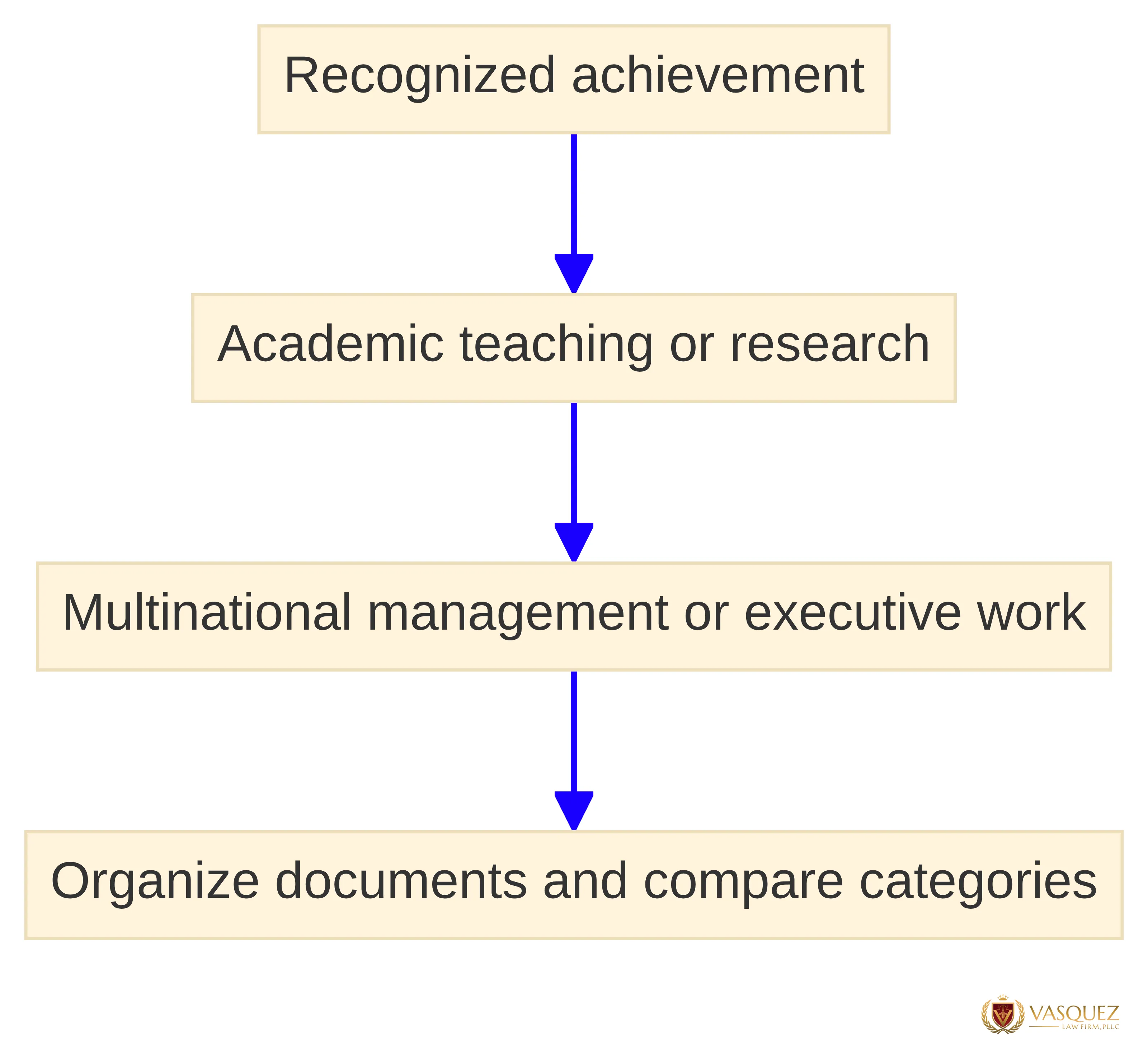
- Does your record center on recognized achievement in a field such as science, business, education, the arts, or athletics?
- Does your record center on academic teaching or research and an offered position connected to that work?
- Does your record center on management or executive responsibility in a multinational business structure?
The first answer may point toward EB-1A, the second toward EB-1B, and the third toward EB-1C. That shorthand helps you organize questions; it does not decide eligibility.
The category label alone cannot establish that you qualify. USCIS guidance identifies the three EB-1 groups, while the applicable rules and evidence requirements determine whether your facts fit one of them. Requirements and procedures can change, so use this comparison to prepare a focused review of current USCIS requirements and your documents rather than treating it as a filing checklist.
A useful opening file has three parts: your professional timeline, the employment or position connected to the proposed case, and the documents that show what you actually did. Keep those parts separate. A strong-looking résumé may identify possible evidence, but it does not by itself show which regulatory requirement a document addresses.
Use three profile signals to narrow the possibilities
Your professional record can be narrowed with three signals: the kind of achievement you can document, the academic work you can document, and the organizational role you can document. These signals are a sorting method, not legal conclusions.
1. Recognized achievement. An EB-1 extraordinary-ability inquiry begins with work in the sciences, arts, education, business, or athletics. If your record includes several of those kinds of material, examine the extraordinary-ability category against the current requirements.
2. Academic teaching or research. An EB-1 outstanding-professor-or-researcher inquiry begins with academic work. USCIS states that you must have at least three years of teaching and/or research experience in the academic field. The selected USCIS instructions also call for the actual job offer, including the job title and the terms and conditions of the offered position. If those facts describe your situation, organize the academic timeline and position documents before comparing individual evidence items.
3. Multinational management or executive work. USCIS identifies certain multinational managers and executives as the third EB-1 group. If your possible case depends on leadership across related organizations or offices in more than one country, place the organizational structure, your duties, and the relevant employment history at the center of the review. The category name is a starting signal, not proof that the required conditions are met.
Use the signals in sequence rather than trying to force every document into every category:
- Write a short description of the work you want the petition to recognize.
- Mark whether the record is mainly achievement-based, academic, or organizational.
- List the documents that show the work, not only documents that describe your title.
- Identify the category whose stated structure most closely matches those documents.
- Record the questions that still require current-rule or case-specific review.
This method keeps category selection tied to the record. It also prevents a single award, article, job title, or employer name from carrying more weight than the underlying facts support. To make the sorting more reliable, describe the same record in three separate sentences before choosing a branch: what work or achievement is being presented, what document or person shows that fact, and what employment or academic setting connects it to a category. If you cannot complete one of those sentences, mark the signal as an open question rather than treating the gap as an eligibility decision. This is especially useful when a record contains mixed signals. Academic authorship may appear in a broader achievement file, while an academic timeline may include research publications; the purpose of the material still needs to be identified in the comparison. Keep a short note explaining why each possible category remains in or leaves the review. That note gives the later evidence index a reasoned starting point without turning an early screen into an eligibility conclusion.
If the record centers on recognized achievement, examine EB-1 extraordinary ability
EB-1 extraordinary ability is the category to examine when your record centers on recognized work in the sciences, arts, education, business, or athletics. Those examples give you a way to sort your files by what each document is meant to show. They do not turn every award, membership, article, or judging invitation into qualifying evidence. The relevant question is whether the document connects to the requirement it is offered to support and whether its details fit the current rule.
USCIS identifies authorship of scholarly books or articles as an evidence item. Keep the publication and its connection to your field together when organizing authorship evidence.
A recognized-achievement record may also include judging or original research. USCIS identifies participation on a panel or individually as a judge of the work of others in the same or a similar field, and it identifies original scientific or scholarly research contributions of major significance in the field. Organize the underlying invitation, assignment, dates, field connection, and resulting work rather than listing the activity in a résumé without context.
Artistic records may require a different document pattern. The USCIS checklist identifies displays of your work at artistic exhibitions in more than one country as an evidence item. Keep exhibition information with proof that the displayed work was yours and with the dates and locations that explain the claim.
The extraordinary-ability category therefore calls for a document-by-document match. If your record contains only a broad reputation statement or a single notable accomplishment, pause before treating that item as a category answer. Map the record to the current USCIS requirements and obtain case-specific review before deciding that EB-1A is the appropriate filing path.
Treat evidence as proof of the requirement, not a collection of impressive documents
Evidence becomes useful when each document has a defined job. A résumé, award, article, letter, or contract should be connected to a particular requirement and explained through facts that can be checked. A large file without that structure can make it difficult to see what each exhibit is meant to establish.
Use a simple evidence note for every important document:
- Requirement: What current USCIS requirement are you addressing?
- Document: What is the exhibit, and who created it?
- Fact shown: What does the document actually establish?
- Field connection: How does it relate to your field or offered position?
- Limit: What does the document not establish by itself?
USCIS instructs filers in the outstanding-professor-or-researcher context to identify the applicable regulatory criteria and the evidence submitted for each criterion. That instruction supports a broader organizing habit: label the purpose of each exhibit before assembling the packet. Do not let the presence of a document substitute for an explanation of its relevance. To make the note usable during review, add two working fields: Source and date: who created or issued the document and when; Open gap: what fact still needs confirmation. These fields do not create a new legal test. They make it easier to distinguish a document that records an event from a document that explains the event’s significance. When one exhibit is relevant to more than one question, list each proposed use separately and state the fact it supports for each use. Do not assume that relevance to one criterion carries over to another. If the record contains a gap, label it directly—such as a missing date, unclear field connection, unexplained role, or incomplete position detail—rather than filling it with a favorable inference. This lets a professional reviewer see the proposed category, the factual support, and the precise point that remains unresolved.
The evidence type should match the proposition you want it to support. An award certificate may show that you received an award, but the award's scope, selection process, and connection to outstanding achievement require their own facts. A publication may show that material appeared in print, but an article about your work and an article authored by you are different evidence categories. A judging invitation may show that you were asked to judge, but the field relationship and nature of the judging assignment still matter.
A role document needs the same discipline. USCIS says that, when officers evaluate whether a role was leading or critical, they examine your actual leadership or contribution rather than merely your title. A letter can help explain the significance of your work, but the letter should be tied to facts about what you did and why that work mattered.
Use the evidence list as a filing map, not as a scorecard. Counted documents are not a substitute for a clear connection between your work and the requirement.
If the record centers on academic work, examine EB-1 outstanding professor or researcher
EB-1 outstanding professor or researcher is the category to examine when your possible case centers on academic teaching or research. Organize the academic timeline before comparing the evidence with the current USCIS instructions. The selected USCIS instructions also direct the filer to submit the actual job offer, including the job title and the terms and conditions of the offered position.
The experience record and the offered position create separate workstreams. Your experience file should show the academic field, the teaching or research work, and the period attributed to that work. Your position file should show the offered job, title, and terms and conditions. Do not combine the files so that a résumé or general employment letter is expected to answer every question.
Start with a timeline that names each institution, role, field, and period of teaching or research. Add documents that explain the nature of the work. Then place the offered position in a separate section and identify which document establishes the job title and which provisions describe the terms and conditions.
Academic achievement evidence can overlap with other professional records, but overlap does not remove the need to identify its purpose. USCIS lists original scientific or scholarly research contributions and authorship of scholarly books or articles among evidence items in the selected EB-1 guidance. Those materials may help explain your academic work, but the supporting file should still show what you contributed, where the work appeared, and how the document relates to the applicable requirement.
The three-year experience statement does not answer every other part of an academic petition. It addresses the experience requirement described in the selected USCIS instructions. The job offer addresses the offered position. The evidence index connects each additional document to the criterion it is intended to support.
If your academic history includes changes in institutions, fields, or positions, preserve the sequence instead of presenting only your current role. The selected USCIS instructions address documentation for positions held after an initial hire, so changes in employment deserve careful review against the current filing instructions.
Build an academic petition around a criterion-to-exhibit index
An academic petition benefits from a criterion-to-exhibit index because the index makes the purpose of each document visible. USCIS says that, for an outstanding-professor-or-researcher petition, the filer should identify which of the six regulatory criteria the beneficiary is attempting to satisfy and identify the evidence submitted for each requirement.
Build the index in a separate working document with four columns:
| Column | What to record |
|---|---|
| Regulatory criterion | The current criterion you are addressing |
| Exhibit | The document name and exhibit number |
| Factual point | The specific fact the document supports |
| Follow-up question | Any missing detail, translation, date, or field connection |
The index is an organizing tool. It does not establish that the evidence satisfies the criterion, and it does not replace the current USCIS instructions. Its immediate use is to show where a document belongs and which questions remain open before filing.
Review the index in this order:
- Confirm that the experience timeline addresses at least three years of teaching and/or research in the academic field, as stated in the selected USCIS instructions.
- Identify the offered position and attach the actual job offer with its job title and terms and conditions.
- List the regulatory criteria you are attempting to address.
- Match each exhibit to one or more stated factual points without using vague labels such as “strong evidence.”
- Mark documents that need translation, clarification, or confirmation against current instructions.
A document can be relevant without answering the entire petition. Keep the distinction visible. If an exhibit proves only that you authored an article, do not describe it as proof of the article's impact, field significance, or another proposition unless the document and current rule support that use.
If the record centers on multinational leadership, examine EB-1 multinational manager or executive
EB-1 multinational manager or executive is the category to examine when your possible case centers on management or executive work connected to a multinational organization. USCIS identifies certain multinational managers and executives as one of the three EB-1 groups. The word “certain” matters: the category label identifies the subject area, but it does not supply every condition required for your case.
Organize this possible pathway around the work and the organizational structure, not around the title printed on a business card. Begin with a list of the organizations involved, the countries connected to the employment history, the dates of each role, and the duties you actually performed. Then identify the proposed position and the relationship between the entities involved.
Use current USCIS requirements to test each part of that structure. The selected materials for this guide establish the category, but they do not provide a complete set of EB-1C eligibility criteria. Do not fill that gap with assumptions based on a senior title, an international employer, or a general description of management.
Leadership evidence should describe your actual contribution. A practical document question is: what did you control, direct, decide, or materially contribute to, and which records explain those facts? Depending on your circumstances, the answer may require organizational charts, duty descriptions, employment records, project documents, or letters from people with personal knowledge. Do not treat any one document type as automatically sufficient; match each document to the fact it can establish.
A multinational management or executive inquiry should remain open until the current category requirements and the facts of the employment structure have been reviewed together. If the record proves only a title but not the work behind it, the next action is to gather factual role evidence before choosing a filing strategy.
Separate a job title from the work the record proves
A job title is a label; the work record explains what the label meant in practice. USCIS says that officers evaluating a leading or critical role examine actual leadership or contribution and not merely the title. For an academic petition, USCIS separately directs the filer to provide the actual job offer with the job title and the terms and conditions of the offered position. Those instructions show why title, duties, and position terms should be documented as separate facts.
Use three columns in your role summary:
- Title: The formal title shown in the employment or offer document.
- Duties: The work you performed, including responsibilities, decisions, supervision, or research activity that the records support.
- Significance: The factual explanation of how the work related to the organization, division, academic field, or proposed position.
Do not use “manager,” “executive,” “professor,” “researcher,” or “leader” as a conclusion without describing the underlying work. A title can identify the role for review. It cannot, by itself, answer the legal question.
Letters can help explain a role when the writer has personal knowledge of your work and its significance. USCIS identifies personal-knowledge letters as potentially helpful when evaluating the significance of a leading or critical role. The letter should therefore do more than repeat your résumé. It should identify the writer's relationship to the work, the facts the writer knows, and why your contribution mattered to the organization or relevant division.
Compare the letter with independent records. If the letter describes responsibility for a project, look for documents that identify the project, your role, and the result or organizational activity connected to it. If the letter describes academic teaching or research, place it beside the timeline and offered-position documents. If the records do not line up, preserve the discrepancy as a question for professional review instead of choosing the more favorable description.
Compare category fit before choosing a filing strategy
The three EB-1 groups can be compared by the center of your record and the documents that need early attention. The table does not determine eligibility; it identifies the next factual question for each category.
| Category | Record center | Evidence or condition established in the guidance | First question to investigate |
|---|---|---|---|
| EB-1A extraordinary ability | Recognized achievement in the sciences, arts, education, business, or athletics | USCIS lists awards, qualifying memberships, published material about your work, judging, original research contributions, and scholarly authorship among evidence items | Which current requirements do your achievement documents address, and what facts explain their field connection? |
| EB-1B outstanding professor or researcher | Academic teaching or research | USCIS states at least three years of teaching and/or research experience in the academic field and identifies an actual job offer with the title and terms and conditions | Can your timeline and position documents establish the stated experience and offered position requirements? |
| EB-1C multinational manager or executive | Management or executive work in the multinational category | USCIS identifies certain multinational managers and executives as an EB-1 group; the complete conditions require current-rule review | What do the organizational records and duty evidence show about the relevant employment structure and your actual work? |
Use the table as a branching tool:
- Choose an extraordinary-ability review when recognized achievement is the organizing fact and your documents can be connected to the applicable evidence categories.
- Choose an outstanding-professor-or-researcher review when academic teaching or research, the stated experience period, and an offered position are central to the record.
- Choose a multinational-manager-or-executive review when the employment structure and actual management or executive work are central, then test the complete conditions under current USCIS requirements.
If two branches appear plausible, do not select one because its title sounds more favorable. Build a short comparison using the same timeline, role descriptions, and evidence inventory, then ask which branch can be supported with the clearest facts. A useful worksheet can give each branch the same fields: the central work being presented, the category-specific condition identified in the current guidance, the documents that address that condition, and the questions that remain unanswered. For EB-1A, describe the recognized achievement and the evidence item the document is meant to address. For EB-1B, separate the academic timeline, the stated three-year teaching or research experience, and the actual offered position. For EB-1C, describe the multinational organizational setting and the actual management or executive work while marking the complete conditions for current-rule review. Use descriptions such as “supported,” “unclear,” or “not yet documented” as working labels, not as legal conclusions. Do not resolve a comparison by counting exhibits or by assuming that a title supplies the missing facts. The purpose of the worksheet is to show where the record is coherent, where it overlaps, and what must be confirmed before a filing strategy is chosen.
Mark what the available record cannot answer
An EB-1 comparison cannot answer whether you qualify from a title, résumé, award, article, or short description of your work. Category selection also cannot answer every procedural question, including which current filing instructions apply to your facts or whether a particular document satisfies a requirement.
Mark these boundaries in your working file:
- The category label identifies the general group, not your eligibility.
- An evidence example identifies a possible document type, not an automatic result.
- A three-year academic experience statement applies to the outstanding-professor-or-researcher requirement described by USCIS, not to every EB-1 category.
- A job offer with title and terms is a stated academic-petition document, not a universal condition that can be transferred to every EB-1 branch.
- A leadership title does not establish the actual contribution USCIS says officers assess.
These boundaries keep you from carrying a fact from one category into another. Treat each requirement as attached to the category and rule that state it.
Open questions deserve a separate page rather than a guess. Write down whether your documents establish the dates, field, role, organizational relationship, offered position, publication details, judging assignment, research contribution, or other fact under review. Then identify what would answer the question: an employment record, contract, publication, organizational document, letter, or current USCIS instruction.
If the question affects a consequential filing decision, pause before submitting anything. A case-specific immigration review should resolve how the requirement applies to your facts, which documents need clarification, and whether another category should remain in the comparison.
Assemble a focused review packet
A focused review packet should let you explain your category choice without searching through an unstructured archive. Put the documents in five groups:
- Identity and immigration history: Your basic case information, prior filings, notices, and status documents relevant to the question you want reviewed.
- Professional timeline: Employers, institutions, positions, fields, dates, teaching or research periods, and changes in role.
- Category evidence: Awards, memberships, publications, judging records, research contributions, exhibition records, academic materials, or organizational documents that relate to the possible category.
- Position and employment documents: The offered position, job title, terms and conditions, employment records, and documents that explain the organizational structure.
- Open questions: A one-page list of unclear dates, missing records, translations, field connections, and current-rule questions.
For an outstanding-professor-or-researcher inquiry, include the criterion-to-exhibit index. USCIS directs the filer to identify the applicable criteria and match evidence to each one. For an extraordinary-ability inquiry, separate evidence about your work from work you authored, and identify the purpose of each exhibit.
Use the packet to support a conversation, not to announce a conclusion. Put a short note at the front stating the category or categories you want to compare and the facts that led you there. Follow that note with the timeline, evidence index, and documents in a consistent order.
Label each file with its date and subject. Preserve the original language and prepare translations where needed under the applicable instructions. When a role is central, include records that explain actual duties and contribution rather than relying only on the title. When a publication or award is central, include the details that identify what it was, who issued or published it, and how it connects to your field.
A packet is ready for review when you can answer three practical questions: what category are you examining, what requirement does each major document address, and what remains uncertain? If you cannot answer those questions, organize the missing facts before treating the packet as complete.
Verify the current rule before relying on the comparison
USCIS requirements and filing procedures can change, so confirm the current rule before you rely on a category comparison or prepare a filing. Check the current USCIS page for the relevant EB-1 group, the applicable policy guidance, the Form I-140 instructions, and the filing procedures that apply to your case.
Compare the current instruction with your packet in four places:
- The category definition and eligibility conditions.
- The evidence required for each criterion.
- The job offer, employment, or organizational documents required for the category.
- The filing form, filing location, fees, and procedural directions applicable at the time of filing.
Use the current text for the filing decision. An older checklist, a general online explanation, or a document prepared for another category may not answer the requirements that apply to you. Keep a verification log while doing this review. For each important conclusion, note whether it comes from the current USCIS guidance, from a document in your own record, or from an unresolved question. Then check that the source and the document are addressing the same EB-1 category. If a statement in a general comparison cannot be connected to the current category guidance or to a fact in your packet, leave it marked for confirmation instead of treating it as established. Revisit the category definition, evidence discussion, position or employment conditions, and filing directions together before relying on the comparison. This record of what was checked and what remains open can also help focus the questions presented for professional review.
The selected USCIS instructions specifically direct an outstanding-professor-or-researcher filer to identify the applicable criteria and the evidence submitted for each one. That makes the final pre-filing check concrete: compare every listed criterion with the exhibit index, confirm that the documents address the stated facts, and mark unresolved issues for professional review.
Do not use a general comparison to predict approval, a processing result, or a filing timeline. Use it to identify the correct category question and the documents needed to discuss that question.
Use professional review to choose the next question
Your next question should be specific: which EB-1 category best matches the work you can document, which current requirements apply, and which facts still need support? A focused packet gives an immigration attorney the timeline, category comparison, evidence index, and open issues needed for a more useful discussion. It also keeps you from treating a general explanation as an individualized eligibility decision.
A qualified immigration professional should assess your individual suitability, the current rules, and the consequences of filing based on your complete facts. Bring your organized packet, identify the category or categories you are considering, and ask which requirement each major document is intended to address. Start now
What should I verify before relying on an EB-1 comparison?
What are the main EB-1 categories for green card eligibility?
The main EB-1 categories include EB-1A for individuals with extraordinary ability in the sciences, arts, education, business, or athletics; EB-1B for outstanding professors and researchers; and EB-1C for certain multinational managers and executives.
What types of evidence are needed for an EB-1A extraordinary ability petition?
For an EB-1A petition, evidence may include major awards, memberships requiring outstanding achievement, published material about the individual's work, judging the work of others, original research contributions, and authorship of scholarly articles.
What should I do if I have questions about my eligibility for an EB-1 category?
If you have questions about your eligibility, it is advisable to consult with an immigration attorney who can provide personalized guidance based on your specific circumstances.
How do I prepare my documents for an EB-1 petition?
Organize your documents into categories such as identity and immigration history, professional timeline, category evidence, position documents, and open questions to facilitate a focused review.
Sources
- Checklist of Required Initial Evidence for Form I-140 (for informational purposes only) | USCIS — www.uscis.gov
- Green Card for Employment-Based Immigrants | USCIS — www.uscis.gov
- Petition Filing and Processing Procedures for Form I-140, Immigrant Petition for Alien Workers | USCIS — www.uscis.gov
- Chapter 2 - Extraordinary Ability — www.uscis.gov