

Decide whether the NIW is worth investigating
The EB-2 National Interest Waiver is worth investigating when you can evaluate two separate questions: whether your case has an EB-2 foundation, and whether the record supports waiving the usual job-offer and labor-certification requirements. The NIW is a self-petition pathway within the broader EB-2 category. It can allow you to file Form I-140 directly with USCIS when you establish that your proposed work benefits the United States enough to justify the waiver.
That flexibility does not turn the process into a one-document test. The Dhanasar framework considers whether you are well positioned to advance the proposed work and whether the United States would benefit from waiving the standard requirements. Your task at the investigation stage is not to predict approval. It is to determine whether those questions can be answered with a specific, coherent record.
Start with this working decision:
- Investigate further if you can identify an EB-2 basis, describe the work you intend to advance, and connect your education, experience, skills, or other available documentation to the three waiver questions. Write down the basis and the records that support it before treating the NIW as a filing option.
- Pause before relying on the NIW label if you are an entrepreneur and your plan depends mainly on broad assertions about general economic benefits or possible job creation; those assertions alone do not establish eligibility. Narrow the proposed endeavor and identify the missing connection before relying on those statements.
- Seek focused legal review if your immigration history, prior filings, proposed work, or available documents make the category or waiver analysis difficult to separate. Bring the specific uncertainty to the consultation rather than treating a general description as a case decision.
The rest of this guide gives you a way to organize that inquiry without making a case-specific eligibility conclusion.
Separate the EB-2 foundation from the waiver question
The NIW is a separate waiver question within EB-2, so a strong description of your proposed work does not by itself answer the foundation question. If you cannot connect your records to a specific basis, keep that connection as an open issue for individualized review.
Treat the inquiry as two connected columns:
- EB-2 foundation: What EB-2 basis would you ask an immigration professional to evaluate, and what records support that basis?
- NIW request: Why should the usual job-offer and PERM requirements be waived for the proposed endeavor?
Keeping these columns separate prevents a common planning error: treating national importance as though it automatically establishes the underlying classification. The accepted NIW description supports the waiver of the job-offer and PERM requirements within EB-2; it does not make the category question disappear.
Use these questions to organize your first review:
- What specific EB-2 basis would you ask an immigration professional to evaluate?
- Which records describe your education, experience, skills, or other qualifications relevant to that basis?
- What is the proposed endeavor, stated as work you intend to advance in the United States rather than as a general job title?
- Which part of your record connects you to that endeavor?
- Which documents address the waiver questions, rather than only describing your background?
USCIS reviews education, experience, and skills together with the benefit to the national interest when assessing an NIW case. It also considers the evidence as a whole, so a document that helps with one part of the inquiry does not necessarily answer every part. Build your assessment around the relationship among the category, the endeavor, and the waiver—not around a single credential.
For each document, write four short notes: what fact it shows, which question it addresses, how it connects to the proposed endeavor, and what remains unclear. This keeps background material from being mistaken for a complete waiver showing. If you cannot explain the connection in plain language, mark that item for further review instead of assigning it a result.
Use the three waiver questions to test the case
USCIS applies the Dhanasar framework through three questions. The questions are related, but they measure different things, so answer each one separately before drawing an overall conclusion. The first focuses on the proposed endeavor, the second on your position to advance it, and the third on the reason to waive the standard requirements.
1. Does the proposed endeavor have national importance?
Describe the work itself and the significance of advancing it. This question is about the proposed endeavor, not simply the size of your employer, the popularity of your occupation, or the fact that the work could produce a general benefit. Your explanation should identify what you intend to advance and why the endeavor has significance beyond an unsupported assertion.
2. Are you well positioned to advance the proposed endeavor?
Connect your record to the work you propose. USCIS may review your education, experience, and skills as part of the overall assessment. The question is not whether you can promise a favorable result. It is whether the record establishes that you are well positioned to advance the endeavor.
You do not have to prove that the proposed endeavor is more likely than not to succeed. You do have to establish by a preponderance of the evidence that you are well positioned to advance it. That distinction leaves room for uncertainty about the future while still requiring a supported showing about your preparation and ability to move the work forward.
3. Would the United States benefit from waiving the job-offer and labor-certification requirements?
This is the balancing question. The issue is not simply whether your work has value. It is whether, on balance, the benefit to the United States supports waiving the standard requirements in your circumstances. Explain why the waiver makes sense in relation to the proposed endeavor and the record you have assembled.
A useful self-check is to write one short answer for each question without reusing the same sentence three times:
- Endeavor: What work are you proposing, and what makes its importance more than a broad promise?
- Position: What does your record show about your ability to advance that work?
- Waiver: Why would waiving the job-offer and labor-certification requirements benefit the United States on balance?
Then look for gaps between the answers. A detailed background may show preparation but say little about the importance of the proposed endeavor. A compelling description of the endeavor may say little about your ability to advance it. A general benefit may not explain why the standard requirements should be waived. Those are separate decision points, not wording problems that one paragraph can automatically solve.
Keep the three answers proportional to the questions they address. A résumé may help explain your preparation, but it does not by itself define the endeavor or establish why the waiver should apply. A business plan may describe future work, but it does not by itself establish your position to advance that work. Treat each document as part of a connected record rather than as a substitute for the analysis.
Map the evidence to the proposed endeavor
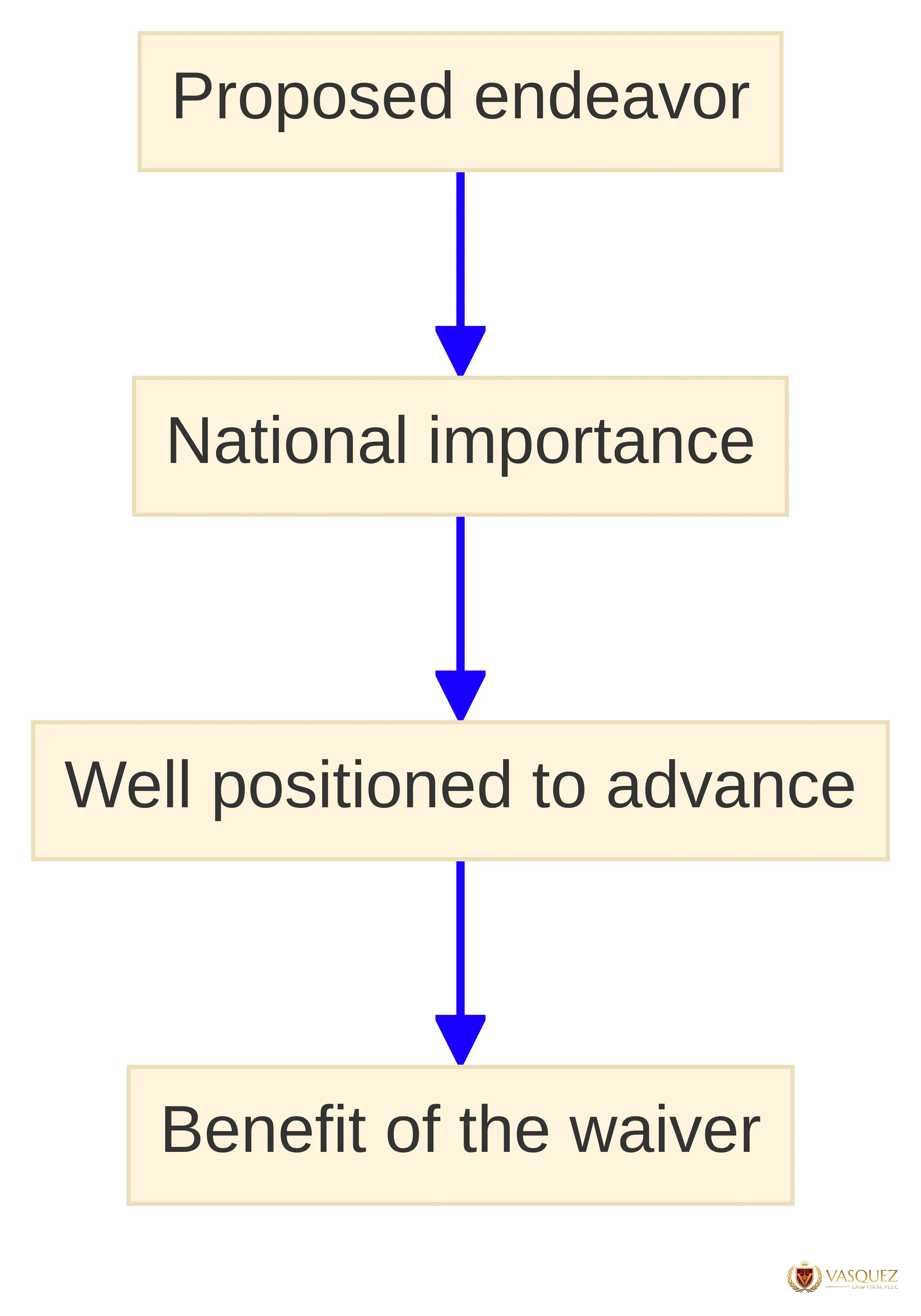
The proposed endeavor should be the organizing point for your record. Instead of collecting documents because they sound impressive, identify the question each document helps answer and the connection it has to the work you intend to advance.
Use a simple four-part map:
- Define the work. Write what you intend to advance in concrete terms. Keep the description narrower than a general statement such as “help the U.S. economy.”
- Explain its significance. Identify why the endeavor has national importance, using a description of the work rather than a slogan.
- Connect your record. Note how your education, experience, skills, letters of support, business plans, or other available material relates to your ability to advance that endeavor. Letters and business plans can be relevant in the circumstances discussed by USCIS, but no single item automatically establishes eligibility.
- Address the waiver balance. Explain why the United States would benefit from waiving the usual job-offer and labor-certification requirements for this endeavor.
This map is a practical organizing aid, not a promise that any particular document will carry a particular result. USCIS evaluates the evidence in the aggregate, and the value of a document depends on the question it answers and the connection it establishes.
Before seeking a consultation, create four headings on a working sheet: proposed endeavor, national importance, ability to advance, and benefit of the waiver. Under each heading, list the documents and facts you would use, then mark whether the connection is direct, indirect, or still unclear.
For each entry, add the name of the document, the fact you expect it to support, and the question it does not answer. For example, a record of past experience may support your background while leaving the proposed endeavor or the waiver balance unexplained. This format makes it easier to spot a gap before you organize a filing.
The exercise helps you distinguish a document that proves something about your past from a document that explains why your past matters to the future work you propose. It also shows where you are relying on a broad statement instead of a concrete connection. Bring the questions and gaps to an individualized discussion rather than treating the worksheet as an eligibility decision.
Look beyond broad promises of economic benefit
Broad promises about economic benefits or possible job creation do not establish an entrepreneur’s NIW qualification by themselves. USCIS has clarified that not every entrepreneur qualifies for an NIW and that general assertions need more evidence.
That boundary matters even when your work could have economic effects. Replace a general promise with a clearer explanation of the proposed endeavor, the part you intend to advance, and the record connecting you to it. Do not assume that a business plan, projected jobs, or a favorable description answers all three waiver questions merely because it sounds persuasive.
Ask yourself:
- Does the proposed endeavor identify work, rather than only a desired economic result?
- Does your record explain why you are well positioned to advance that work?
- Does the waiver explanation address the standard job-offer and labor-certification requirements?
- Are you treating one projection, credential, or letter as though it decides the entire case?
USCIS considers the record as a whole. A stronger presentation is therefore not necessarily a longer list of documents; it is a clearer explanation of how the documents relate to the three questions.
Use the same standard for language in your proposed endeavor. Words such as “benefit,” “impact,” or “innovation” do not explain the work by themselves. Follow each broad term with the activity you intend to advance and the connection between that activity and your record. If the explanation remains a general promise, keep it marked as an issue for review.
Compare NIW flexibility with its proof burden
The NIW changes the requirements you must analyze; it does not remove the need for a detailed record. This comparison keeps the trade-off visible:
| Shared question | NIW pathway | Standard EB-2 job-offer-and-PERM route |
|---|---|---|
| Job offer | The usual job-offer requirement may be waived when the NIW showing supports it. | The job offer remains part of the standard requirements described for comparison. |
| PERM or labor certification | The usual PERM or labor-certification requirement may be waived. | The standard process includes the labor-certification requirement. |
| The comparison centers on the standard job-offer and labor-certification requirements rather than a conclusion about every filing detail. | ||
| Main proof focus | You must address national importance, being well positioned to advance the endeavor, and the benefit of the waiver. | The NIW-specific three-prong waiver analysis is not the same question as meeting the standard requirements. |
| Practical trade-off | More flexibility around the job offer and PERM requirements, paired with a fact-specific waiver showing. | A different structure that retains the standard requirements described above. |
The comparison does not tell you which route fits your circumstances. It tells you what to compare: the requirements you would avoid, the showing you would need instead, and the record available to support that showing.
Do not describe the NIW as an easier version of EB-2. Its flexibility may matter if you do not have the standard job-offer and PERM structure, but the waiver request shifts attention toward the proposed endeavor and the full evidentiary record. USCIS also warns that no single credential or document necessarily establishes eligibility by itself.
A useful comparison question is: Which route gives you the clearer supported explanation, not merely the more attractive label? If the standard requirements are workable and your NIW record is speculative, the apparent flexibility may not answer your real problem. If the NIW record is coherent but a standard job-offer route would not reflect your circumstances, the waiver deserves focused investigation.
Write down the trade-off in practical terms before choosing what to discuss. Identify which standard requirement is relevant to your circumstances, which NIW question would replace it, and what material you have for that question. If you cannot name all three, stop at comparison and request case-specific guidance rather than treating the table as a route selection.
Move from fit assessment to filing decisions
For a general filing overview, organize the pathway around decisions rather than around a form checklist:
- Review the EB-2 foundation. Name the basis you want evaluated, then organize records describing your education, experience, and skills that are relevant to it. Any unclear connection becomes a question for individualized review before filing.
- State the proposed endeavor. Describe the work you intend to advance in the United States with enough specificity to test its significance.
- Apply the three waiver questions. Address national importance, whether you are well positioned to advance the endeavor, and whether the United States would benefit from waiving the standard requirements.
- Build the record around those answers. USCIS evaluates the evidence in the aggregate, so arrange documents and explanations so their relationships are clear.
- Check current requirements before filing. The relevant guidance and requirements are date-sensitive, so do not treat a general explanation as a substitute for the rules in effect when you file.
These steps help you reach a filing decision without pretending that the decision can be made from the NIW label alone.
If your matter includes a prior petition decision or motion, add another question: Does the new material address the decision being challenged? A nonprecedent USCIS decision illustrates that evidence aimed at an earlier decision may not explain why a later decision should be reopened. That example is case-specific, but it gives you a practical boundary: organize new facts and documents around the decision or issue they are meant to address.
For an initial filing, use the same discipline. Name the waiver question first, then place the supporting material underneath it. This makes it easier to see whether your explanation has a missing link before you commit to a filing strategy.
Keep a separate list of decisions that depend on facts you have not resolved, such as the EB-2 foundation, the definition of the endeavor, or the relationship between your record and the proposed work. Take that list into a consultation. It is more useful than presenting an unranked collection of documents because it identifies the questions that must be answered before a filing choice.
Plan for timing variables without relying on promises
Timing questions can depend on the readiness of the EB-2 foundation, the clarity of the proposed endeavor, the time needed to organize the record, and requirements or guidance in effect when you file. The available guidance is date-sensitive, so current USCIS requirements and processing information should be checked before filing.
Use questions instead of promises:
- Which part of the record still needs development before a filing decision?
- What current requirements apply to the intended filing?
- Which filing route applies, what current visa-availability information should you verify, and which dates or later procedural stages should you track after the petition is filed?
- What would change if the proposed endeavor or immigration circumstances changed before filing?
A consultation can help turn those questions into a case-specific planning discussion. Do not choose a route solely because someone attaches a completion estimate to a fact-specific process.
The uncertainty is not a reason to abandon the inquiry. It is a reason to separate what you can prepare now from what depends on current rules and the facts of your case. You can define the proposed endeavor, organize your immigration documents, map your record to the three waiver questions, and identify the points that require current review. You should not treat preparation as a prediction of approval or a promise about when the process will finish.
Create a simple chronology of your immigration history and intended filing decisions. Mark facts that could change before filing, documents that may need updating, and questions that depend on the rules in effect at that time. This gives you a planning record without turning an estimate into a promise. Keep any date-sensitive question open until it receives current, case-specific review.
Know when individualized immigration review is important
Individualized immigration review becomes especially useful when you cannot clearly separate the EB-2 foundation from the NIW request, or when the connection between your proposed endeavor and your record is uncertain. Consider requesting focused review if:
- You are unsure which EB-2 basis your case would rely on.
- Your proposed endeavor is described mainly through a job title, industry label, or general economic promise.
- You have education, experience, or skills that appear relevant but cannot explain how they position you to advance the specific endeavor.
- Your documents address your background but do not address national importance or the benefit of waiving the standard requirements.
- You are relying on projected economic benefits or possible job creation without additional support.
- A prior petition, decision, or motion affects the questions you need to answer.
- Your immigration documents or correspondence contain facts that may change how the pathway should be analyzed.
These indicators do not determine eligibility. They show where a general overview stops being enough for a responsible planning decision.
Before contacting an immigration lawyer, write down the exact question you want answered. For example: “What EB-2 foundation should be evaluated?” “How should I define the proposed endeavor?” or “Which part of the three-prong framework is least supported by my current record?” A focused question gives the discussion a clear starting point.
We offer legal help for immigration issues. Bring the facts that explain your immigration history and the work you intend to advance, rather than relying on the NIW title to describe your situation.
Organize the conversation around the point that could change your next step. If the uncertainty concerns the category, start there. If the category is clear but the proposed endeavor is broad, start by defining the work. If the record is organized but the waiver balance remains unclear, bring that specific question instead of asking for a general prediction.
Prepare your information for a focused consultation
A focused consultation starts with organized facts, not a conclusion about eligibility. Prepare a short description of the work you want to advance, the EB-2 question you need evaluated, and your answers to the three waiver questions. Then gather relevant immigration documents, including green cards, previous visa applications, work permits, and correspondence with immigration authorities.
Use your materials to ask:
- What EB-2 foundation should be analyzed?
- Is the proposed endeavor specific enough to assess national importance?
- What shows that you are well positioned to advance it?
- How does the record address the benefit of waiving the job-offer and labor-certification requirements?
- Which current requirements or timing variables need attention before filing?
Only a qualified immigration professional can assess how the law applies to your individual circumstances. Start now.
What should you ask before pursuing an NIW?
What is the EB-2 National Interest Waiver (NIW)?
The EB-2 NIW is a self-petition pathway within the EB-2 category that allows individuals to apply for a green card without a job offer or labor certification if they can demonstrate that their work benefits the United States sufficiently to justify waiving these requirements.
Who qualifies for the NIW green card?
To qualify for the NIW, a petitioner must show that their proposed endeavor has national importance, that they are well positioned to advance it, and that waiving the job-offer and labor-certification requirements would benefit the United States.
What are the major decision points in the NIW application process?
Key decision points include identifying the EB-2 foundation, defining the proposed endeavor, addressing the three waiver questions regarding national importance, the petitioner's ability to advance the endeavor, and the benefits of waiving standard requirements.
When should I seek professional immigration advice regarding the NIW?
Consider seeking professional advice if you are unsure about your EB-2 basis, if your proposed endeavor is vague, or if you have documents that do not clearly address the national importance or waiver benefit.
What documents should I gather before consulting an immigration lawyer about the NIW?
You should gather relevant immigration documents, including green cards, previous visa applications, work permits, and any correspondence with immigration authorities to provide a comprehensive overview of your situation.