
What the current Honduras TPS question requires
The current Honduras TPS question cannot be answered by citing one historical date. As of October 30, 2026, the USCIS information addressed here reports that the Secretary of Homeland Security determined Honduras no longer met the conditions for its designation, identifies September 8, 2025, as the date the designation and related benefits terminated, and also records later federal court developments. The same record says a district court vacated the termination decision on December 31, 2025, while the Ninth Circuit stayed that order on February 9, 2026.
The practical answer is that USCIS’s stated termination date and the later court orders must be read together. The July 8, 2025 publication date is the date of the termination notice, not the same event as the stated September 8, 2025 termination date. The December 31, 2025 vacatur and February 9, 2026 stay then changed the legal posture described in the official record. Before you rely on a status, date, benefit, or employment-document conclusion, check the latest USCIS information and the relevant court or Federal Register notices.
The distinction between general TPS rules and Honduras-specific developments is central to this guide. General information cannot determine whether you qualify, whether a document remains sufficient for your situation, or what an immigration decision means for your individual history. Use the dated sequence below to identify what needs checking, then treat personal facts as a separate question.
TPS in plain language
Temporary Protected Status, commonly called TPS, is a temporary form of protection that the Secretary of Homeland Security may designate for a foreign country when specified conditions make return unsafe for the country’s nationals. Those conditions may include ongoing armed conflict, a natural environmental disaster such as an epidemic, or another existing extraordinary and temporary condition that temporarily prevents safe return. A designation is country-specific and does not exist simply because a person is from a country that has experienced hardship.
USCIS may grant TPS to eligible nationals of a designated country who are already in the United States. USCIS may also grant TPS to eligible people without nationality who last resided in the designated country and are already in the United States. The word “eligible” matters: nationality or last residence connects a person to the designated country, but it does not by itself establish that every other applicable requirement has been met.
TPS addresses temporary protection from return under the United States immigration framework. It is not a general statement that every person from the designated country has the same immigration status, and it is not a permanent immigration category. The relevant question for Honduras is therefore two-part: what does the current official record say about the country’s designation, and how do the applicable rules relate to your own dates and history? Keep those questions separate.
Family members need their own careful review. A relative’s nationality, residence, application, or TPS history does not provide enough information to decide another person’s circumstances. The general rule described by USCIS concerns eligible nationals or eligible stateless people who last resided in the designated country and are already in the United States; it does not turn a family relationship into an automatic answer.
What general TPS information can and cannot establish
TPS and work authorization are connected, but the connection has defined limits. USCIS states that people granted TPS, or found preliminarily eligible for TPS during initial review, are authorized to work. That statement describes the people identified in the rule; it does not establish that every Honduran national, every former beneficiary, or every person who once filed an application has current work authorization.
Continuous residence concerns the period a person has lived in the United States, while continuous physical presence concerns time physically spent in the country. The applicable dates come from the country-specific designation notice, so a general explanation cannot substitute for checking the Honduras notice and your own timeline.
General TPS information can help you identify the questions that need answers, but it cannot establish your eligibility or resolve your immigration history. It also cannot tell you whether a particular employment document, filing history, or period outside the United States changes your position. Treat work authorization and residence requirements as separate checkpoints rather than assuming that one favorable fact answers the whole matter.
The following questions keep the general rule within its proper limits:
- What country-specific designation notice supplies the relevant residence and physical-presence dates?
- Which facts show where you lived and when you were physically present in the United States?
- What official information supports any conclusion about your work authorization?
- Which parts of your situation remain personal facts rather than general program information?
A “yes” to one question does not automatically answer the others.
The Honduras TPS timeline from termination to court review
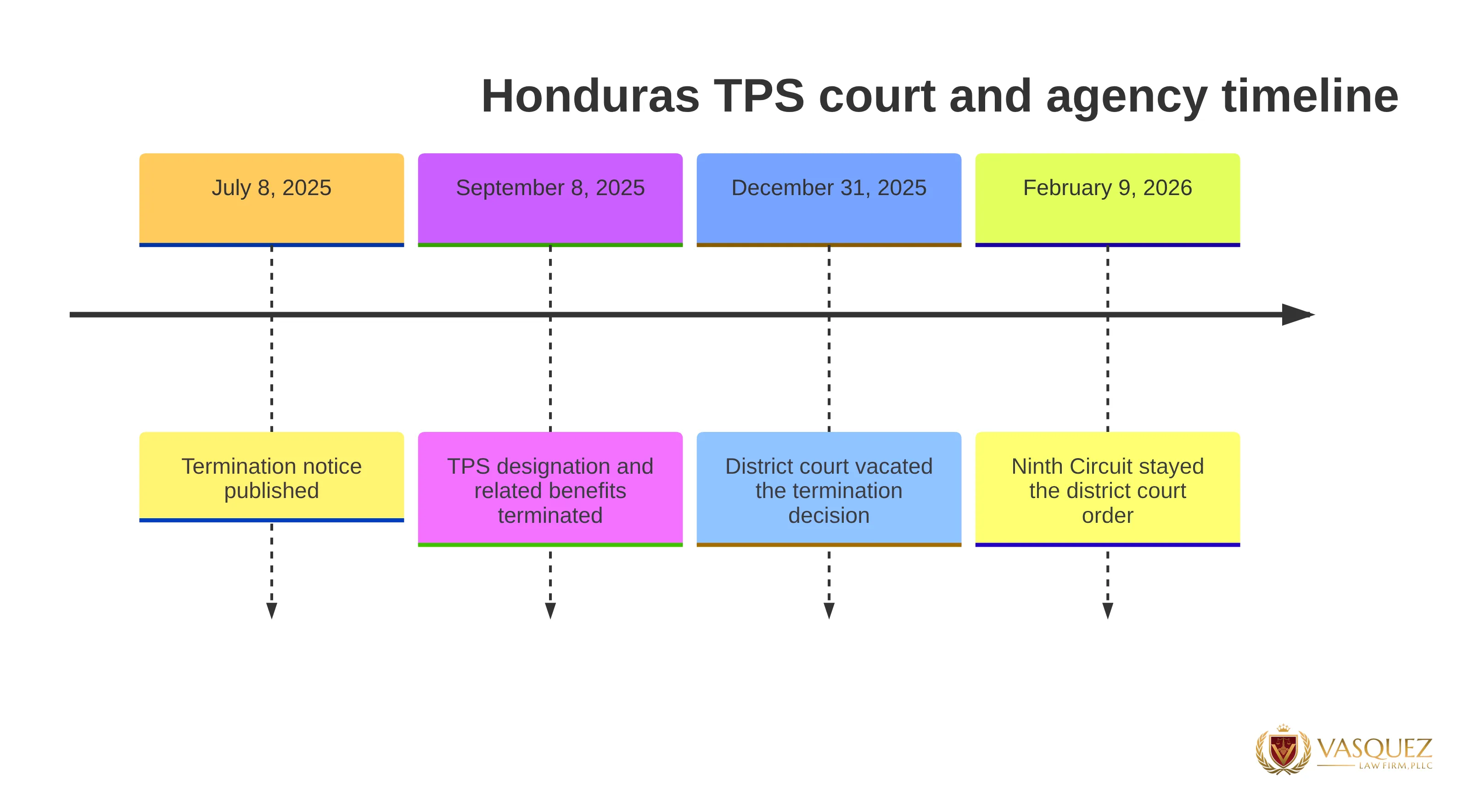
The Honduras TPS timeline contains four dates that perform different functions. Reading the dates in order prevents the publication date, stated termination date, district-court order, and appellate stay from being treated as interchangeable.
The dated sequence is:
- July 8, 2025: The termination notice was published after the Secretary of Homeland Security determined that Honduras no longer met the conditions for its TPS designation.
- September 8, 2025: USCIS states that the Honduras TPS designation and related benefits terminated on this date.
- December 31, 2025: The U.S. District Court for the Northern District of California issued an order vacating the Secretary’s TPS termination decision for Honduras.
- February 9, 2026: The Ninth Circuit Court of Appeals stayed the district-court order.
The sequence shows why a date-only answer is incomplete. July 8 identifies publication of the notice, and September 8 is the termination date USCIS states. December 31 records a later district-court order, while February 9 records an appellate stay of that order. If you find a page or post that mentions only one of these dates, continue to the latest official agency and court information before relying on it.
A personal verification record can organize your research without turning it into a legal conclusion:
- Write the title and date of each official notice or court order you locate.
- Label each item as an agency notice, district-court order, or appellate order.
- Record what the item says about the designation, the termination decision, or the order’s operation.
- Mark the date on which you checked the information.
- Note the specific question that the item does not answer about your circumstances.
This record organizes the status question. It does not determine how the developments apply to your personal circumstances.
How the district-court order and Ninth Circuit stay affect the picture
The February 9, 2026 Ninth Circuit order adds another layer. A stay must therefore be included when you evaluate what the December order means in practice; the district-court order cannot be treated as an unqualified answer that the termination decision was undone.
The described court developments do not support collapsing the case into either “the termination definitely ended the issue” or “the district-court vacatur automatically restored every prior consequence.” The official account contains an agency termination position, a district-court vacatur, and an appellate stay. Those events explain the legal posture reported in the record; they do not, by themselves, decide your eligibility, work-document position, or other immigration questions.
A court-update review should separate three questions:
- What decision is being challenged? Here, the dispute concerns the Secretary’s termination decision for Honduras.
- What did the court order do? The district court issued a vacatur order, and the Ninth Circuit later stayed that order.
- What remains unresolved for you? Your own dates, status history, documents, and other facts still require separate review.
This structure keeps a procedural development from becoming an individualized conclusion.
A practical USCIS and court-notice verification workflow
The official-record workflow starts with the USCIS TPS page and its Honduras-specific information. Use the page to identify the agency’s stated termination date, the notice date, and the court developments described there. Then compare those statements with the underlying Federal Register and court materials rather than relying on a search-result summary or an undated explanation.
The verification workflow can follow these steps:
- Check the USCIS Honduras TPS information. Record the page title, the date you accessed it, and every current alert or status statement.
- Locate the termination notice. Confirm that the notice was published on July 8, 2025, and distinguish that publication date from USCIS’s stated September 8, 2025 termination date.
- Locate the court developments. Record the December 31, 2025 district-court order and the February 9, 2026 Ninth Circuit stay as separate entries.
- Recheck before acting. Status and document consequences require information that is current on the day you rely on it.
Work-document questions require an additional check. USCIS states that people granted TPS, or found preliminarily eligible upon initial review, are authorized to work. Do not turn that general statement into a conclusion about your own employment document. Match any work-authorization question to the official information for your status and the dates involved, and preserve the notices or records on which you rely.
A useful verification log can contain five columns: source or notice title, issuing authority, publication or order date, statement that affects the status question, and the date you checked it. Add a final column for the personal question that remains unanswered. You can also mark whether the item is an agency notice, a district-court order, or an appellate order. The log gives you a focused list to discuss if the official materials do not resolve how the timeline relates to your circumstances. The log can also help you identify the kind of uncertainty you have, which prevents a broad status question from hiding several different issues. If the uncertainty is about what USCIS currently reports, mark it as an agency-information question. If it is about what was published, record the Federal Register notice separately. If it is about the effect of a court development, identify the particular order and whether the material describes its operation. If it concerns your dates, documents, or history, label it as a personal-facts question rather than treating a general page as an answer. This classification does not resolve the issue, but it tells you what record to recheck and what question remains open. Keep the original wording of each source in your notes when possible, because a short summary may omit whether a statement describes a date, a decision, or an order.
When the answer requires review of personal facts
A personal-facts packet can connect the official rules to your situation:
- Your nationality or last country of residence, as relevant to the TPS framework.
- The dates and records showing where you lived in the United States.
- The dates and records showing your physical presence in the United States.
- Any USCIS notices, prior applications, or work-authorization documents connected to the issue.
- The exact question you need answered about the termination notice, court orders, or current documents.
This list prepares the factual record. It does not predict an eligibility result.
Work-authorization review also requires personal facts when your question concerns a particular document or period. The general USCIS statement covers people granted TPS or found preliminarily eligible upon initial review; it does not identify the result for every person who has a Honduras connection or a prior TPS-related record. Keep the general rule, the official status information, and your documents in separate parts of your analysis.
Individualized review is appropriate when you cannot match your dates to the applicable notice, when the court developments create uncertainty about the status information you found, or when a work or immigration document must be evaluated in light of your history. Bring the dated verification log and the underlying notices so the personal question can be addressed directly. Before seeking an individualized answer, convert the unresolved issue into a small set of precise questions. For example, separate what the latest official record says about the Honduras designation, which country-specific dates must be compared with your residence and physical-presence records, what a particular USCIS notice says about your own filing or document, and what the court orders do or do not establish for the question you are asking. This separation matters because a source can answer one question without answering the others. Bring the source title, date, and the sentence or passage that prompted the question, rather than relying only on a remembered headline. If the materials conflict or leave an issue open, identify the conflict plainly; do not fill the gap with an assumption about eligibility, work authorization, or immigration consequences.
Choose the next step after verifying the official record
The Honduras TPS record should be treated as a dated sequence, not as a single headline. Start with USCIS’s stated September 8, 2025 termination date, then account for the December 31, 2025 district-court vacatur and the February 9, 2026 Ninth Circuit stay. Check the latest official materials before relying on any status, benefit, or employment-document conclusion.
The next step is to separate the public-record question from your personal-facts question. Gather the residence and physical-presence dates required by the applicable designation notice, preserve the USCIS and court notices you reviewed, and identify the specific issue that remains unresolved.
Questions to resolve before relying on Honduras TPS information
What is the current status of Temporary Protected Status for Honduras?
As of October 30, 2026, the Secretary of Homeland Security determined that Honduras no longer met the conditions for its TPS designation, with the termination notice published on July 8, 2025, and the designation and related benefits officially terminated on September 8, 2025. However, a U.S. District Court vacated this termination on December 31, 2025, and the Ninth Circuit Court of Appeals later stayed that order on February 9, 2026.
What should I verify regarding the termination of TPS for Honduras?
You should check the latest USCIS information and the relevant Federal Register notices to confirm the current status of TPS for Honduras, including the termination date and any court developments that may affect your situation.
Can individuals with Temporary Protected Status work in the United States?
Yes, individuals granted TPS or found preliminarily eligible for TPS during initial review are authorized to work in the United States. However, this does not automatically apply to all individuals from Honduras or those who previously held TPS.
What steps should I take if I have questions about my TPS status?
If you have questions about your TPS status or how the current legal situation affects you, it is advisable to consult an immigration attorney for personalized guidance.
How can I keep track of the official information regarding TPS for Honduras?
Maintain a verification log that includes the title and date of each official notice or court order you locate, along with the specific statements that affect your status question. This will help you organize your research and clarify any unresolved issues.
Sources
- Temporary Protected Status and Deferred Enforced Departure | USCIS — www.google.com
- Update on Termination of TPS for South Sudan, Nicaragua, Honduras, Nepal, and Syria | USCIS — www.uscis.gov
- Temporary Protected Status | USCIS — www.uscis.gov
- Ninth Circuit Rejects Rehearing in TPS Case [2026] | Vasquez Law Firm