
The answer depends on a post-September 9, 2026 verification
Temporary Protected Status for El Salvador requires a post-September 9, 2026 check before you rely on any current-status conclusion. USCIS reported that the designation was extended for 18 months, from March 10, 2025, through September 9, 2026. The USCIS country page also lists Salvadoran TPS as continued through September 9, 2026.
September 9, 2026 has passed as of October 30, 2026. A continuation date ending on September 9 does not establish whether protection continued, ended, or changed after that date. The direct answer is therefore a verification step: locate the official notice that addresses the period after September 9, 2026 before you treat your status, work authorization, or a deadline as settled.
Your current-status check should use the current USCIS country information and any applicable Federal Register notice as its starting point. Compare the notice date, effective date, affected population, registration instructions, and employment-authorization language with your own records. Do not use an older extension notice as proof of what applies after its stated end date.
This distinction matters even if you previously held TPS or completed an earlier re-registration. A country designation, an individual grant, a re-registration period, and an employment authorization document address related but separate questions. Keep those questions separate while you determine what action, if any, follows from the post-September 9, 2026 status.
Your verification should produce a clearly dated answer to one question: which official action, if any, governs the period after September 9, 2026? If that answer is not clear, preserve the documents you found and treat the status issue as unresolved rather than filling the gap with an older notice.
Why older TPS notices can create confusion
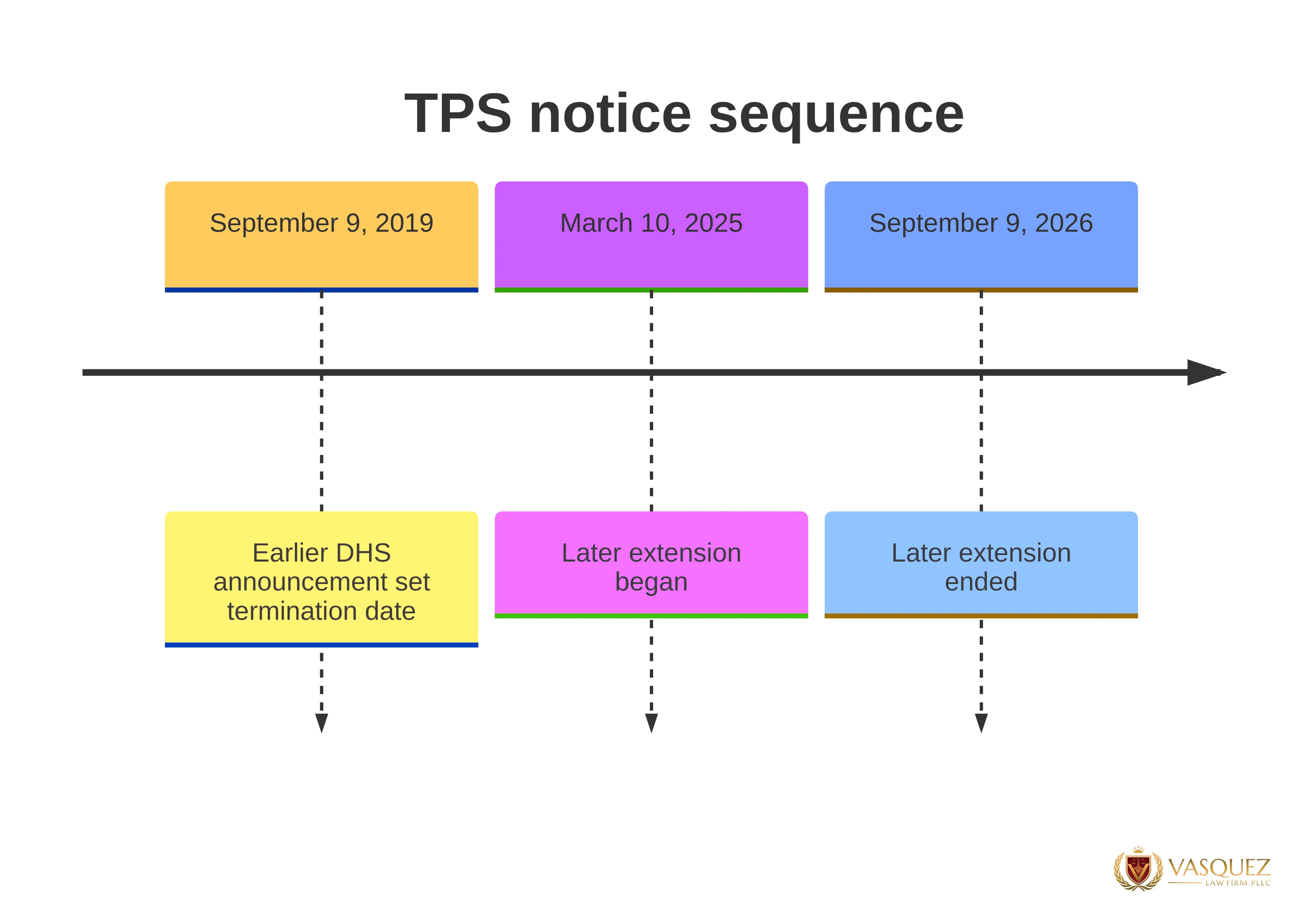
The 2019 termination notice is part of the history of Salvadoran TPS, not a complete answer to the later status question. The Department of Homeland Security announced that the designation would terminate on September 9, 2019 after reviewing the disaster-related conditions connected with the original designation. A later extension superseded that announced date and continued TPS through September 9, 2026.
The timeline has two separate points:
- An earlier DHS announcement set September 9, 2019 as the termination date.
- A later USCIS-reported extension covered March 10, 2025 through September 9, 2026.
A search result, article, or notice that stops at the first date can make the status appear settled when a later action changed the timeline. The reverse problem can also occur: a notice that ends on September 9, 2026 cannot by itself answer what happened after that date.
Date and sequence should guide your comparison. First identify whether the document discusses the original termination announcement or a later continuation. Then identify the period covered by the document and whether it addresses people who already had TPS, employment authorization, or another issue.
The later extension does not erase the earlier notice; it changes how the earlier date must be understood in the timeline. A historical termination date and a later extension can both be accurate descriptions of different points in the process. For a current decision, rely on the notice that covers the relevant period rather than choosing the shortest or newest-looking sentence without checking its effective dates.
Your comparison should also separate a notice's subject from its date. A document about a designation may not answer a question about re-registration or an employment authorization document, even when all three appear in the same search. Match the document to the precise decision you need to make.
What the government review process means for the next check
The statutory review rule explains why a designation can require a new official check near its expiration. The cited USCIS notice states that at least 60 days before a current TPS designation or extension expires, the secretary of homeland security must review conditions in the foreign state after consulting appropriate government agencies.
That review requirement describes a process. It does not predict whether a designation will continue, end, or change, and it does not establish the result after September 9, 2026. The date of a required review is not the same as the date of a final notice, a re-registration period, or an employment-authorization rule.
Your next check should use the review rule as a reason to look for a later official action, not as a substitute for that action. A useful check asks four questions:
- Has an official notice addressed the period after September 9, 2026?
- Does the notice continue the designation, end it, or change its terms?
- Does the notice identify a specific group or existing beneficiary population?
- Does the notice provide dates for registration, re-registration, documentation, or another required step?
If a document answers only the historical question or describes the period ending September 9, 2026, keep looking for the notice that addresses the period you need to understand. Avoid treating the review requirement itself as proof of an outcome.
The review rule can help you understand why a later government action matters, but it cannot tell you what that action says. Record the exact period and affected group in any notice you find before comparing it with your own documents.
Separate current status from personal eligibility
Salvadoran TPS status and your personal eligibility are separate questions. Those statements describe a government designation or a period covered by a notice; they do not decide whether you qualify, remain covered, or can rely on a particular document after that period.
The existence of a country designation is therefore not the same as an individual approval. Your answer may depend on your own TPS history, the notice that applies to you, and the dates or documents connected to your case.
Your personal review may require you to distinguish among several questions:
- Whether you were granted TPS for El Salvador.
- Whether you completed the applicable re-registration step for an earlier period.
- Whether the current official notice covers your beneficiary category.
- Whether your employment authorization document is covered by a current rule.
- Whether another immigration fact changes the consequence of the TPS question.
A general country designation cannot answer those questions from nationality alone. Treat the designation date as a starting point for review, not as proof that every Salvadoran national or every past beneficiary has the same present status.
The same separation applies when you read an official page. Its country-specific information can identify the designation period and listed conditions, but your personal conclusion still requires matching those details with your records and the notice that governs the relevant time.
General Salvadoran TPS facts to compare with your records
Residence and physical presence are separate concepts in a TPS review. A record that helps with one date may not answer the other question.
Your comparison of the listed dates with your own history is not an eligibility decision. Write out the dates you entered the United States, the addresses where you lived, and any periods that may require closer review. Gather records that help you reconstruct residence and physical presence, including prior immigration documents and records showing relevant dates or travel.
The USCIS page lists the February 13, 2001 residence date and March 9, 2001 physical-presence date as country-specific details. The listed dates alone do not determine your eligibility. Questions about departures, interruptions, prior filings, or other facts require a review of your circumstances rather than a simple date match.
Your record should use the two dates as separate lines. Mark the evidence that supports your residence history apart from the evidence that supports physical presence, and note any gap or conflicting information instead of silently filling it in. That organization can show which question remains unresolved when you check official information or request individualized guidance.
If a single document appears to support both histories, identify which dates it actually shows. Do not assume that an address record proves every period of physical presence or that an entry record proves continuous residence. Keep the distinction visible when you organize the file.
Use a four-part verification checklist
A four-part verification checklist can organize your next questions without turning general information into a personal conclusion. Use the checklist in this order:
- Current status. Find the official action that addresses the period after September 9, 2026. Record whether it continues, ends, or changes Salvadoran TPS and which dates it covers.
- General eligibility facts. Compare your residence and physical-presence history with the USCIS-listed dates of February 13, 2001, and March 9, 2001. Keep each history separate.
- Records and documents. Collect your notices, prior TPS records, employment authorization records, residence history, physical-presence information, and any dates that may affect the question.
- Individualized guidance. Use the organized record to identify the specific issue that needs a case-specific review before you act on status, employment authorization, or a deadline.
Your first check should focus on the current designation rather than an old headline. Those dates tell you what the cited notices cover; they do not answer the post-September 9 question.
Read each official notice for its scope. Note the date of the notice, the period it addresses, and the people or documents it describes. Then identify whether it concerns the designation itself, registration or re-registration, or employment authorization. A notice that answers one of those questions does not automatically answer the others. Preserve any stated limitation, such as language directed to people who already had TPS or to certain employment authorization documents.
For the post-September 9, 2026 question, look for language that expressly addresses the period after that date. If a document only describes an earlier period, keep it in your timeline but do not use it to fill the later gap. If the document does not state whether the designation continued, ended, or changed, that outcome remains unestablished by that document. Likewise, a date listed for an earlier registration period or an automatic employment-authorization rule should not be carried forward without a later official statement that covers the period you need to understand.
Write down the exact date range and affected group for each notice you rely on. Add the question the notice leaves open, such as whether it applies to your beneficiary category or document. Compare that limited answer with your own TPS history and records. If the documents do not resolve the question, preserve them, identify the uncertainty, and seek individualized guidance rather than treating the absence of a clear answer as proof of any particular result. This keeps the historical date, the current-status question, and the personal review from being collapsed into one conclusion.
Your third check should make your record usable. Put documents in date order, separate residence material from physical-presence material, and flag missing or inconsistent dates. Include the notice or document that caused your question so the status issue can be identified precisely.
Your fourth check should occur before you rely on an unresolved conclusion. We recommend that TPS beneficiaries consult an immigration attorney for personalized guidance. A focused record gives that review a clear starting point without deciding the result in advance.
When you finish the checklist, write down the exact unanswered question in one sentence. For example, identify whether the issue concerns the designation period, a registration date, a work-authorization document, or your personal history. That keeps general status research from becoming an unsupported conclusion about your case.
Check registration and work-authorization information separately
Re-registration and employment authorization are separate questions. The USCIS country page lists January 17, 2025 through March 18, 2025 as the re-registration period for people who already had TPS. That period is historical as of October 30, 2026; its dates do not establish a later re-registration period.
The USCIS country page also lists certain employment authorization documents as automatically extended by Federal Register notice through March 9, 2026. March 9, 2026 has passed, so that listed automatic extension cannot by itself establish work-authorization validity after that date.
Do not combine the two entries into a single assumption. A re-registration date addresses a registration question, while an automatic EAD extension addresses the validity of certain employment authorization documents for the period covered by the notice. Each requires its own current official check.
Your records should have separate headings for TPS designation, re-registration, and employment authorization. Under each heading, write the applicable notice, date range, and document number if you have it. Then compare each heading with the post-September 9, 2026 official guidance rather than carrying forward a date from an earlier notice.
If your ability to work or meet a deadline depends on the answer, pause before relying on a historical date. Mark the issue for individualized review and preserve the document that sets out the question.
The point of separating these headings is practical: a document can be relevant to one question without resolving the others. Keep the registration record and the employment authorization record together only for organization, not as proof that one automatically establishes the other.
Build a record before asking for case-specific help
A focused record gives you a concrete set of dates and notices to use when you check current information or request case-specific help. Start with the document that prompted your question, then add the records that show your TPS history, residence, physical presence, and employment authorization.
Your record can be organized into short sections:
- Status notices: Keep the TPS notices you received and identify the dates each notice covers.
- Registration history: Record whether you re-registered during the January 17, 2025 to March 18, 2025 period listed by USCIS, if that period relates to your history.
- Residence history: List addresses and dates relevant to the USCIS-listed continuous-residence date of February 13, 2001.
- Physical-presence history: List entries, departures, and other dates relevant to the USCIS-listed continuous-physical-presence date of March 9, 2001.
- Employment authorization: Keep EADs, notices, and expiration or extension information together, without treating the historical automatic extension through March 9, 2026 as current proof.
Your record does not need to answer every issue before you ask for help. Mark uncertainty directly: a missing notice, an unclear travel date, a gap in residence records, or an EAD rule that ends before the period you need to cover. Clear questions are more useful than a document collection with no timeline.
Keep copies of the current official information you use for the status check, along with the earlier notices that explain your history. The goal is to compare the current rule with your facts, not to reach a personal eligibility conclusion from a checklist.
Before requesting case-specific guidance, place the documents in chronological order and write a short timeline of the events they show. Note where the timeline changes from documented fact to uncertainty. That makes it easier to identify whether the main question concerns current protection, registration, employment authorization, or an eligibility issue.
Know what this general guide cannot decide
General TPS information cannot decide your individual immigration position. This guide cannot determine whether you qualify for Salvadoran TPS, remain protected after September 9, 2026, may re-register under a later notice, or may rely on a particular employment authorization document.
Your facts may also affect the consequence of a status question in ways that a general date list cannot resolve. The unresolved issue might involve your prior TPS history, residence, physical presence, registration record, employment authorization, or another part of your immigration history.
Use the boundary as a practical rule: treat the listed dates as subjects for comparison, not as a personal approval or denial. Do not present a general USCIS country-page detail as proof of your own status, and do not treat an old notice as a current answer after its stated period.
A country-specific date can help you identify what to investigate, but it cannot replace the review of your own documents and immigration history. Keep any conclusion limited to what the official notice actually addresses.
If your next decision depends on whether you are protected, authorized to work, required to meet a deadline, or affected by an immigration consequence, identify that exact decision in your notes. Preserve the documents connected to it and obtain individualized guidance before acting on an unresolved conclusion.
Do not turn the absence of a clear answer in your records into an assumption that no issue exists. Record the uncertainty, identify the date or document that needs clarification, and seek case-specific advice before relying on a conclusion about your status.
Choose the safest next step
Your next step is to check whether a post-September 9, 2026 official notice changed Salvadoran TPS. Start with current USCIS information and any applicable Federal Register notice, then compare the notice with your TPS history, residence and physical-presence records, registration information, and employment authorization documents.
The cited USCIS information establishes dates through September 9, 2026, while the listed re-registration period and automatic EAD extension ended earlier. Those dates should remain in your file as historical references, not as automatic answers to a question arising after those periods.
Write down the official notice date and the period it covers before deciding what the information means for you. If your status, work authorization, deadline, or immigration plans depend on a later development, keep that issue open until the applicable guidance and your records have been considered together.
We recommend that TPS beneficiaries consult an immigration attorney for personalized guidance when status, employment authorization, deadlines, or immigration plans depend on the answer. We offer legal help for immigration issues.
What should you verify before relying on Salvadoran TPS information?
What should I verify about Temporary Protected Status for El Salvador after September 9, 2026?
You need to check the current USCIS information and any applicable Federal Register notice to determine if Salvadoran TPS has continued, ended, or changed after September 9, 2026.
How can I check my current TPS status and what documents should I gather?
Start by locating the official notice that addresses your TPS status after September 9, 2026. Gather records that show your TPS history, residence, physical presence, and employment authorization.
What is the re-registration period for TPS for El Salvador?
The re-registration period for individuals who already have TPS was from January 17, 2025, to March 18, 2025. This period is historical and does not establish a later re-registration period.
What should I do if I have questions about my TPS status?
It is recommended to consult an immigration attorney for personalized guidance, especially if your status, work authorization, or deadlines depend on the current TPS situation.
What does the government review process mean for my TPS verification?
The government must review conditions in El Salvador at least 60 days before a TPS designation or extension expires. This review does not predict outcomes but indicates the need for a current official check.
Why is it important to separate my personal eligibility from the general TPS status?
General TPS status information does not determine individual eligibility. Your personal circumstances, including your TPS history and documentation, must be reviewed separately to assess your current status.
Sources
- Secretary of Homeland Security Kirstjen M. Nielsen Announcement on Temporary Protected Status for El Salvador | Homeland Security — www.dhs.gov
- Temporary Protected Status (TPS) for El Salvador Extended for 18 Months; Certain EADs Automatically Extended Through March 9, 2026 | USCIS — www.google.com
- Temporary Protected Status Designated Country: El Salvador | USCIS — www.uscis.gov
- Ninth Circuit Rejects Rehearing in TPS Case [2026] | Vasquez Law Firm
- What Does DHS Mean for Immigration in 2026 | Vasquez Law Firm