

Use a four-point fit check before contacting the firm
A four-point fit check gives you a practical way to decide whether Vasquez Law Firm appears relevant to your situation before you make an inquiry. Instead of treating a firm name or a general service description as an answer to your legal problem, compare four concrete points: the type of legal help you need, the location connected to your matter, the language in which you want to communicate, and the available contact route.
This approach helps you separate a basic service match from a case assessment. You can use it to decide whether contacting the practice makes sense, but it cannot determine your eligibility, legal position, deadline, strategy, or likely result. Those questions depend on your facts and the documents connected to your situation.
The four fit points are:
- Service: We offer immigration legal help. If your need concerns immigration, this is the first point to compare with your situation.
- Location: We have four office locations across North Carolina and Florida: Charlotte, Raleigh, Smithfield, and Orlando. We serve clients throughout North Carolina and Florida.
- Language access: Our bilingual team communicates in English and Spanish.
- Contact method: You can use the supplied contact page and form, or use the listed phone route when the matter is urgent.
The rest of this review examines each point separately, then gives you a short preparation checklist. That sequence lets you stop at the boundary that matters: if the service or location does not fit, language access and contact convenience do not change the underlying mismatch.
Identify Vasquez Law Firm’s stated legal-service areas
Our immigration legal help is the clearest service starting point for this review. We offer immigration legal help, so your first question is whether your concern belongs to an immigration matter rather than whether the firm name appears in a search result.
That distinction matters because a broad legal search can bring together different kinds of problems, locations, and deadlines. Write down the issue in ordinary language before you contact us: for example, you might describe the immigration question you are trying to resolve, the notice or event that prompted you to seek help, and the point at which you need guidance. A short description gives the initial inquiry a defined subject without pretending that the description itself answers your case.
A service match is a starting point, not a legal conclusion. If your situation involves immigration legal help, continue to the location, language, and contact checks below. If your question falls outside that subject, do not assume that the information in this review establishes a fit for it; this article evaluates the immigration service point and the contact information supplied for North Carolina and Florida.
You can make the service check in three steps:
- Name the legal problem without choosing a legal solution for yourself.
- Note whether the issue involves an application, status question, notice, removal concern, or another immigration event, if you already know that description.
- Keep the facts separate from your hoped-for result. A request for information is not a finding that you qualify for a particular option.
Once the service subject appears relevant, use the next section to check whether the geographic information also fits.
Check whether the firm’s locations fit your situation
Use the location check this way:
- If your matter is connected to North Carolina or Florida, record the relevant city, county, or state before you inquire.
- If you are near Charlotte, Raleigh, Smithfield, or Orlando, note that office as a possible point of contact without assuming that the office location determines who will handle your matter.
- If your matter is connected to another state, treat the location fit as unresolved rather than assuming that service throughout North Carolina and Florida extends nationwide.
The geographic point is therefore a boundary, not a promise. A location match means the firm’s stated service-area information is relevant to your screening decision. It does not provide an individualized assessment of jurisdiction, venue, eligibility, or legal strategy.
Consider English-and-Spanish communication access
English-and-Spanish communication access can affect whether an initial inquiry is understandable and usable for you. Our team is bilingual in English and Spanish. If you prefer to communicate in English or Spanish, state that preference at the beginning of your inquiry.
Language access is more than choosing a language for a form. You may need to describe an event, identify a notice, explain a family relationship, or ask what information to provide next. Clear communication can help you present those points in the language you use most comfortably, but bilingual access does not decide whether your legal matter fits the service or whether a particular legal option applies.
A simple language check can keep your request focused:
- Choose the language in which you want the initial conversation.
- State whether you need interpretation or prefer to communicate directly in English or Spanish.
- Prepare names, dates, and a short description in the language that lets you explain the matter accurately.
- Keep any translation question separate from the legal question itself.
This information helps you decide whether the firm’s described communication access matches your needs. It does not mean that every document, legal term, or future communication will have a particular format, so describe your preference rather than assuming details that are not listed.
Separate general firm information from individualized legal advice
General firm information can help you compare a stated service, location, language access, and contact route with your situation. General information cannot decide whether you qualify for relief, which filing or defense applies, what deadline controls, or what outcome you may receive. Those questions turn on facts that a short public description cannot resolve.
A sample website disclaimer published by the State Bar of Nevada says that general legal information is not legal advice or a substitute for particularized advice from counsel. The same sample says that using a website does not create an attorney-client relationship. That statement is a general boundary from sample disclaimer material, not a case assessment and not a conclusion about your situation.
Use the distinction in a practical way. You can use this review to decide whether the stated service and location information make an inquiry sensible. You should not use it to tell yourself that a filing is available, a defense will work, a deadline has passed, or a result is likely.
Before you submit an inquiry, separate these two lists:
- What you know: the event, notice, status, location, dates, and language preference you can describe.
- What you need assessed: eligibility, legal options, deadlines, strategy, and the effect of missing or conflicting information.
That separation keeps your first contact accurate without turning a general description into an individualized legal determination.
Use a practical checklist before submitting an inquiry
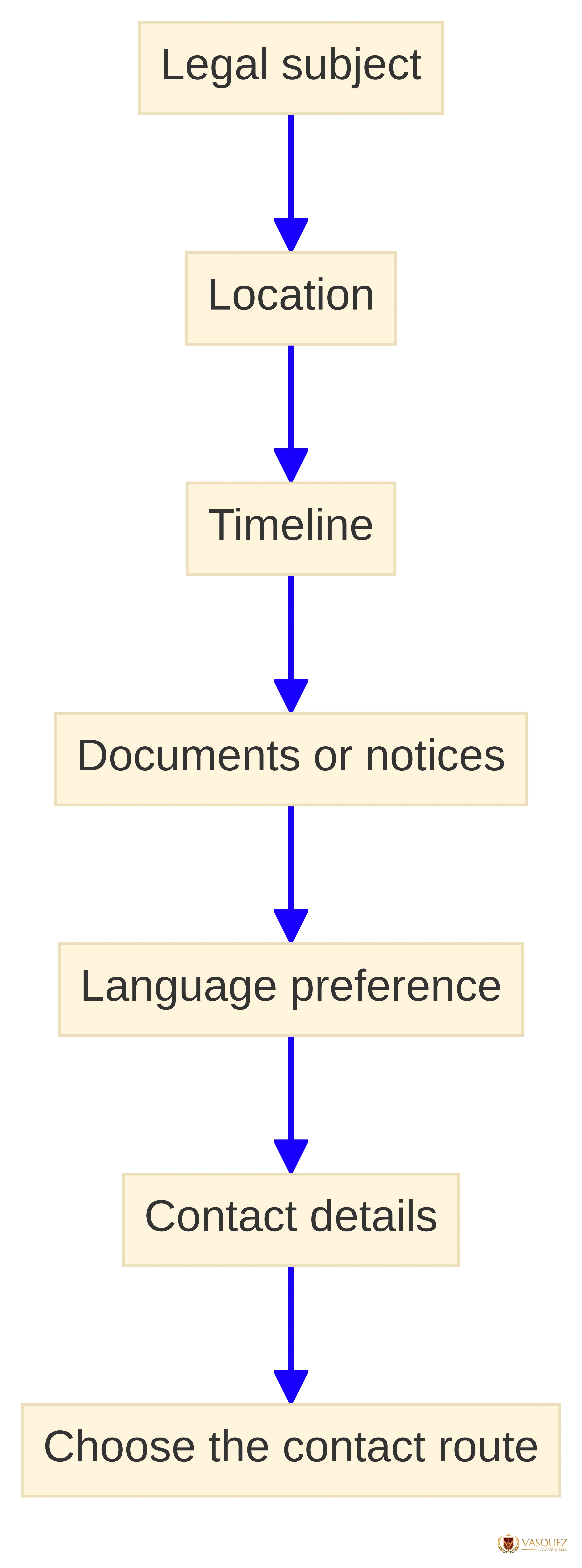
A practical inquiry checklist gives you a short set of details to organize before you use the contact route. Use these items:
- Legal subject: Write one or two sentences describing the immigration issue you want to discuss.
- Location: Note the North Carolina or Florida connection, including the city or county if it helps explain the situation.
- Timeline: List the dates you know, such as when an event occurred or when you received a notice. Do not guess at a legal deadline.
- Documents or notices: Identify what you have available and describe any document you do not understand. Keep copies for your records rather than treating a general checklist as a request for every original.
- Language preference: Say whether you want to communicate in English or Spanish.
- Contact details: Use information that lets the firm respond to the inquiry you submit.
These items help you give the inquiry a clear subject while leaving case-specific conclusions for the appropriate conversation.
A focused inquiry does not need to predict the answer. State what happened, where the matter is connected, what language you prefer, and what you want clarified. Avoid presenting an uncertain conclusion as a fact. For example, describe the notice or event you received instead of declaring that a specific legal remedy applies.
The immediate use of this checklist is simple: complete the fit points you can answer, mark the questions that require individualized review, and choose the contact route that matches the urgency of your situation. Before sending, review the form’s contact permission as part of your preparation. The form lets you agree that Vasquez Law Firm may contact you by call, text, and/or email about your inquiry and possible legal services. This means your submission should include contact information through which you are comfortable receiving that communication. It does not change the fit check: the form records an inquiry and a contact preference, while questions about eligibility, deadlines, strategy, and possible representation still require individualized assessment. If you are not ready to authorize those communication methods, pause and review the form before submitting it.
Start the conversation through the supplied contact options
The contact page identifies four office locations across North Carolina and Florida and provides contact information for reaching the practice. If the service, location, and communication points fit your situation, use the page to present the short description you prepared.
An online inquiry is useful when you want to organize the basic facts before sending them. Keep the message focused on the legal subject, the location, the known timeline, and your language preference.
Use the listed phone route for urgent matters
The contact page says that our bilingual team is available 24 hours a day, 7 days a week for immigration emergencies, arrest situations, and other urgent legal matters. It lists 1-844-967-3536 as a number you can call at any time to reach a member of our team.
Use the phone route when your situation is urgent rather than relying only on an online message. When you call, begin with the immediate event, your location, the best language for communication, and any date or notice that makes the matter time-sensitive. Keep the description factual and concise. The listed availability gives you a contact route; it does not promise a legal outcome, a particular response, or a determination about your case.
The urgent route also has a clear boundary. A phone call can begin communication about an emergency, arrest situation, or other urgent legal matter, but the call itself does not establish that a particular defense, application, or deadline applies. Give the team the information you know and identify the question that needs attention.
If your matter is not urgent, the contact form remains a practical way to organize the inquiry. If it is urgent, use the listed number and explain why timing matters. Choose the route based on the circumstances you can describe, not on an assumption about the result.
Take the next step only when the stated fit points align
Your next step is easier to judge when the four fit points agree: you need immigration legal help, your matter connects with North Carolina or Florida, the described English-and-Spanish communication access meets your preference, and the available contact route suits the urgency of the situation. When those points align, you have a reasonable basis to make an inquiry without treating the review as an answer to your case.
A qualified legal professional must assess your individual suitability and options from your facts. General information does not create an attorney-client relationship or replace particularized advice. Use the checklist to describe the situation accurately, identify what you need assessed, and keep your expectations within those boundaries.
The decision is therefore practical: contact us when the stated service, geography, language access, and route match your situation; pause when one of those points does not fit or when you need an answer that only an individualized assessment can provide.
Frequently asked questions about contacting Vasquez Law Firm
What types of legal services does Vasquez Law Firm provide?
Vasquez Law Firm specializes in immigration law, personal injury, workers' compensation, criminal defense, family law, and traffic violations.
Where are the offices of Vasquez Law Firm located?
The firm has offices in Charlotte, Raleigh, Smithfield, and Orlando, serving clients throughout North Carolina and Florida.
Is Vasquez Law Firm bilingual?
Yes, Vasquez Law Firm has a bilingual team that provides services in both English and Spanish.
How can I contact Vasquez Law Firm for legal assistance?
You can contact Vasquez Law Firm through their website's contact form or by calling 1-844-967-3536 for urgent matters.
What should I prepare before contacting Vasquez Law Firm?
Before contacting the firm, prepare a brief description of your legal issue, your location, any relevant dates, and your language preference.
What is the availability of Vasquez Law Firm for urgent legal matters?
Vasquez Law Firm is available 24/7 for urgent legal matters, including immigration emergencies and arrest situations.
Sources
- Sample Web Site Disclaimers — nvbar.org
- Contact Vasquez Law Firm | Free Case Evaluation — vasquezlawnc.com