

Begin by deciding what kind of immigration help you need
Choosing an immigration lawyer starts with identifying the problem you need to discuss, the location connected to your matter, and the communication support you need. Distance can help narrow your search, but it does not show whether a provider handles the type of immigration issue you face. Begin with the matter itself, then use location and communication needs to refine the choice.
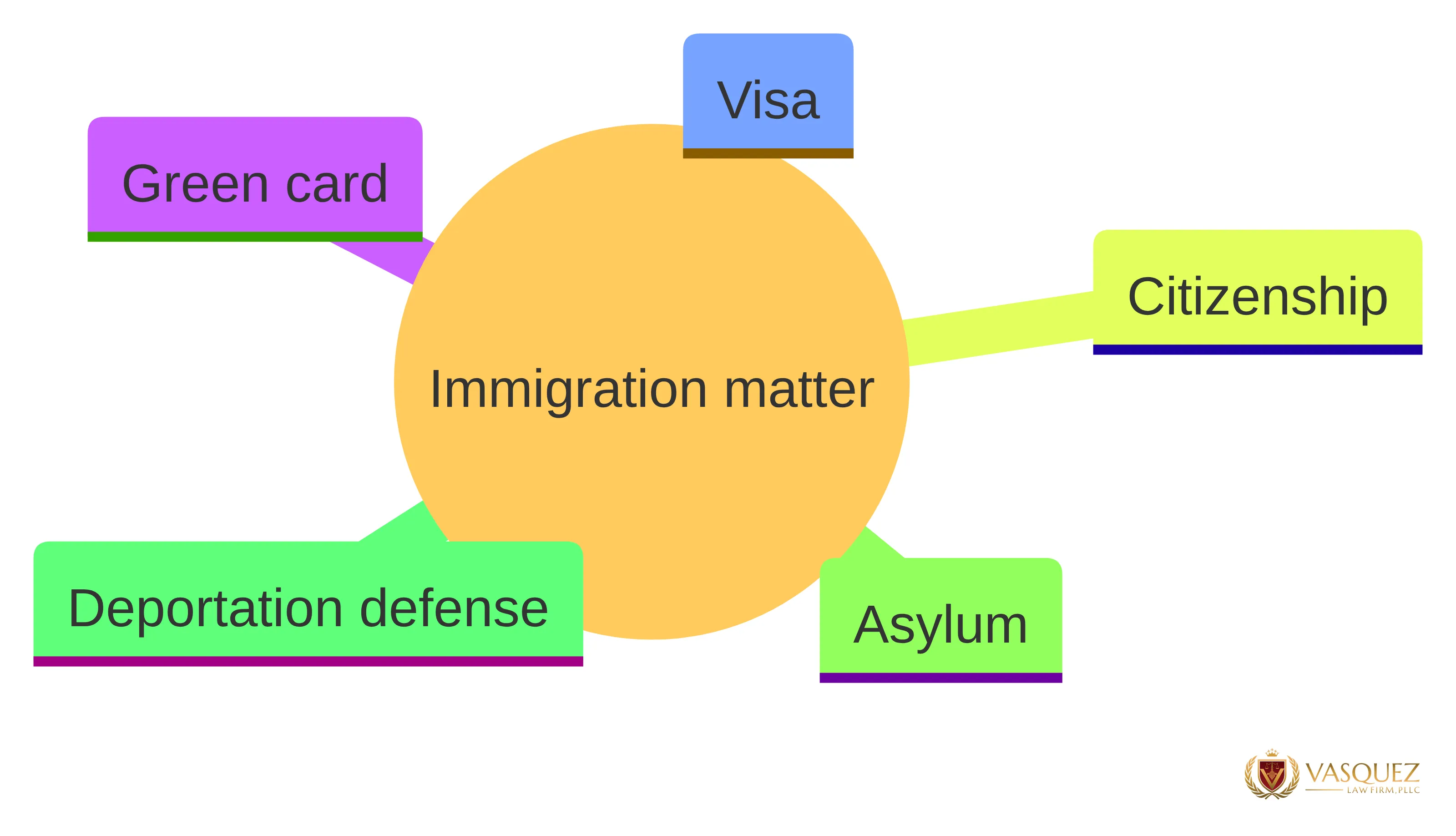
Your question may involve a green card, visa, citizenship, deportation defense, asylum, or another immigration concern. Those labels help you describe your situation, but they do not determine eligibility or predict an outcome. Your immigration history, notices, prior filings, deadlines, and personal circumstances may change what questions require individual review.
A useful first description can be short: name the immigration matter, explain what has happened, identify any deadline or court concern, and state where you need help. You do not need to solve the legal issue before contacting a qualified provider. You need enough information to help the provider decide whether the matter fits the assistance offered.
Vasquez Law Firm offers immigration legal help. If you are considering the firm, treat that statement as the beginning of a fit check rather than as an answer about your particular case. Prepare to explain the matter you want reviewed and the location connected to it.
Use this starting path:
- Name the kind of help you think you need, such as a green card, visa, citizenship matter, deportation defense, or asylum concern.
- Write down whether you have received a notice, filed an application, attended an immigration proceeding, or missed a required date.
- Note the state where you live and any other location tied to the matter.
- Identify the language in which you need legal communication.
- Separate questions about general information from questions about what you should do in your own circumstances.
This preparation gives your first contact a clear purpose without treating your initial description as a legal conclusion.
Match the lawyer to your immigration matter
The right service fit depends on the immigration matter you need to discuss, not only on the provider appearing closest to you. A practice may advertise immigration services while handling only some types of cases, so ask directly whether the provider works with the category that matches your concern.
Use the category as a conversation prompt. For a green card matter, ask whether the provider handles the pathway you are considering. For a visa question, describe the visa type and your purpose for seeking it. For citizenship, explain whether you are asking about the application process, a prior filing, or a complication in your history. For asylum or deportation defense, identify any notice, hearing, detention concern, or deadline without trying to label the legal remedy yourself.
A provider's answer should tell you whether the matter belongs within its work and what information it needs next. A vague answer does not resolve fit. Ask what kind of review is available and whether another type of authorized provider would be more appropriate.
That answer gives you a usable decision point: continue only if the provider can connect your matter category to the kind of review offered, explain what information is needed to assess fit, and identify any location limitation you should resolve. Keep three questions separate: whether the provider recognizes the subject, whether the provider can review your documents or history, and whether the provider will represent you. A “yes” to the first question is not a promise about the other two. If the answer is no, record the reason rather than changing the label of your problem to make it appear to fit. You can then use authorized-resource information to look for another option without treating a referral or listing as a decision about your case.
A Notice to Appear, Form I-862, is the charging document the Department of Homeland Security uses to begin removal proceedings in immigration court. If you have that notice, identify it when you contact a provider and keep the document available for discussion. The notice can help the provider understand the kind of proceeding involved, but it does not by itself answer what defense or other response may apply.
A focused service-fit question can be direct: I have this type of matter, this notice or filing, and this location; does your practice handle cases like mine? Ask the same question if your concern involves a missed court date, a pending application, a prior denial, or a family-based process. The goal is to place your circumstances with a provider whose work matches the issue before you spend time discussing convenience.
Confirm where the lawyer can help before treating a result as nearby
Location fit requires more than finding a name in a search result. Ask where the lawyer can provide immigration assistance, which state or proceeding is connected to your matter, and whether the provider accepts inquiries from your location. A nearby address may be convenient while still leaving an unanswered question about whether the provider can assist with your specific circumstances.
Your location checklist should cover four separate points:
- Where you live now.
- Where an immigration filing, notice, or court matter is connected.
- Where the provider is authorized to assist.
- Whether the provider can communicate with you through a practical office, phone, or online channel.
You can give those details during the first inquiry rather than assuming that a search result settles them. If your matter involves more than one state, say so. If you are outside the firm's stated service locations, ask about that boundary before treating the firm as a nearby option.
Vasquez Law Firm offers legal assistance for immigration cases in North Carolina. Attorney Vasquez is described by the firm as admitted in North Carolina and Florida and able to assist with immigration cases. Those facts give you a starting point for a location conversation; they do not establish that every matter or every location falls within the firm's work.
If you are in North Carolina, include your city and the location connected to your matter in the inquiry. If Florida is connected to your matter, identify that connection as well. If you are elsewhere in the United States, explain your location before assuming that the firm is the right nearby option. A clear location description lets the provider address fit without requiring you to guess from a search listing.
Verify that the provider is authorized to give immigration legal advice
Authorization is a basic screening question when you look for immigration legal advice. An unauthorized provider cannot give that legal advice.
Ask who will provide the advice and what role that person holds. If the person is an accredited representative, ask which recognized organization they work for. If the person is an attorney, ask for the attorney's name and the jurisdictions connected to the matter. These questions do not require you to understand every professional designation; they give you a direct way to distinguish legal advice from general assistance with forms or information.
Treat authorization as separate from friendliness, advertising, language access, and proximity. A provider can communicate clearly and still not be authorized to give the legal advice you need. Resolve that question before sharing sensitive details or relying on a recommendation.
EOIR-recognized organizations provide immigration legal services through accredited representatives and must have a policy for accommodating clients who cannot pay. EOIR's pro bono list includes nonprofit organizations, pro bono referral services, and private attorneys willing to provide free legal services in immigration court proceedings.
USCIS also directs people to EOIR resources for attorneys, accredited representatives, and recognized organizations that may offer free or low-cost immigration services. If cost affects your search, use those resources as another way to identify authorized options. Ask whether the service is available for your kind of matter and location; a listing does not determine whether a provider can take your particular case.
The practical boundary is simple: do not treat a person as an immigration legal adviser merely because that person offers to complete paperwork, speaks your language, or appears in an online search. Ask about authorization and service fit first.
Compare language access and communication practices
Language access affects whether you can understand questions, notices, options, and requests for information. Choose a provider that can communicate with you in the language you use for important legal discussions, or ask how qualified interpretation will be arranged. Do not rely on a family member or child to carry every detail of a complicated conversation when a professional language solution may be available.
Ask practical questions before you commit to a consultation:
- Can you communicate with the attorney or accredited representative in your preferred language?
- If an interpreter is needed, who arranges that interpretation?
- Will important instructions and follow-up messages be available in a language you understand?
- Which channel will the provider use for questions and notices?
- How should you send documents or explain a change in your circumstances?
Communication is part of fit. A provider who handles the right matter but cannot explain the process in a way you understand may not meet your needs.
Before ending the first contact, ask the provider to state the immediate next step, the documents requested, and the channel for follow-up in the language you will use for legal discussion. Repeat back your understanding or ask for clarification; the purpose is not to reach a legal conclusion, but to confirm that the process for exchanging information is understandable. Also ask how changes, such as a new notice or date, should be communicated. This distinguishes an initial conversation from a communication practice you can use as the matter develops. If you cannot understand the answer, treat that as an unresolved fit question rather than relying on assumptions.
EOIR's Immigration Court Online Resource is available in Chinese, English, Haitian Creole, Portuguese, Punjabi, and Spanish. The resource offers general information about hearings, case status, court contacts, legal representation, and appeals. You can use those language options to understand general court information while you decide what type of authorized help to contact.
General information and direct communication with your provider serve different purposes. A translated resource can help you understand the subject of a notice or the kind of question to ask. It does not turn general material into an individualized legal answer. Tell the provider which language you need and ask how communication will work before you rely on the provider for case-specific guidance.
Prepare information for a focused first contact
A focused first contact gives the provider enough context to respond to your inquiry without requiring you to create a complete legal file. Start with a short timeline: explain when the immigration issue arose, what you have filed or received, what changed, and what question you need answered. Include your location and preferred language.
Gather the materials you already have, such as:
- Immigration notices, receipts, or appointment information.
- Copies of applications, petitions, or requests you have filed.
- Prior decisions, correspondence, or hearing information.
- Names and dates that help explain your immigration history.
- A short list of your main questions and any known deadline.
Mark anything you do not understand instead of guessing at its meaning. Preparation helps organize the conversation, but it does not establish eligibility, choose a legal strategy, or guarantee that a provider can take the matter. If a document is unavailable, say that plainly and describe what you remember.
To make the first inquiry easier to review, put the information in a consistent order: one sentence naming the concern, a short chronology, a list of available documents, and the questions you want answered. For each notice or filing, record its title, date, and any response or hearing date you can identify. Keep facts and interpretations separate: describe what happened or what the document says, then mark what you think it means as a question. This structure helps the provider see what is known, what is missing, and what needs individual review without presenting your own interpretation as a legal conclusion.
If you contact USCIS about a filed case, keep the relevant receipt notices and, if possible, a copy of the pending or approved application or petition nearby. Those materials are useful when you ask about that particular filing. The same documents can help you describe the matter to an immigration lawyer, but a lawyer may request additional information after reviewing your circumstances.
Before filing an immigration application, petition, or request, review USCIS filing guidance and the instructions for the applicable form. That step is separate from contacting a lawyer. You can bring questions about the form, a notice, or your history to the first legal contact rather than assuming that a general form instruction answers your individual situation.
Keep the purpose of your preparation narrow: make the facts, documents, and questions easier to discuss. Do not treat a missing document or an organized folder as proof that you qualify for an immigration benefit.
Use official resources to check general information and safer options
Official resources can help you understand the subject of your question before you contact a provider. EOIR's Immigration Court Online Resource covers general information about hearings, case status, contacting an immigration court, finding legal representation, and appealing an immigration judge's decision. USCIS also directs people to resources for attorneys, accredited representatives, and recognized organizations that may offer free or low-cost immigration services.
Use those resources for specific, limited tasks:
- Identify the general subject of a notice or proceeding.
- Find information about contacting an immigration court.
- Learn where to look for authorized or lower-cost legal help.
- Review USCIS filing guidance and the instructions for the form involved.
- Write down questions that remain after reading the general information.
This approach helps you move from confusion to a focused inquiry without treating an online explanation as a decision about your case.
EOIR's recognized-organization and pro bono resources can help you identify other authorized options, including organizations and providers willing to offer free or low-cost services in the situations covered by their listings.
Read each resource for the question it is designed to answer. A government page may explain a form, proceeding, or source of legal assistance, but it does not review your personal history. A provider listing may help you find a contact, but it does not decide whether that provider handles your matter.
Treat court-date and detention concerns as urgent reasons to seek qualified help
Court-date and detention concerns call for a prompt contact with qualified immigration help rather than a long comparison based only on online reviews. A Notice to Appear, Form I-862, begins removal proceedings in immigration court. If you have that document, a hearing notice, or a concern that you may miss a court date, say so at the beginning of your inquiry.
Vasquez Law Firm assists clients who miss an immigration court date or fear they will. If that describes your situation, include the court date, the notice you received, the location tied to the proceeding, and what you believe may prevent you from attending. Do not wait to make the description perfect. A concise account can help the provider understand why the inquiry needs prompt attention.
EOIR's Immigration Court Online Resource provides general information about hearings, court contacts, case status, legal representation, and appeals. You can use it to locate general court information while seeking authorized assistance, including information in Spanish and other listed languages.
A court or detention concern should not be handled by guessing from a search result or relying on an unauthorized person for legal advice. State what has happened, identify every known date, and disclose whether you are detained or fear detention. If another family member is helping you make contact, keep the information as precise as possible and explain who needs the assistance. The provider must assess the individual circumstances and the appropriate next step.
Check whether Vasquez Law Firm fits your location and matter
Vasquez Law Firm offers immigration legal help and legal assistance for immigration cases in North Carolina. That stated scope still requires you to confirm whether your matter and location fit the firm's services. These facts make location and matter fit the first questions to address in your inquiry.
Use the following details to make that fit clear:
- Your city and state.
- The state or court connected to the immigration matter, if different.
- The type of concern, such as a visa, green card, citizenship, asylum, deportation defense, or another immigration issue.
- Any notice, filing, hearing date, or missed date involved.
- The language you need for communication.
If your circumstances involve a location outside North Carolina or Florida, identify that before assuming the firm is nearby or can assist. The firm’s stated ability to help with immigration cases does not replace a case-specific review.
Vasquez Law Firm provides a free evaluation for immigration cases and offers immigration case consultations and evaluations. Use that information to frame the initial contact around your matter, questions, location, and documents rather than trying to decide the legal answer alone.
A useful inquiry can say what type of immigration help you are seeking, where the matter is connected, what notice or filing you have, and what you want clarified. Include whether you need communication in a language other than English. Ask whether the firm can address the matter you described and what information should come next.
A consultation or evaluation is a point for discussing your circumstances. It is not a promise of eligibility, representation, or a particular result. Keep those distinctions clear while you compare the firm's matter and location fit with your own needs.
Take the next step with a focused website or form inquiry
The next contact step is easier to take when your inquiry answers four questions: what immigration matter do you need to discuss, where is it connected, what deadline or notice matters, and what language do you need for communication? Add the documents or receipt information you have, identify anything missing, and list the questions you want addressed.
If your matter and location fit the firm's stated services, use the Vasquez Law Firm website or form to share that focused inquiry. A short, accurate description gives the initial contact a clear starting point and helps separate a request for general information from a request for case-specific review.
A qualified immigration lawyer must decide how the law applies to your individual circumstances. General information can help you organize your questions, but it cannot determine eligibility, predict an outcome, or replace individualized legal advice.
What should I verify before contacting an immigration lawyer near me?
What types of immigration matters can an immigration lawyer assist with?
An immigration lawyer can help with various matters including green cards, visas, citizenship applications, deportation defense, and asylum cases.
How can I evaluate if an immigration lawyer is right for my situation?
To evaluate an immigration lawyer, consider their experience with your specific immigration issue, their location relative to your matter, their communication capabilities, and whether they are authorized to provide legal advice.
What information should I prepare before contacting an immigration lawyer?
Before contacting a lawyer, gather relevant immigration notices, receipts, copies of applications, and a list of your main questions. This preparation helps the lawyer understand your situation better.
How do I ensure that the immigration lawyer I contact is authorized to give legal advice?
You can ensure a lawyer is authorized by asking if they are an attorney or an accredited representative from a Department of Justice-recognized organization.
What should I do if I have a court date or detention concern?
If you have a court date or fear detention, contact a qualified immigration lawyer immediately. Provide them with details about the notice or hearing to get prompt assistance.
Can I get free or low-cost immigration legal services?
Yes, there are organizations and attorneys that offer free or low-cost immigration legal services. You can find these options through EOIR's pro bono list or other authorized resources.
What steps should I take to contact Vasquez Law Firm for immigration assistance?
To contact Vasquez Law Firm, prepare a focused inquiry that includes your immigration matter, location, any relevant notices, and your preferred language. You can use their website or contact form to submit your inquiry.
Sources
- USCIS Contact Center | USCIS — www.uscis.gov
- Learn About Legal Representation — www.justice.gov
- Avoid Scams | USCIS — www.uscis.gov
- Self-Help Legal Materials — www.justice.gov
- What You Need to Know About This Week in Immigration... | Vasquez Law Firm
- What Is Form I-9 and How to Complete It in 2026 | Vasquez Law Firm
- How ICE Impacts Your Immigration Case in Orlando in 2026 | Vasquez Law Firm
- How Federal Immigration Cases Work in Charlotte NC in 2026 | Vasquez Law Firm
- How Immigration Attorney Near Me Can Help in Raleigh 2026 | Vasquez Law Firm