
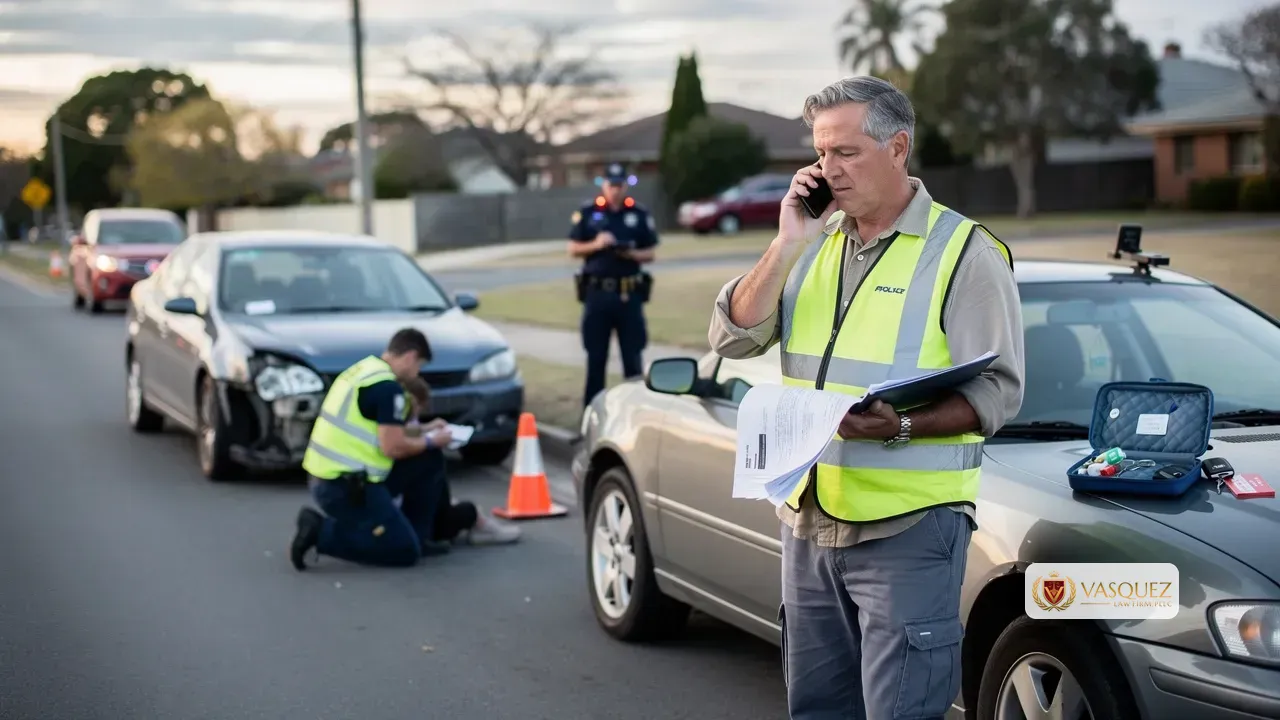
Start with safety and emergency assistance
A car accident requires an ordered response: protect people from additional harm, address urgent medical needs, document what happened, complete required reporting, and preserve records for later decisions. Claims, insurance calls, and settlement questions come after immediate safety. Start with the condition of the people involved and the condition of the scene.
The North Carolina Department of Transportation accident-response procedure directs personnel to make the scene safe for other people and emergency services, determine whether anyone needs medical treatment, and call 911 for injuries requiring immediate medical attention. Use that order as your first guide: assess the immediate danger, obtain emergency help when medical treatment cannot wait, and only then turn to information and claim tasks.
Your first response can follow five practical questions:
- Is anyone in immediate danger or in need of urgent medical treatment? Address that need first.
- Can the scene create another collision or injury? Take appropriate steps to make it safer for people and emergency services.
- Who and what were involved? Identify the drivers, passengers, vehicles, property, and witnesses.
- What must be reported? Apply the rule for the location where the crash occurred, including the North Carolina distinctions explained below.
- What records should you preserve? Keep the crash information, photographs or other scene documentation, medical records, and insurer communications together.
Stabilize the scene and obtain help when needed
The first scene assessment concerns people, traffic, and emergency access. Determine whether anyone needs medical treatment, and call 911 for an injury that requires immediate medical attention. Do not let claim paperwork or a discussion about fault delay an urgent request for help.
Scene safety requires attention to the surrounding roadway and to the path emergency services may need to use. Take appropriate action to make the scene safe for other people and emergency responders, but do not create a new hazard while trying to collect information. If you cannot safely document the crash at that moment, prioritize medical and scene needs instead.
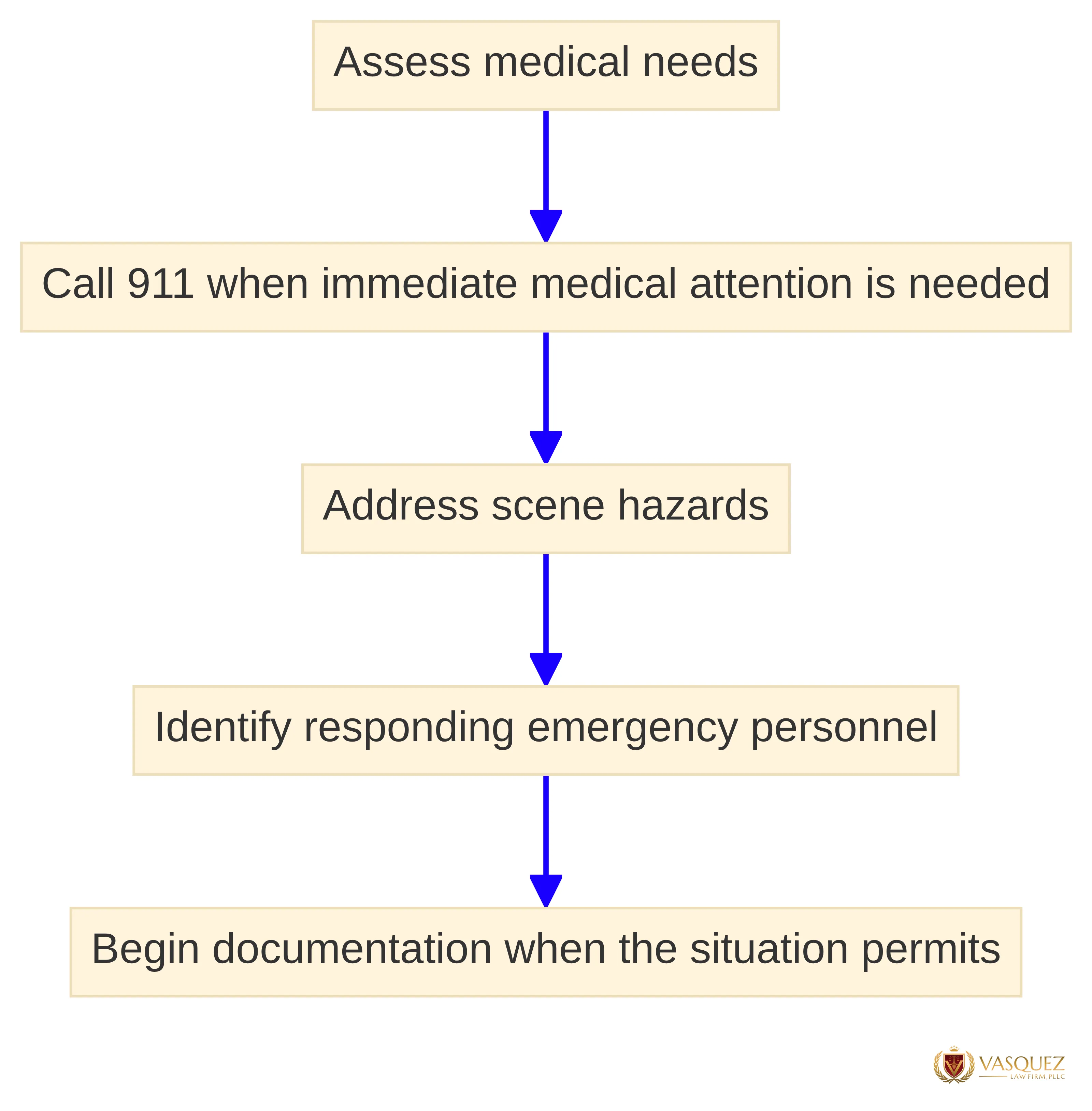
A practical order for the first minutes is:
- Assess whether anyone needs medical treatment.
- Call 911 when an injury requires immediate medical attention.
- Address hazards that could cause another collision or injury.
- Identify whether law enforcement or other emergency personnel are responding.
- Begin documentation only after the immediate situation permits it.
The purpose of this order is to keep the first response focused. A complete claim file cannot repair an injury caused by a second danger at the scene.
Emergency assistance is the right focus when an injury needs immediate medical attention. A crash can still require careful documentation even when the initial scene appears manageable, so move from emergency response to information preservation once the immediate danger has been addressed.
Create a reliable record before the details disappear
A reliable crash record identifies the crash, the vehicles, and the people involved. Official crash reports use scene evidence and interviews with participants and witnesses to help investigators determine how the crash occurred. Your own notes and documentation can help you preserve the details you remember while those details are fresh.
If the scene permits documentation, record the following:
- The location, roadway, direction of travel, and approximate time of the collision.
- The vehicles involved, including identifying information and visible damage.
- The position of the vehicles and relevant features of the scene.
- Names and contact information for witnesses.
- Visible injuries and the condition of the people involved.
- Photographs or other records that show the vehicles, damage, roadway, surrounding area, and relevant conditions.
Document what you can observe. Do not fill gaps with guesses about speed, distance, visibility, or fault.
The other driver's insurance and driver's-license information should be collected after a car accident. Witnesses' names and contact information should also be gathered. Check the spelling and numbers as you record them, and keep the information with your other crash documents.
Scene evidence and witness accounts matter because a crash report is built from information about the crash, the vehicles, and the people involved. A short written account can separate what you personally observed from what another person told you. That distinction helps keep later communications factual.
Exchange information without turning the conversation into a fault debate
North Carolina law requires drivers who must stop at a crash scene to provide the other involved people, or the person whose property was damaged, with the driver's name, address, driver's-license number, and vehicle license-plate number. The required exchange is about identifying information. Keep the conversation centered on those facts rather than arguing about responsibility at the roadside.
Insurance information belongs in the same record. Collect the other driver's insurance and driver's-license information, and gather names and contact information for witnesses. If the scene is tense or confusing, record the information calmly and avoid adding conclusions that you cannot support.
A factual exchange can cover:
- Who was driving each vehicle.
- Which vehicles or property were involved.
- The identifying information required at the scene.
- Insurance information.
- Witness names and contact details.
- Whether emergency or law-enforcement personnel were contacted.
Do not speculate about injuries, speed, visibility, or fault simply to end an uncomfortable conversation. Preserve observations separately from opinions, and let later claim discussions rely on the documented record.
Vehicle damage and the surrounding scene can change after vehicles are moved, repairs begin, or weather alters the area. Record visible damage and preserve the photographs or notes you make when the scene allows. If immediate safety prevents documentation, write down what you remember as soon as practical.
Use the North Carolina reporting fork
North Carolina reporting depends on the type of collision. A reportable accident creates one law-enforcement notification rule, while a collision with a parked or unattended vehicle creates a separate duty to report the collision to the vehicle's owner. Do not treat the parked-vehicle rule as interchangeable with the reportable-accident rule.
In North Carolina, a driver involved in a reportable accident must immediately notify the appropriate law-enforcement agency by the quickest means of communication. The North Carolina rule is location-specific, so apply this branch to a crash that occurred in North Carolina rather than treating it as a nationwide instruction.
A North Carolina driver who collides with a parked or unattended vehicle on a highway must report the collision to its owner, even if the accident is not otherwise reportable. This branch matters when the damaged vehicle is empty and no owner is immediately present.
For a damaged parked vehicle whose owner cannot be identified at the scene, North Carolina law provides a method for leaving the required information on the vehicle if the driver thereafter fully complies with G.S. 20-166.1(c) within 48 hours. Treat the 48-hour condition as part of that specific North Carolina process, not as a general deadline for every car-accident claim.
Use this reporting sequence after a North Carolina crash:
- If you are unsure whether a North Carolina collision is reportable, contact the appropriate law-enforcement agency promptly to confirm what reporting step applies.
- If it does, notify the appropriate law-enforcement agency immediately by the quickest means of communication.
- If a parked or unattended vehicle was damaged, report the collision to its owner even when the accident is not otherwise reportable.
- If the owner cannot be identified at the scene, follow the specific information and follow-up process provided by North Carolina law.
- Keep a record of the report, the agency contacted, and the information exchanged.
Get medical evaluation and keep the treatment trail
Medical needs come before claim strategy. The North Carolina DOT accident-response procedure directs personnel to determine whether anyone needs medical treatment and to call 911 for injuries requiring immediate medical attention. If the situation is not an emergency but you have symptoms or concerns after the crash, seek a prompt medical evaluation and follow the provider's instructions rather than waiting to complete documentation or speak with an insurer. If you receive care, keep the records and related communications with the crash file so the treatment information remains available for later review. A general checklist cannot determine what care your condition requires. For a non-emergency concern, contact a medical provider promptly, explain that the concern followed the crash, and describe when it began or changed. Ask what evaluation or follow-up is appropriate, follow the provider's instructions, and keep those instructions and resulting records with the crash file. This gives the treatment trail a clear starting point without asking a general article to choose care for you.
Medical records can matter in an insurance claim because insurers may use them to evaluate the injury, the treatment, and the connection between the accident and claimed damages. Keep the records connected with the crash, including documents you receive from medical providers and communications about the care. Keep copies of records as received, including their dates and provider names, so later review can distinguish the treatment record from your own timeline.
A useful treatment trail contains the date and source of each medical record, instructions you receive, and related communications or documents. Keep the information organized in date order. Avoid changing or summarizing medical information in a way that could blur what the provider actually recorded.
Preserve the records and separate the medical facts from conclusions about what the claim should produce.
Notify the insurer, but communicate carefully
Your auto policy may require you to notify the insurer about how, when, and where the accident happened. The policy may also require information about injured people and witnesses, cooperation with the investigation, and access to relevant documents and medical information. Read the notice and cooperation requirements that apply to your policy, then provide accurate information within those requirements.
An insurer notification should distinguish observed facts from unanswered questions. Give the location, date, basic circumstances, involved people, witness information, and injury information you know. If you do not know an answer, say that you do not know rather than guessing.
Keep copies of notices, emails, letters, claim numbers, recorded statements or interview requests, and documents you send or receive. The North Carolina Department of Insurance explains that a policy may require cooperation with the investigation and access to appropriate records, so preserve a clear communication log while you respond. If the insurer requests a statement, authorization, or record, note the request and its date, preserve the version you provide, and keep the response with the claim number. If the request or document is unclear, treat that uncertainty as a reason to seek individualized review rather than guessing at its scope.
North Carolina treats property-damage settlements in a specific way: a property-damage settlement does not itself admit liability or release other claims unless a properly executed written settlement agreement specifically makes it a full settlement. That rule is limited to North Carolina and to the circumstances described by the statute. Before signing a document that could affect more than property damage, understand exactly what the written agreement says.
Do not treat an informal explanation of a document as a substitute for reading its written terms, and do not describe a property-damage rule as a universal rule for every state.
Preserve the record in the days after the crash
A post-crash file should make the event understandable without relying on memory alone. Keep the crash report or report details, scene photographs and notes, vehicle-damage records, witness information, insurance communications, and medical records in one organized place. A dated file also helps you see which information is confirmed and which questions remain open. An organized file should also show the handoff from one stage to the next: scene documentation, law-enforcement contact, medical evaluation, insurer notice, and later requests. For each stage, record the date, the source of the information, and the next action still open. This turns a collection of documents into a usable chronology without changing what any document says.
Use separate folders or labels for:
- Crash and law enforcement: report information, agency contacts, and reference numbers.
- Scene evidence: photographs, notes, vehicle information, and witness contacts.
- Medical care: records and treatment-related communications.
- Insurance: notices, claim communications, requests, and documents provided.
- Personal timeline: a dated account of what happened and when you took each step.
This structure is a practical filing aid. It does not determine fault, prove a claim, or guarantee a particular insurance decision.
A crash report records information about the crash, vehicles, and people involved, while scene evidence and interviews can help investigators determine how the crash occurred. Preserve the original files when possible, label copies with the date, and keep later additions separate from the first account.
Update the file when you receive a medical record, an insurer request, a repair document, or a new witness communication. Record what you sent, where you sent it, and when you sent it. A complete communication trail helps you answer questions without relying on scattered messages or recollection.
Decide when prompt legal guidance may be useful
Prompt legal guidance may be useful when the facts, injuries, evidence, insurer communications, or claim options need individual review. We believe contacting a personal-injury attorney as soon as possible can help protect your legal rights and guide you through the claims process after a car accident. We also believe getting legal advice early can help protect your options regarding your claim.
Consider requesting a focused review when:
- The crash involves an injury or continuing medical care.
- The cause of the collision is disputed or the available evidence is incomplete.
- You need help organizing scene evidence, witness information, or records.
- An insurer requests information you do not understand or asks you to sign a document.
- You are evaluating a settlement or a release.
- You are unsure which reporting, insurance, or claim issue applies to the crash location.
These signals do not predict the result of a claim. They identify situations in which the facts may require more analysis than a general checklist can provide.
We can investigate your car-accident scene, gather evidence, handle communications with insurance companies, and negotiate for a fair settlement. Those tasks connect directly to the records and communication trail you begin building after the crash. Bring the materials you have, including the crash information, photographs, witness details, medical records, and insurer communications.
Early review is about preserving choices while the facts are still being collected. It is not a promise that a claim will succeed, that compensation will be available, or that a particular settlement will result. A case-specific review must account for the collision, the injuries, the records, the insurance communications, and the location.
Know the limits of a general checklist
A general checklist cannot determine fault, liability, coverage, settlement value, or the deadline that applies to your collision. It also cannot decide whether a particular medical step is appropriate for your condition. Those conclusions depend on facts and documents that differ from one accident to another.
Location changes the legal analysis. The reporting rules described here include North Carolina requirements for reportable accidents, parked or unattended vehicles, driver information, and a specific 48-hour follow-up condition. A crash in another state may follow different rules, so do not carry the North Carolina reporting fork into another jurisdiction. For a crash outside North Carolina, use the location's own reporting information instead of converting the North Carolina examples into a nationwide checklist. The same caution applies to policy terms and claim communications: check the documents that govern the particular situation before assuming that a North Carolina rule applies.
Insurance policies also differ in their notice, cooperation, and records provisions. Medical records can help an insurer evaluate an injury, treatment, and connection to claimed damages, but the records do not answer every legal or insurance question. Use the checklist to organize the next action, not to assume an outcome.
Finish with the next safe action
Your next action should match what remains unresolved: address immediate medical needs, make the scene safe, complete applicable reporting, exchange required information, notify the insurer under the policy, and organize the crash and treatment records. If the collision occurred in North Carolina, apply the reporting distinctions rather than relying on a general rule. A qualified personal-injury lawyer can assess individual legal and claim questions that this general guide cannot decide.
Sources
- Accident and Injury Response SOP 10-1 — connect.ncdot.gov
- Chapter 1 — www.ncleg.gov
- Medical Records as Evidence After a California Car Accident – Impact Attorneys — www.google.com
- 20‑166.1. Reports and investigations required in event of ... — www.ncleg.gov
- State of Louisiana Uniform Motor Vehicle Traffic Crash ... — www.nhtsa.gov
- G.S. 20-166 — www.ncleg.gov
- FAQs About Auto Insurance | NC DOI — www.google.com
- 7 Steps You Must Take at a Car Accident Scene in 2026 | Vasquez Law Firm
- What to Know About Hiring a Car Accident Lawyer in Charlotte | Vasquez Law Firm