

Begin with the risk question, not the label
An H-1B matter deserves a risk-based review, not an automatic answer based only on the visa category. Begin by asking what could affect your status, work authorization, filing position, travel plans, employment, or immigration history. A matter may be relatively straightforward when your facts and records are consistent, but uncertainty deserves attention before you submit a filing, change jobs, travel, or rely on a pending request.
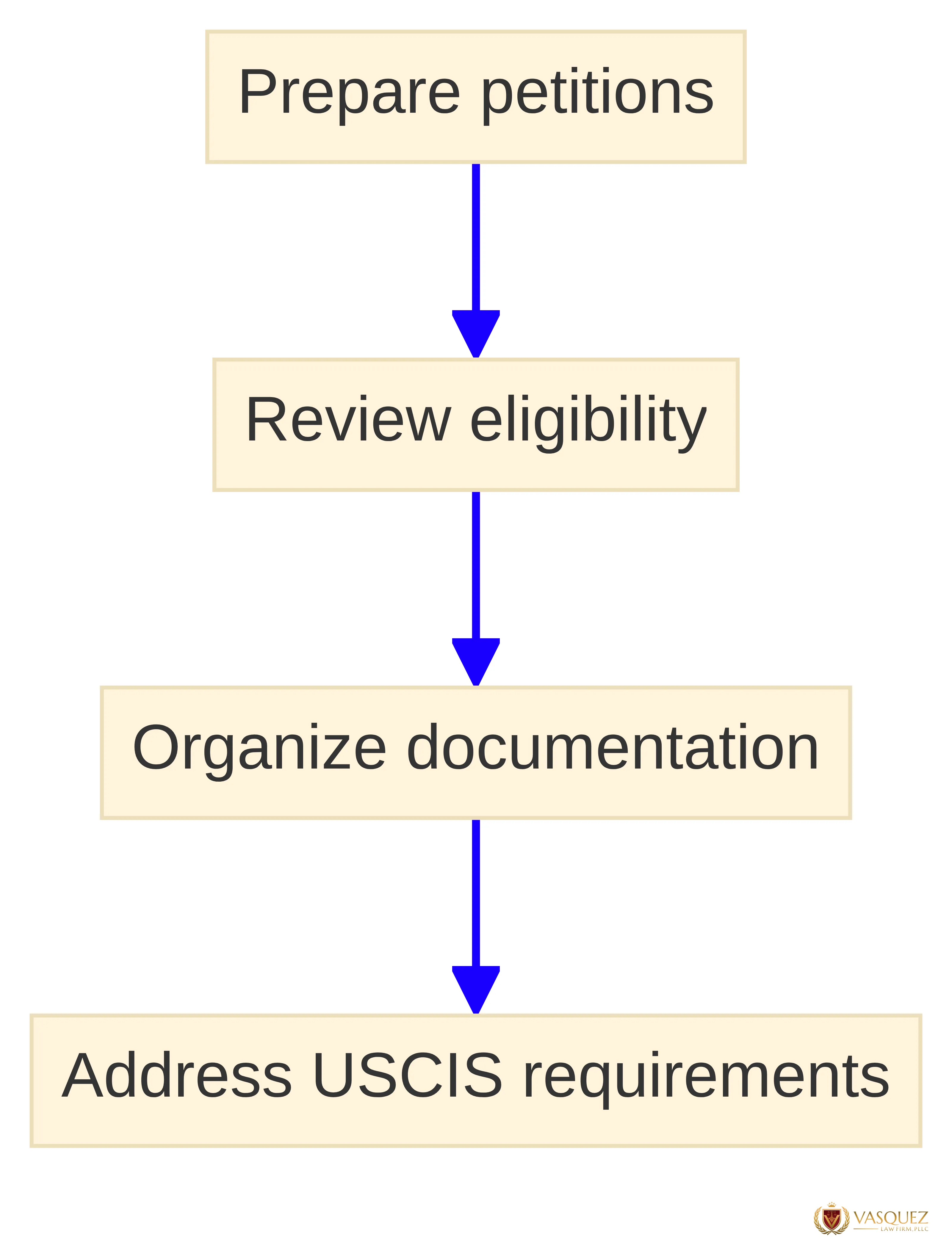
An immigration lawyer can help applicants and employers prepare petitions, review eligibility, organize documentation, and address USCIS requirements. That role becomes more useful when your facts do not fit neatly into a standard filing posture. Look for a consultation when you have a status question, a complicated employment history, a notice you do not understand, a possible violation, an upcoming trip, or a question about what your employer may require.
This guide sorts your situation into two broad paths:
- Review and prepare: Your records appear consistent, and you want help identifying the relevant filing posture and organizing questions.
- Seek prompt individualized guidance: A deadline, status end date, work-authorization question, termination, travel plan, employer request, notice, or possible violation could change what you may do next.
The second path calls for timely legal attention. Gather the facts before the concern becomes a filing or status problem.
Your decision does not depend on whether you can describe the matter as routine. It depends on whether an unresolved fact could change the filing, the timing, your ability to work, your travel plans, or the way a notice or prior event is evaluated. If you cannot confidently place the matter in a clear filing posture, make that uncertainty the first question for the consultation.
What an H-1B immigration lawyer can actually do
An attorney may review documents before submission for missing information, inconsistencies, or potential issues affecting a petition. That review can be especially useful when different records describe your education, job duties, employer, dates, or immigration history in different ways. Gather the records you have and identify any conflict rather than trying to make the documents look uniform on your own.
The consultation can cover educational qualifications, job responsibilities, employer requirements, and supporting evidence according to USCIS requirements. Those categories give you a practical way to frame your consultation:
- What education or professional background is being presented?
- What duties and employment facts are being presented?
- What employer information and supporting records are available?
- Where do the records leave a question, gap, or inconsistency?
Bring those questions together with your timeline. Counsel can then evaluate the facts rather than work from a short description that leaves out a material event.
The useful question is not whether an attorney can make uncertainty disappear. It is whether you can identify the uncertainty early enough to address it deliberately. If your concern involves document organization, preparation may be the main need; if it involves status, travel, employment termination, or a possible violation, ask for a fact-specific review before taking the affected action.
Use the filing posture to frame the consultation
The filing posture describes where you are in relation to the United States and your current nonimmigrant status. Form I-129 instructions identify a filing option for a beneficiary outside the United States, or for a beneficiary in the United States who will leave to obtain a visa or admission abroad. The same instructions identify an option to change the status of a beneficiary who is in the United States in another nonimmigrant classification, and an option to extend the stay of a beneficiary who already holds the relevant nonimmigrant status.
The three filing postures support three separate consultation questions:
- Outside the United States or leaving for visa or admission: What facts and records describe the planned visa or admission path?
- In the United States in another nonimmigrant classification: What supports the requested change of status, and what dates or travel plans affect it?
- Already holding the relevant nonimmigrant status: What supports the requested extension of stay, and what does your current status record show?
These filing options describe possible procedures; choosing one does not, by itself, decide whether you qualify or what result will follow.
Your consultation outline should state your current location, current status if known, the status or filing you are considering, and whether you expect to leave the United States. Add the dates shown on your immigration records. This short outline helps prevent a change-of-status question from being treated as an extension question, or an admission question as though it were only a filing made inside the country.
If your location, current status, intended travel, or requested benefit is unclear, preserve the uncertainty in your notes and bring it to counsel instead of selecting a posture based on a general description alone.
Escalate when status or work authorization is uncertain
A timely filed, nonfrivolous change-of-status request generally provides a period of authorized stay while it is pending, even after H-1B status expires. That rule does not mean you may continue working without checking the separate work-authorization consequence: a pending change-of-status request does not authorize work beyond the H-1B status end date until the change of status is approved.
Travel can also change the analysis. Departure from the United States while a change-of-status request is pending leads to denial of the change-of-status request and does not provide a basis for admission. If travel is planned or unavoidable, raise it before relying on the pending request. Do not assume that a pending filing protects both your stay and your ability to work or return.
Form I-94 generally shows your authorized period of stay. For admissions marked for duration of status, unlawful presence typically begins after status ends if you remain in the United States; for other admissions, it typically begins after the applicable authorized-stay date. Locate your Form I-94 and compare its information with your other notices and records before the consultation.
Status or work-authorization uncertainty calls for a clear timeline before you act. Prepare these facts:
- The status and end date you believe apply.
- The Form I-94 information you can access.
- Any pending request and its filing or receipt information.
- Planned travel and the date you expect to leave or return.
- The work activity you believe is authorized and the date it would begin or end.
A clear timeline gives counsel a usable starting point. Ask for individualized guidance before you work past a status end date, depart while a change-of-status request is pending, or rely on an assumed expiration date. Keep the dates in separate fields rather than combining them into one “expiration” date. Record the authorized-stay date shown on the I-94, the filing and receipt dates for any pending request, the H-1B status end date, and any planned work or travel date. Then note which document supports each entry and which date remains uncertain. This structure helps the consultation focus on the relationship among stay, work authorization, and travel instead of treating one date as an answer to all three questions. It also gives counsel a way to identify a missing record or a conflict that needs review.
Treat employment changes and employer conduct as review triggers
Employment termination is a prompt for review, not a reason to assume that one outcome automatically follows. USCIS states that you may use a discretionary grace period of up to 60 days to apply to change nonimmigrant status after employment termination, subject to the applicable conditions. Because the period is discretionary and conditional, record the termination date, preserve the written communication, and seek guidance about what options fit your facts.
Employer requests can also justify a consultation. An employer that has filed an H-1B labor condition application may not require an H-1B nonimmigrant to pay a penalty for ending employment before an agreed date when the payment is a penalty rather than liquidated damages under applicable state law. An employer may not require an H-1B worker to reimburse or otherwise compensate the employer for all or part of an H-1B petition fee described in the cited statutory provision.
Employment records should preserve the context of the change. Keep agreements, pay-related communications, termination notices, and requests for payment in their original form. Do not decide that a charge is lawful or unlawful from its label alone; the wording, timing, agreement, and applicable legal conditions can matter. Ask counsel to assess the specific request and explain what you should do next.
Your consultation questions should include:
- What date controls the employment change or termination?
- What status or work-authorization issue follows from that date?
- Does a discretionary grace period appear relevant, and what conditions need review?
- What should you do with an employer request for a payment or reimbursement?
- Which communications or agreements should you preserve?
Prompt review is especially sensible when employment has ended, may end soon, or has changed in a way your immigration records do not clearly describe.
Recognize records, notices, and possible violations as high-risk facts
A notice, inconsistent record, or possible violation may affect what the consultation needs to address. Put every notice with its envelope or delivery information, identify the date you received it, and write down the deadline or response date shown. Do not rely on a summary of the notice when the wording itself is available. Bring the complete document so the issue can be evaluated in context. For each notice, record its title or type, the date printed on it, the date you received it, any response deadline, and the action it requests. Keep the page order and note whether an envelope or delivery record is available. If a date or instruction is unclear, mark it as an open question rather than interpreting it from memory. For a possible violation, describe the event separately from its legal label: record what happened, when, where, and which status or employment arrangement you believed applied. This gives counsel the underlying facts without assuming the conclusion the consultation is meant to evaluate.
Your immigration history deserves particular care if you may have stayed beyond an authorized date or worked under conditions you did not understand. Form I-94 generally shows the authorized period of stay, and unlawful presence typically begins after the applicable authorized-stay date or, for duration-of-status admissions, after status ends if you remain in the United States. Write down the dates and events as you remember them, including departures, entries, filings, and changes in employment.
USCIS states that status, employment, or nonimmigrant-visa violations not exceeding 180 days may qualify for the listed exemption, while violations exceeding 180 days do not qualify under the table’s stated conditions. The day count is therefore not a complete answer by itself. Preserve the dates, the type of conduct, the status or employment involved, and the records that show what happened before asking counsel to apply the relevant rules.
An urgent notice, a status or work-authorization concern, a possible violation, or a concern about enforcement may warrant prompt individualized guidance. Bring the complete sequence of events, including facts that seem unfavorable or uncertain.
Build a consultation packet in five parts
A focused consultation packet helps an attorney review your facts instead of reconstructing them from scattered messages. Organize what you have into five parts. Keep originals where they belong and provide copies or accessible records for discussion; do not assume that an informal list replaces the underlying documents.
1. Immigration history and status records
List entries and departures, prior statuses, filings, decisions, notices, and the Form I-94 information you can access. Add the date you believe your current status began and ends. Mark any date you cannot confirm instead of filling the gap with an assumption.
2. Employment history
List employers, job titles, work locations, employment dates, changes in duties, and any termination or threatened termination. Include the employment documents and communications that describe the work or the change.
3. Filing and notice records
Gather petitions or applications, receipt or decision notices, requests or letters you received, delivery information, and any deadline shown. Put documents in date order so a reviewing attorney can see what happened first.
4. Concern timeline
Write a short account of the event that brought you to the consultation: a status question, work-authorization concern, travel plan, employer request, notice, termination, or possible violation. Separate what you know from what you suspect.
5. Questions and desired decision
Write the decision you need to make, such as whether to seek review before filing, traveling, changing employment, or responding to a notice. Add questions about your filing posture, dates, records, work, travel, and immediate boundaries.
A final records check can expose the issue you need to discuss first. Compare the dates across your records and flag contradictions. A simple two-column note can help: document or event and question it raises. For example, a status end date beside a planned travel date shows why travel needs discussion; an employer payment request beside the agreement shows what counsel should examine. This packet is a conversation aid, not a complete checklist for every H-1B matter. To make the packet easier to evaluate, label each item as confirmed by a document, reported from memory, or unknown. Use the same labels for dates, employment changes, travel, and status information. If two documents conflict, keep both versions visible and identify the conflict; do not silently choose the date that seems most favorable. For each unknown, write the question that would resolve it and the record that may answer it. This approach helps distinguish a missing document from a disagreement about what the document means, so the consultation can address the uncertainty that needs attention.
Your questions should be specific enough to produce a useful discussion:
- Which fact needs confirmation before you file, travel, work, or respond?
- Which document best supports or challenges that fact?
- What deadline or date should receive immediate attention?
- What information should you avoid assuming from a general USCIS explanation?
- What should you do while the issue is being evaluated?
Write the questions before the appointment so urgency does not replace accuracy.
Separate official requirements from legal application
H-1B information has two layers. The first layer is the official description of a filing posture or requirement. Form I-129 instructions identify options involving a beneficiary outside the United States, a change of status for someone in another nonimmigrant classification, and an extension for someone who already holds the relevant nonimmigrant status. The second layer is the application of that description to your actual history, documents, dates, employment, and travel plans.
That is different from merely finding a form or reading a general explanation. The legal application asks which facts matter, which records support them, and which uncertainty needs resolution before you act.
Your research should separate three questions:
- Official requirement: What does the applicable form, instruction, or agency material describe?
- Your application: How do your dates, status, employment, travel, and records fit that description?
- Open question: What fact could change the analysis, and what document could clarify it?
A general filing option is not an individualized eligibility answer. Keep time-sensitive questions tied to the rules and agency materials that apply when your matter is reviewed, and take unresolved status, work, travel, notice, or violation issues to counsel.
A published explanation can help you identify the subject of a consultation, but it cannot apply every rule to your history. If your question turns on a date, prior filing, employment event, travel plan, notice, or possible violation, carry that fact into the consultation instead of treating a general description as permission to act.
Choose the next step without assuming the outcome
Your risk map and consultation packet should determine the next step. If your records are organized and no immediate status, employment, travel, notice, or violation concern appears, use a consultation to clarify the filing posture and open questions. If any of those concerns is present, contact an immigration lawyer promptly and avoid relying on an assumed deadline, work authorization, travel consequence, or eligibility answer.
General educational information cannot determine whether you qualify or what you may do in your specific case. A qualified immigration professional must assess your individual facts under the rules that apply when your matter is reviewed. We offer immigration legal help. We also offer immigration case consultations and evaluations.
Frequently asked questions about H-1B immigration lawyers
What does an H-1B immigration lawyer do?
An H-1B immigration lawyer assists applicants and employers in preparing petitions, reviewing eligibility, organizing documentation, and addressing USCIS requirements.
When should I consider consulting an H-1B immigration lawyer?
You may want to consult an H-1B immigration lawyer if you have a status question, a complicated employment history, a notice you do not understand, a possible violation, or if you are planning to travel.
What documents should I prepare for my consultation with an H-1B immigration lawyer?
Gather your immigration history, employment records, filing and notice documents, a timeline of concerns, and a list of questions you want to address.
How can an H-1B immigration lawyer help with documentation?
An H-1B immigration lawyer can review your documents before submission to identify missing information, inconsistencies, or potential issues that may affect your petition.
What should I do if I receive a notice regarding my H-1B status?
Keep the notice with its envelope, note the date you received it, and bring it to your consultation for evaluation in context.
What factors should I consider when deciding whether to seek legal help for my H-1B situation?
Consider the complexity of your case, any status concerns, employer obligations, and whether there are potential violations or urgent deadlines.
Sources
- Chapter 8 - Inapplicability of Bars to Adjustment — www.uscis.gov
- FAQs for Individuals in H-1B Nonimmigrant Status | USCIS — www.uscis.gov
- Form I-129, Instructions for Petition for a Nonimmigrant ... — www.uscis.gov
- H-1B Labor Condition Application — www.dol.gov
- Unlawful Presence and Inadmissibility | USCIS — www.uscis.gov
- Options for Nonimmigrant Workers Following Termination of Employment | USCIS — www.uscis.gov
- How Immigration Lawyers Help with H1B Applications | Kenjay Law — kenjaylaw.com
- How Medicare Works: What Dreamers Should Know in 2026 | Vasquez Law Firm
- What Is Form I-9 and How to Complete It in 2026 | Vasquez Law Firm