

Start with the question each document answers
A work permit and a Green Card answer different immigration questions. A work permit, commonly represented by an Employment Authorization Document, or EAD, shows that you are authorized to work in the United States. A Green Card, officially called a Permanent Resident Card, represents permanent resident status.
The distinction matters because permission to work and immigration status are related but separate concepts. An EAD can provide evidence of employment authorization without establishing that you are a lawful permanent resident. The document you have, the application connected to it, and the category listed on your notices can change the question you need to answer next.
Your first question should be practical: are you trying to show that you may work, understand the status you hold, or determine what application is pending? If you have a pending Form I-485, you may be pursuing lawful permanent resident status while also seeking employment authorization. If you have another status or immigration application, the reason for your EAD may be different. Treat the card, the underlying status, and the pending application as separate pieces of your case.
This comparison gives you a way to organize those pieces. It does not determine whether you qualify for either document, because eligibility depends on your immigration category, history, location, applications, and current USCIS requirements.
What a work permit means
A work permit generally refers to an Employment Authorization Document issued on Form I-766. The EAD is a USCIS-issued card that shows its holder is authorized to work in the United States. In plain language, the card answers this question: what document can you use to show employment authorization?
An EAD is not the same thing as a Green Card. The EAD shows work authorization; it does not, by itself, show that you hold lawful permanent resident status. Your underlying immigration category or circumstance explains why you may have the authorization and what other rules apply to your case.
Form I-765 can play different roles depending on your situation. Certain people in the United States may use it to request employment authorization and an EAD. Other people may already be authorized to work because of their immigration status or circumstances and use the form to obtain evidence of that authorization.
Examples identified in USCIS materials include a pending Form I-485, a pending Form I-589, or a status that permits you to remain in the United States but does not allow you to work without prior permission from USCIS. Other people, including some asylees, refugees, and U nonimmigrants, may have employment authorization based on status or circumstances and need an EAD as evidence. These examples show why the same type of card can appear in different kinds of cases.
An EAD usually provides open-market work authorization, although exceptions exist. You should not assume that every work-related document has the same scope, category, or duration. USCIS instructions also exclude lawful permanent residents, conditional permanent residents, and certain nonimmigrants authorized to work only for a specific employer from using Form I-765 in the way described for applicants seeking an EAD.
Before relying on a work permit, identify the category shown on the card and the application or status connected to it. That information can matter when you renew the card, interpret a receipt notice, or decide whether a document supports the employment situation you are considering.
What a Green Card means
A Green Card is officially a Permanent Resident Card. The status behind the card is lawful permanent resident status, which allows you to live and work permanently in the United States. In plain language, the Green Card answers a broader question than an EAD: what immigration status allows you to remain and work as a permanent resident?
The card itself is evidence of that status, while the route to permanent residence depends on your individual situation. If you are in the United States and seek adjustment of status, Form I-485 is the application used to apply for lawful permanent resident status. The eligibility requirements for that application vary by immigrant category.
Your location can affect the Green Card process. If you are in the United States, USCIS identifies adjustment of status as the application process and uses Form I-485 for that purpose. If you are outside the United States, the general process is consular processing with the Department of State. Your location alone does not establish eligibility, but it helps identify which process you need to investigate.
A pending Form I-485 is still a pending Green Card application. You should not describe a pending application as an already approved Green Card or as completed permanent resident status. The filing, its receipt notices, and the category supporting it need to be considered separately from any EAD you may hold while the application remains pending.
A conditional Green Card has a specific limitation. A conditional permanent resident receives a Green Card valid for two years, and the conditions must be addressed during the 90-day period before the conditional card expires. The conditional card cannot be renewed as an ordinary Green Card renewal; you must use the process for removing the conditions.
The two-year rule applies to a conditional Green Card, not automatically to every Green Card situation. If your card or immigration history involves conditional residence, treat that detail as a separate issue that may control the next filing deadline.
Compare work authorization, status, and limitations
A work permit and a Green Card differ across the questions that usually matter most:
| Question | Work permit or EAD | Green Card |
|---|---|---|
| What does it primarily show? | Evidence that you are authorized to work in the United States. | Lawful permanent resident status, with permission to live and work permanently in the United States. |
| Does it establish permanent resident status? | No. The EAD is evidence of employment authorization, while your underlying category or circumstance supplies the immigration context. | Yes, the Green Card represents lawful permanent resident status, subject to the rules that apply to your situation. |
| How can it arise? | You may request it through Form I-765, or you may already have work authorization and use that form to obtain evidence of it, depending on your circumstances. | You may apply through a process such as adjustment of status in the United States or consular processing from outside the United States. |
| How broad is the work authorization? | The usual open-market description has exceptions; check the category and current USCIS rules. | A Green Card allows permanent residents to live and work in the United States. |
| What should you check about duration? | Do not assume one duration applies to every EAD; the category and current USCIS rules matter. | Do not assume one duration applies to every Green Card; conditional residence has a specific two-year rule and separate process. |
| What limitation is easy to miss? | The card does not by itself tell you that you have permanent resident status. | A pending application or a conditional card is not the same as an unrestricted assumption that every Green Card issue follows the same process. |
The comparison points to the main practical difference. An EAD is primarily about employment authorization, while a Green Card is about lawful permanent resident status and the ability to live and work permanently in the United States. A person can therefore have work authorization without having a Green Card, and a Green Card holder is not the ordinary Form I-765 applicant described in the USCIS instructions.
The distinction also prevents a common mistake: treating an EAD as proof that a permanent residence application will succeed. Your work permit may be connected to a pending application or another immigration circumstance, but that connection does not turn the EAD into a Green Card. Keep the employment document and the status or application supporting it clearly identified.
If you are comparing the documents in your own file, check these four items together:
- The document name and card type.
- The immigration category or circumstance connected to the document.
- The application and receipt notice, if an application is pending.
- The expiration date and any instructions that describe what happens next.
This check does not replace an eligibility review. It gives you a clearer description of what each document is doing in your case.
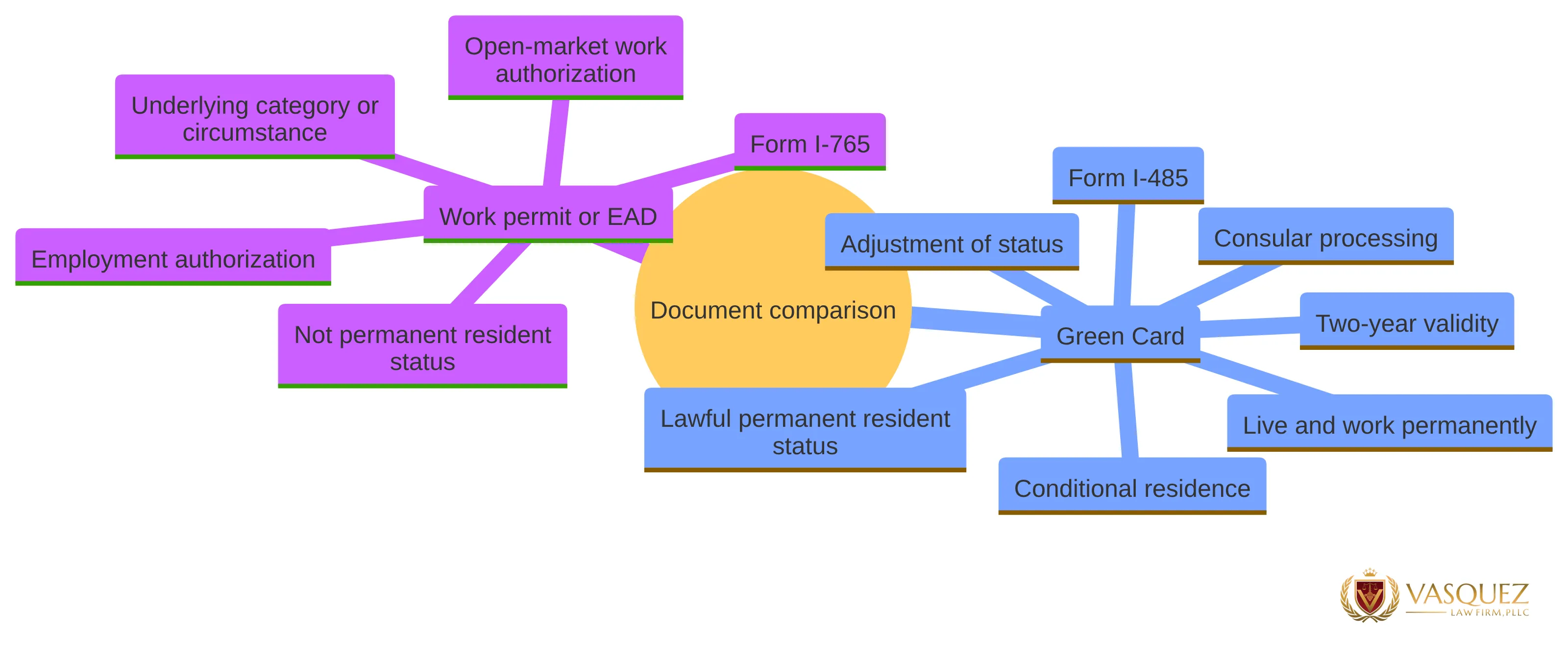
How the two documents can appear in the same case
A work permit and a Green Card application can appear in the same case without meaning the same thing. For example, you may have a pending Form I-485 while also seeking employment authorization through Form I-765. The EAD addresses whether you have evidence of work authorization during the relevant period; the I-485 addresses the application for lawful permanent resident status.
A pending I-485 means the Green Card application is still pending. It should not be described as an already approved Green Card. The EAD may help you address employment authorization while the application is pending, but the EAD does not guarantee approval of the Green Card application.
Other immigration situations can also produce a work permit without a Green Card application. USCIS materials identify a pending Form I-589 and certain statuses or circumstances that permit presence in the United States but require prior permission to work. They also identify situations in which you are already authorized to work because of your status or circumstances and need an EAD as evidence.
The same physical card therefore does not tell you the entire story. Your category, underlying status, application history, and notices explain why the card was issued and what limits may apply.
Use the branch that resembles your situation:
- You have an EAD and no pending Green Card application. Treat the EAD as evidence of employment authorization and identify the category behind it. Do not assume that the card creates a path to permanent residence.
- You have an EAD and a pending I-485. Keep the employment authorization record separate from the pending permanent residence application. Track both documents and their notices.
- You have a Green Card. USCIS instructions generally do not direct lawful permanent residents to use Form I-765 for the EAD process described here. Identify the Green Card issue and the status question instead.
- You are unsure why you received an EAD. Compare the card category with your application and receipt notices before relying on a general explanation. If the documents conflict or the employment consequences are immediate, obtain individualized immigration advice.
Do not assume the expiration date tells the whole story
An expiration date tells you when a document requires attention, but it does not answer every status or renewal question. EAD validity can depend on the applicable category and current USCIS rules. Green Card rules can also differ, and a conditional Green Card has its own two-year validity and condition-removal process.
Do not assume that every EAD or Green Card follows one universal duration. Read the document together with the category, application, and USCIS notice connected to it.
A past automatic-extension rule illustrates why timing and category matter. For specified eligibility categories and conditions, a timely Form I-765 renewal filed before October 30, 2025, could provide an automatic extension of employment authorization and/or an EAD for up to 540 days while the renewal remained pending. The rule applied only when the stated filing, category, and notice conditions were met.
That historical date and the listed conditions matter. You should not treat a general statement about automatic extensions as a current answer for every renewal. Match the renewal filing date, eligibility category, receipt notice, and applicable USCIS guidance before relying on an extension.
When a document is close to expiration, organize the issue in this order:
- Identify whether the document is an EAD, a regular Green Card, or a conditional Green Card.
- Record the exact expiration date and the category shown on the document.
- Locate the related application, receipt notice, and any later USCIS notice.
- Determine whether the applicable rule concerns renewal, an automatic extension, or removal of conditions.
- Get individualized advice before relying on a rule when the category, filing date, or notice is unclear.
The checklist helps you frame the issue. It does not establish that a particular extension or filing option applies to you.
Use your case facts to identify the right question
Your next question depends on the facts behind your documents. Gather the information that connects the card to your immigration situation:
- Document: Write down whether you have an EAD, a Green Card, a conditional Green Card, or only a receipt notice.
- Category: Record the eligibility category printed on the EAD and the immigrant category or status connected to any permanent residence application.
- Applications: Identify whether you filed Form I-765, Form I-485, Form I-589, or another application, and note whether USCIS has issued a receipt notice.
- Location: Note whether you are in the United States or outside the United States, because USCIS identifies different general Green Card processes for those locations.
- Timing: Record filing dates, expiration dates, and dates stated in USCIS notices.
- Conditions: Check whether your Green Card is conditional or whether your work authorization depends on a particular status or circumstance.
These facts help separate an employment-authorization question from a permanent-residence question. They do not, by themselves, determine eligibility.
Use your documents to form a precise question rather than asking only whether you have a work permit or Green Card. For example:
- What immigration category supports my EAD?
- Does my current status already authorize employment, or does the EAD provide the permission I need?
- Is my Form I-485 pending, approved, or not part of my case?
- Does the category on my EAD match the category on my renewal receipt notice?
- Does my expiration date require renewal, a response to a notice, or removal of conditions?
- Does a current USCIS rule apply to my filing date and category?
Specific questions make it easier to distinguish what your document proves from what you still need to establish. They also reduce the risk of treating a general explanation as an individualized legal conclusion.
Eligibility and next steps can change with your immigration category, status, application history, physical location, filing date, and USCIS notices. A work permit may be available in one situation and unavailable in another, while the requirements for adjustment of status vary by immigrant category. A Green Card application and an EAD application may therefore require different questions and different supporting information.
If your documents appear inconsistent, your work authorization is expiring, or you are unsure whether an application affects your status, do not choose a filing path from the document names alone. Preserve the notices and seek a case-specific review before taking action that could affect your immigration situation.
Choose a safe next step when your documents or status are uncertain
A work permit primarily addresses employment authorization. When both appear in your file, compare the document, category, application, expiration date, and USCIS notices instead of treating the EAD as proof that permanent residence has already been granted.
If your status, application, work authorization, expiration date, or USCIS notice remains uncertain, a qualified immigration lawyer should determine how the rules apply to your individual circumstances. Bring your cards, applications, receipt notices, and other USCIS correspondence to that review. We offer immigration case consultations and evaluations.
Write down the specific question you need answered and organize the documents connected to it before requesting individualized guidance. That preparation can help keep the discussion focused on the work authorization or permanent residence issue that concerns you.
Questions to ask when a work permit and Green Card situation is unclear
What is the difference between a work permit and a Green Card?
A work permit, or Employment Authorization Document (EAD), shows that you are authorized to work in the United States, while a Green Card, or Permanent Resident Card, reflects lawful permanent resident status, allowing you to live and work permanently in the U.S.
What does a Green Card allow me to do?
A Green Card allows you to live and work permanently in the United States, reflecting your status as a lawful permanent resident.
What should I check regarding the expiration of my work permit or Green Card?
Check the document type, expiration date, category shown on the document, and any related applications or USCIS notices to understand your renewal options and requirements.
What steps should I take if my immigration status is uncertain?
If your immigration status is uncertain, gather your documents and seek individualized guidance from a qualified immigration lawyer to clarify your situation and next steps.
What limitations should I be aware of regarding a work permit?
A work permit does not establish permanent resident status and may have specific limitations based on your immigration category or circumstances.
Sources
- Form I-765, Instructions for Application for Employment ... — www.uscis.gov
- How to Apply for a Green Card | USCIS — www.uscis.gov
- Employment Authorization Document | USCIS — www.uscis.gov
- Conditional Permanent Residence | USCIS — www.uscis.gov
- Application for Employment Authorization — www.uscis.gov
- Employment Authorization Document (Form I-766/EAD) | USCIS — www.uscis.gov
- What Is Form I-9 and How to Complete It in 2026 | Vasquez Law Firm