

A backlog describes a constraint, not a guaranteed wait time
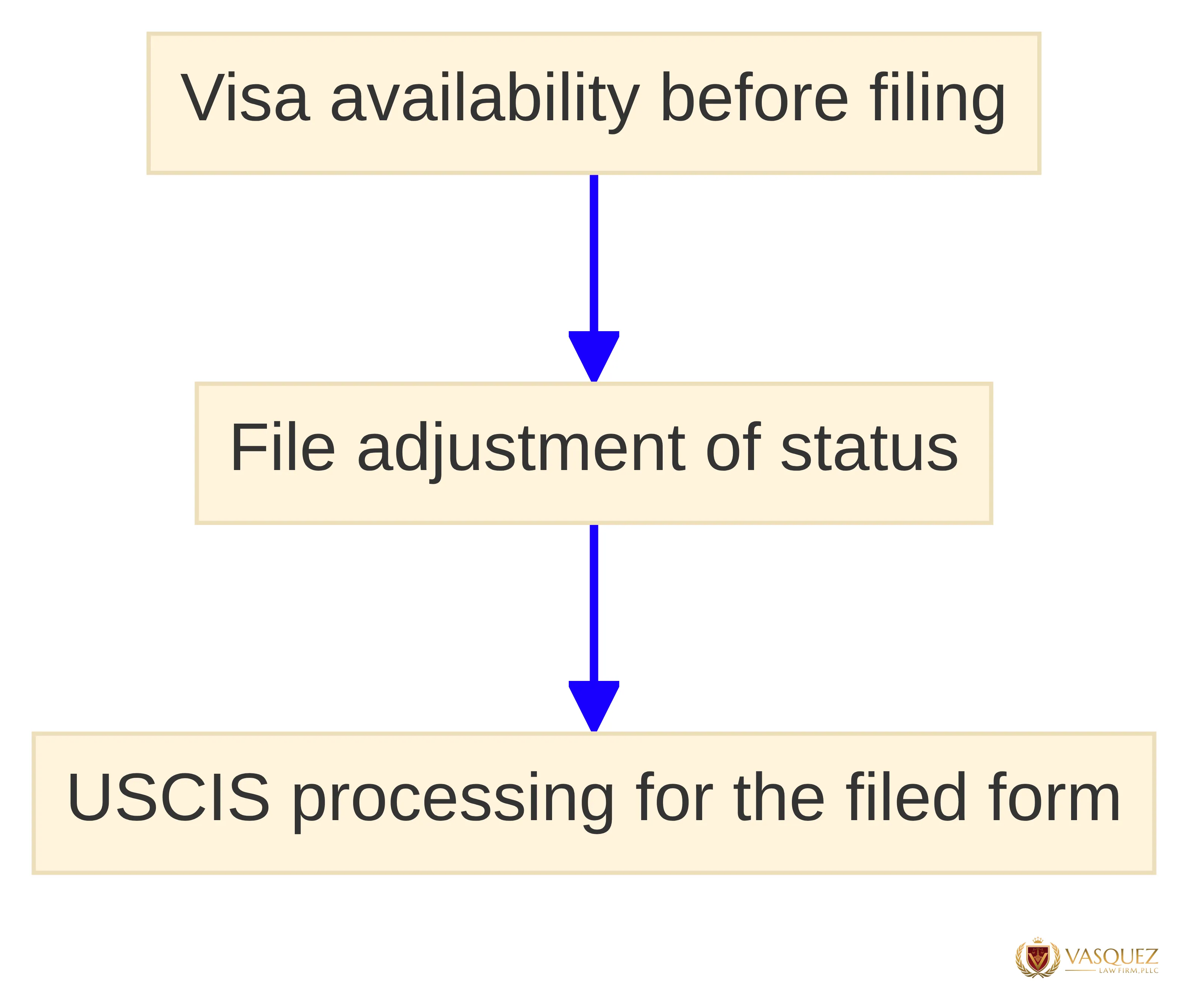
A green card backlog is a practical way to describe a delay or constraint affecting the path to permanent residence, but the phrase does not tell you how long your case will take. Two different questions may be involved: whether an immigrant visa is available in the applicable category and whether USCIS is still processing a form that has already been filed. Those questions can affect different stages of the same process.
Visa availability concerns the supply of immigrant visas in the category connected to your case. If a relative or employer has filed an immigrant visa petition for you, you may have to wait for an available visa in the applicable category before filing an adjustment-of-status application. That is different from an agency processing delay, which concerns the time USCIS takes to act on a form after receiving it. Separating these questions keeps a general backlog statement from becoming a personal timeline prediction.
The useful starting point is not a promised number of months. It is the case stage that is waiting, the record that identifies that stage, and the official information that applies to it. The sections below help you sort those pieces before deciding whether ordinary monitoring is enough or whether the record calls for individualized review.
First identify which green card stage is waiting
Your green card stage determines which delay question deserves attention first. A petition or immigrant-visa stage is not the same as a pending adjustment-of-status application, and the available records do not cover both stages in the same way.
Use these questions to locate the waiting point:
- Has a relative or employer filed an immigrant visa petition for you?
- Are you waiting for an available visa in the applicable category before filing Form I-485, the adjustment-of-status application?
- Have you already filed an adjustment-of-status application and received a receipt or other USCIS correspondence?
- Is the record about an immigrant-visa process rather than an adjustment-of-status process?
The September 2026 USCIS filing guidance explains that a person with a filed petition may have to wait for an available visa before filing the adjustment application. That means a pending petition or visa-availability question should not be treated as though it were only a USCIS form-processing question.
The employment-based inventory report is a focused estimate for pending Forms I-485 in employment-based preference categories, organized by selected country of chargeability and estimated priority-date month and year. Those fields make it possible to compare the described inventory with the corresponding fields in a pending adjustment record. They do not turn the report into a personal timeline: the report’s purpose is to describe the inventory fields it contains, while the case record identifies the stage and dates that need to be reviewed. Use the report only when those fields and the pending adjustment stage match the question you are trying to answer.
Visa availability depends on the case’s place in the queue
Visa availability for an employment-based immigrant visa depends on more than the date you submitted a form. USCIS identifies several factors that affect the wait: the supply and demand for the particular preference category, your priority date, the country to which the visa will be charged, and statutory limits such as per-country caps. The country of chargeability is usually your country of birth.
Your preference category matters because visa supply and demand are assessed within that category rather than across every green card case as one group. Your priority date matters because it places the case in relation to other cases in the applicable category. Country of chargeability matters because the same category and priority-date month can be treated differently when statutory country limits affect availability.
These factors make the backlog a moving availability question rather than a simple clock that starts on the same day for everyone. The approved USCIS inventory information can help you examine employment-based Forms I-485 in relation to category, country of chargeability, and estimated priority-date month and year.
Before interpreting a visa-availability record, write down the facts you are using:
- the preference category;
- the priority date shown in your records;
- the country of chargeability, if the applicable process uses it;
- whether you are waiting to file adjustment of status or already have a pending Form I-485; and
- whether the question concerns an immigrant-visa process rather than a USCIS adjustment process.
If any of those facts is uncertain, treat the conclusion as unfinished rather than filling the gap with a general backlog estimate.
USCIS processing is a separate kind of delay
USCIS’s publicly posted processing time for a particular form describes the average amount of time the agency took to process that form, from receiving the application through making a decision on the case. The measure is tied to the form and the agency’s processing record. It is not a statement that every case will receive a decision at that same point.
USCIS also uses an internal measure called cycle time. Cycle time measures how many months’ worth of pending cases for a particular form are awaiting a decision. USCIS uses that internal measure in its operational work to gauge progress in reducing the backlog and overall case-processing times.
The two measures are related but not identical. USCIS states that cycle times are generally comparable to its publicly posted median processing times, while the public processing-time information describes the average time taken to process a particular form from receipt to decision. Read the public measure as an agency-level processing indicator, not as a personal prediction.
When you check processing information, record the form and the date of the check. Then compare that information with your own receipt and correspondence. A processing-time page can help you understand the agency’s general handling of that form, but it cannot answer a separate question about whether an immigrant visa is available in your category. This creates a useful interpretation rule: match the record to the question before drawing a conclusion. A form-processing measure belongs beside the receipt and form involved; a visa-availability review belongs beside the category, priority date, and country information used for that analysis. If those inputs do not match, the result may describe a different stage of the process. Keeping the two records separate also makes it easier to explain what is known, what remains unclear, and what would need individualized review.
How visa availability and USCIS processing can overlap
Visa availability and USCIS processing can control different parts of the same path. An available visa may be required before you can file an adjustment-of-status application, while a form that has already been filed may then be subject to USCIS processing. Looking at only one of those questions can leave a major part of the case record unexplained.
For an employment-based case, ask whether the concern is placement within the preference category or action on a pending Form I-485. The USCIS inventory report is designed to estimate pending employment-based Forms I-485 by category, selected country of chargeability, and estimated priority-date month and year. A person who has not yet applied for adjustment of status may be dealing with a different record and a different information gap.
Use a two-part sequence:
- Identify whether visa availability applies before the adjustment filing stage.
- If a form has already been filed, identify the USCIS processing information for that form.
The sequence does not produce a promised timeline. It tells you which official record to examine first and prevents an agency processing measure from being used as a substitute for visa-availability information. Apply the sequence to the stage shown in the record. If adjustment of status has not been filed, the immediate question may concern the available-visa requirement rather than the processing time for a form that does not yet exist in the case record. If a Form I-485 is pending, case status and the processing information for that form become relevant, and the employment-based inventory report may provide a limited comparison when its fields match the case. If a notice has changed the case, such as a request for evidence or a denial, the record should be reviewed as a case development rather than treated as an ordinary backlog check. This stage-based approach helps prevent a correct piece of information from being applied to the wrong step.
Assemble the facts that define your place in the process
Your case record should make the waiting stage easy to identify. We recommend gathering relevant immigration documents, including green cards, previous visa applications, work permits, and correspondence with immigration authorities. Add the documents that show the category, priority date, filing stage, form, receipt information, and any later notice connected to the delay. The purpose of collecting these papers is to keep the facts connected, not to create a prediction. A priority date without the related category or country information may not answer the same availability question, and a receipt without the form may not identify the processing measure to compare. Correspondence can also show whether the case has reached a new stage or whether USCIS has issued a request or decision that needs separate attention. Preserve the dates and wording in the records rather than summarizing them as a general backlog.
Create a short case-facts page with these headings:
- Category: Write the preference category shown in the petition or adjustment records.
- Priority date: Copy the date exactly as it appears in the relevant record.
- Country of chargeability: Record the country used for the applicable visa analysis, usually the country of birth for the employment-based information described by USCIS.
- Filing stage: Mark whether you are waiting to file adjustment of status, already have a pending Form I-485, or are tracking an immigrant-visa process.
- Form and receipt: Record the form name, receipt information, and dates shown on notices.
- Agency correspondence: Keep requests, decisions, and other notices in date order.
This arrangement gives you a focused set of facts to compare with official information.
Compare the official case-status, processing, and visa records
Your official records should answer three different questions: what has happened to the case, how USCIS is processing the relevant form, and whether an available visa is required for the next adjustment step. Do not replace those three questions with one general search for the phrase green card backlog.
Work through the records in this order:
- Case status: Read the status and notices connected to your receipt or filed application. Record the latest dated development rather than relying on memory.
- Form processing: Identify the USCIS processing information for the form involved. USCIS describes this information as the average time from receipt of a particular form until a decision.
- Visa availability: If a relative or employer has filed an immigrant visa petition and the adjustment filing has not yet occurred, check whether an available visa is required in the applicable category before filing.
- Record match: Compare the category, priority date, country of chargeability, and filing stage in your documents with the information you are reviewing.
For a clearer review, make four short notes rather than one overall statement that the case is backlogged. First, write the latest case-status development and its date. Second, identify the form and the agency processing information being compared. Third, state whether visa availability is part of the step still waiting. Fourth, list any mismatch, missing field, request, or decision that prevents a confident comparison. This format separates a delay shown by the agency record from a missing fact in the reader’s own file. It also gives an immigration lawyer a concise starting point without asking a general processing page to answer a question about eligibility or an individual outcome.
Save the date of each check and keep the underlying notice with your notes. Visa availability and USCIS processing information can answer different parts of the question, so a result that addresses one part should not be treated as an answer to the other.
USCIS adjustment-of-status filing guidance
Use the employment-based inventory report within its limits
The USCIS employment-based inventory report is an estimate of pending Forms I-485 in employment-based preference categories. It organizes the estimate by selected country of chargeability and by the month and year of the estimated priority date. The report organizes its estimate using those fields, which can help you compare the surrounding pending inventory.
If you have a pending adjustment-of-status application, you can use the report to estimate how many Forms I-485 in your preference category and country of chargeability have earlier priority dates. Use it as a way to understand the surrounding inventory, not as a calculation of your personal decision date.
To use the report carefully, compare the same three fields:
- your employment-based preference category;
- your country of chargeability; and
- the month and year of your estimated priority date.
Then check whether your Form I-485 is actually pending. If the case is still at the petition or immigrant-visa stage, the report may not describe the part of the process that is waiting.
Read the report as a comparison of the fields it reports, not as a prediction about a particular case. Compare the category, country of chargeability, and estimated priority-date month and year with the pending Form I-485 record, and keep the result tied to that record. If the record does not establish one of those fields, pause the comparison rather than filling the gap with a general backlog estimate.
Know when the record calls for individualized review
A USCIS request for evidence or denial concerning your green card changes the question from general monitoring to a response tied to your record. We recommend calling a lawyer after you receive a USCIS request for evidence or a denial concerning your green card. The notice, its deadline, and the documents already submitted belong together in that review.
Prepare the material that allows the issue to be examined directly:
- the request for evidence or denial;
- the receipt and filing records connected to the green card matter;
- the documents previously submitted;
- later correspondence from USCIS; and
- relevant immigration documents, including previous visa applications, work permits, green cards, and agency correspondence.
Do not reduce a notice to a single sentence such as “my case is delayed.” The reason stated in the notice may control what needs attention.
We can help determine which forms of relief may apply to your situation. That kind of review uses your documents and the specific development in the case rather than a general backlog label.
Keep backlog information separate from legal advice
The source of immigration legal advice matters. USCIS states that only an attorney or an accredited representative working for a Department of Justice-recognized organization can give immigration legal advice. Use general backlog information to organize the issue and identify the records involved, then direct legal questions to an authorized provider.
Questions about category, priority date, visa availability, or USCIS processing can often be organized before a consultation. Questions about the meaning of a notice, the response to a request for evidence, the effect of a denial, or which relief may apply require attention to the particular record. Keep those two levels separate so a general explanation does not become an assumed case result. A practical boundary is to ask whether the answer would change after reading the person’s petition, receipt, notice, or prior submission. If the answer is no, general information may help with monitoring and organization. If the answer is yes, the issue has moved from explaining backlog concepts to assessing an individual record. That distinction does not decide what the person should file or whether the person qualifies; it identifies when a general source is no longer enough for the question being asked.
Choose monitoring or review based on the case record
We recommend calling a lawyer after you receive a USCIS request for evidence or a denial concerning your green card. This guide can help you organize the question, but it cannot determine your eligibility, predict movement, or decide which filing action fits your facts; an authorized immigration professional must assess individual suitability.
Sources
- USCIS Announces New Actions to Reduce Backlogs, Expand Premium Processing, and Provide Relief to Work Permit Holders | USCIS — www.google.com
- The Unauthorized Practice of Immigration Law — www.uscis.gov
- When to File Your Adjustment of Status Application for Family-Sponsored or Employment-Based Preference Visas: September 2026 | USCIS — www.uscis.gov
- How Federal Immigration Cases Work in Charlotte NC in 2026 | Vasquez Law Firm