

Is DV-2027 registration currently open?
The court account states that the Department of State had not opened the DV-2027 lottery registration period. It describes an October 14, 2026 preliminary injunction requiring the program to be reopened. Those facts describe the court record, not whether the official entry channel is accepting submissions today.
The district court order described in the account required an announcement by October 29, 2026, registration to open by November 1, 2026, and selectees to be notified of their eligibility to apply by no later than December 3, 2026. November 1, 2026 is in the future from October 30, 2026. A court-ordered date is also different from confirmation that the official entry channel is accepting submissions.
The government appealed the preliminary injunction and sought an emergency stay. That leaves you with a practical boundary: do not treat the injunction, an expected date, or an announcement from a private service as proof that registration is open.
Check the Department of State’s current Diversity Visa information and official status-check channel before sharing personal information or paying anyone. If the official record does not expressly confirm that entries can be submitted, pause rather than relying on an assumed opening or cancellation.
What “green card lottery 2027” means
The phrase “green card lottery 2027” refers to the DV-2027 Diversity Visa Program. The Diversity Immigrant Visa Program is a statutory United States program that uses random selection among entries from countries with historically low rates of immigration to the United States. The Department of State administers the program, while later immigration processing can involve different agencies and requirements.
The word lottery describes the random-selection feature. It does not mean that every entry produces a visa or a green card. The program separates entry from selection, and selection from the later visa or adjustment process.
You therefore need to answer two different questions. First, is the government accepting DV-2027 entries during the relevant registration period? Second, what would be required if you were selected? A general description of the Diversity Visa Program can answer what the program is, but it cannot prove that registration is open on October 30, 2026.
The program’s identity also does not settle its current operational status. Use the current official record for the registration question rather than an old instruction sheet, a general description, or a private service’s advertisement.
To keep those questions separate, classify any page or message into one of three categories: program description, current registration instruction, or later-processing guidance. A program description explains the Diversity Visa framework. A registration instruction must address whether DV-2027 entries may be submitted and identify the applicable official instructions. Later-processing guidance concerns what happens after selection and cannot answer the registration question. This classification is useful when helping a spouse, relative, or friend: ask what the source is actually trying to establish before treating it as an answer. If the source only describes random selection or adjustment of status, it has not established that an entry period is active. If it discusses the court order without confirming an operative entry channel, it has not established that a submission can be made. This separation reduces the risk of treating context as permission to file.
Separate DV entry from later green card processing
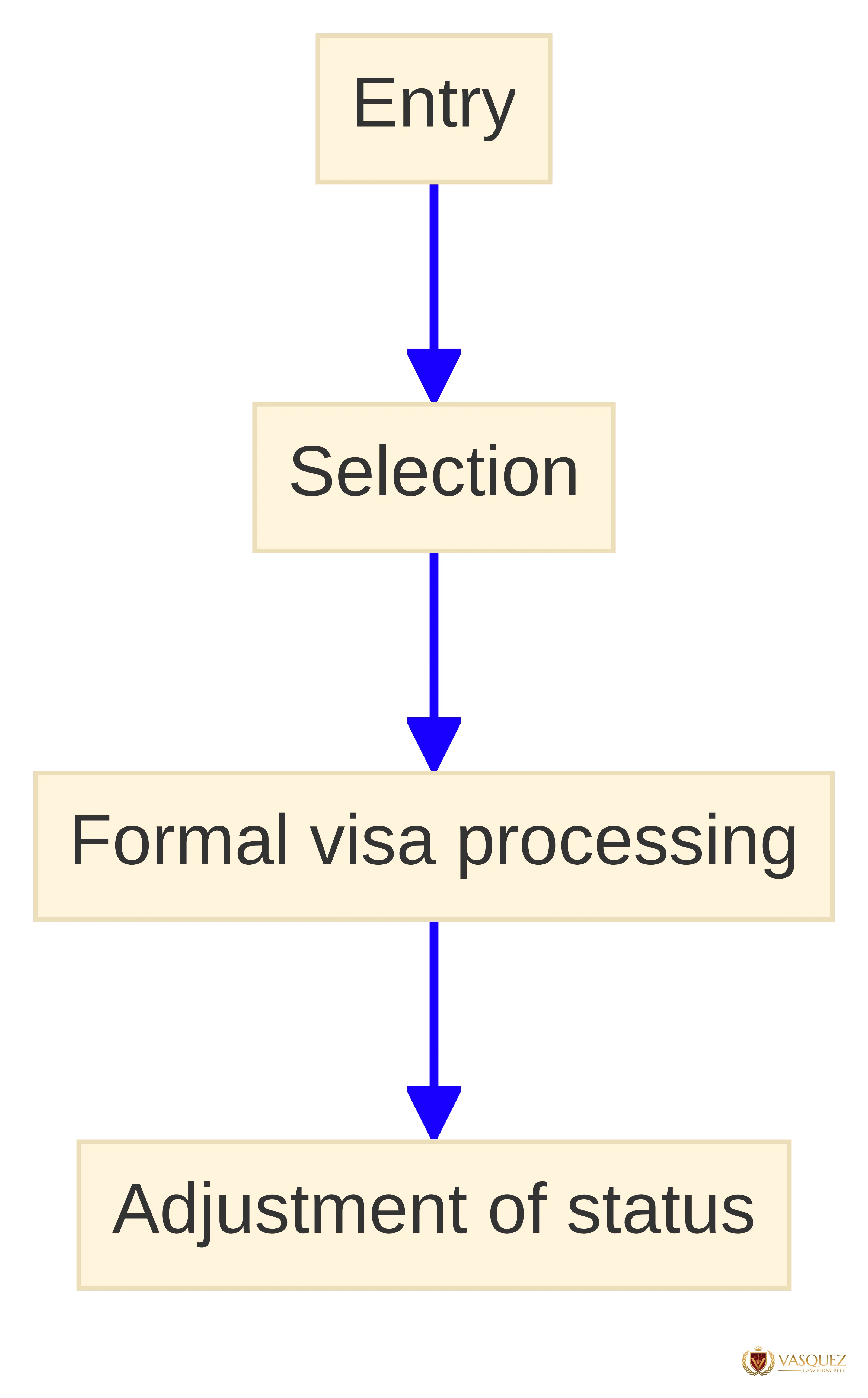
DV-2027 entry and later green-card processing are separate stages, and each stage answers a different question. Keep the sequence clear by separating these four points:
- Entry: Submit an entry only if the Department of State confirms that the DV-2027 registration period is open and provides current official instructions. The court account does not, by itself, confirm that you can submit an entry on October 30, 2026.
- Selection: The Diversity Visa framework uses random selection among entries. Selection moves you toward a possible formal immigration process; it does not establish that a consular officer or USCIS has found you qualified for a visa or permanent residence.
- Formal visa processing: The DV-2026 instructions state that selectees scheduled for an interview must pay a visa application fee before making a formal visa application, after which a consular officer determines whether the person qualifies. That instruction is specifically for DV-2026, so it is not a confirmed DV-2027 fee or procedure. USCIS lists requirements that include filing Form I-485, qualifying after inspection and admission or parole, being physically present in the United States when filing, being selected, and having an immigrant visa number immediately available at filing and final adjudication.
Later processing information cannot create an entry period. It does not show that DV-2027 registration is open, and it does not replace the Department of State’s current registration instructions.
Keep copies of each official record as you move from one stage to another. An entry record, a selection notice, a visa application, and an adjustment filing are different documents with different consequences. Do not treat one as proof that the next stage has begun.
At each stage, ask what event creates the next record and what the current record does not prove. An entry confirmation concerns submission, not selection. A selection result concerns the result of the drawing, not qualification for a visa or permanent residence. A formal visa application starts review, not approval. An adjustment filing is a request evaluated under USCIS requirements, not a grant of status. This does not create additional DV-2027 rules; it keeps the available records in their proper place. It also explains why different questions may require different sources: Department of State material addresses the program and entry process, while USCIS material addresses adjustment-of-status requirements and pending adjustment matters. If a source jumps from an entry claim directly to a green-card result, treat that jump as a missing stage and verify before acting.
What the court record says about DV-2027
The court account describes a sequence of events rather than a confirmed entry opportunity. The sequence stated in that account is:
- The Department of State did not open the DV-2027 registration period.
- The district court ordered an announcement by October 29, 2026.
- The district court ordered registration to open by November 1, 2026.
- The district court ordered selectees to be notified of their eligibility to apply by no later than December 3, 2026.
The phrase “by November 1” describes an ordered deadline, not proof that an entry form was available on October 30 or that the deadline remained operative. The phrase “by December 3” describes the stated notification schedule, not a present finding that you have been selected or can begin a formal application.
The court account also places these dates within an appeal and emergency-stay request. That means you should treat the dates as part of the history you are checking, not as a substitute for current operating instructions.
The Department of State’s official channel must identify whether an entry can actually be submitted and what instructions apply when you act. If the official page does not provide that confirmation, do not fill the gap with a deadline copied from a court summary or private website.
When reading the court account, separate four layers of information: what the Department did, what the district court ordered, what the government challenged, and what remains unknown. The first layer concerns the reported failure to open registration. The second concerns the order’s stated announcement, opening, and notification dates. The third concerns the appeal and emergency-stay request. The fourth includes whether the order’s dates remained operative and whether the entry channel is accepting submissions. This structure prevents a procedural description from becoming an unsupported operational conclusion. It also makes date checking more precise: a date in a court account can tell you what the order required, while only a current official instruction can tell you what action is available to an entrant. Keep those layers in your notes when sharing information with a family member, because repeating the date without its layer can make a requirement sound like a confirmed opening.
Why the registration status remains unresolved
The distinction between a court order and an official entry notice matters for what you should say and do. Do not convert the injunction into a statement that registration is open. Do not convert the earlier failure to open registration into a statement that DV-2027 has been permanently canceled. Either conclusion would go beyond the dated court account.
The operational question is narrower: can you submit a DV-2027 entry through an official Department of State channel under current instructions? A current official notice must answer that question. Until the official record expressly resolves it, treat registration as unconfirmed.
Avoid services that ask you to act on an assumed deadline. If a private message says that you must pay immediately to preserve an opportunity, stop and compare the message with the official Department of State information before taking any action.
For a clearer uncertainty record, label each statement you collect as confirmed by the cited official record, reported as part of the court account, or not resolved by the available record. The first label belongs to an operative Department of State instruction only when it expressly addresses the action you are considering. The second can describe the injunction, its dates, and the appeal without turning them into proof that the channel is live. The third is appropriate for the appeal’s operative disposition and the question whether the ordered dates remained in effect, because the selected court passage does not resolve those points. This note-taking method does not decide the case; it prevents an unresolved point from being silently converted into a deadline, cancellation, or invitation to submit personal information.
Use the official record to choose your next branch
The DV-2027 status shown in the current official record should determine your next action. Use these four branches:
- If an official Department of State notice expressly confirms that registration is open: Follow the current instructions on the Department of State’s Diversity Visa webpage and use the official entry channel identified there. Do not use a private company’s form as a substitute for the government channel. Save the confirmation or other entry record that the official process provides.
- If an official notice confirms that registration is closed: Do not pay a private service to submit an entry after closure or to create an exception. The Department of State warns that payments to nongovernmental sources are not received by the U.S. government and do not count toward visa processing. Keep checking official program information for a later notice rather than treating a paid submission as a government entry.
- If the official record reports a delay, changed date, or court-related change: Wait for revised official direction before submitting information. A court date, news report, or email from a private company may describe the dispute, but the Department of State’s current instructions must identify whether the entry channel is active and what you should do.
- If official sources appear to conflict: Pause, compare the dates and issuing agencies, and use the Department of State’s online status check and Diversity Visa webpage for process information. Do not choose the version that asks for money or personal information simply because it promises immediate action.
The appeal makes this branching approach necessary. The cited account does not establish whether the ordered dates remained in effect, so each branch must be tied to an operative official instruction rather than an assumed result.
Record the answer you find before moving forward. Note the date of the notice, the government agency that issued it, the web address where you found it, and whether it expressly says that entries can be submitted. Those details help you distinguish an active instruction from a general update about the litigation.
Verify the website and notice before sharing information
The Department of State identifies the online status check at https://dvprogram.state.gov and its Diversity Visa Program webpage as official places for Diversity Visa process information. Use those sources to check entry status and find government process instructions. An email, text message, letter, social-media post, or private website cannot replace those official channels.
The Department of State says that no private company or other organization is authorized to notify DV applicants that they have won or to provide the next steps as an official notification. A message’s appearance does not give a private sender authority over your entry or selection notice.
Before you share information, apply this short source test:
- Start with the Department of State’s official Diversity Visa information rather than a link supplied by an unsolicited sender.
- Use the official online status check for entry-status information.
- Compare the notice’s date and instructions with the current official page.
- Treat a private company as a service provider, not as the authority that opens registration, confirms selection, or sets government deadlines.
- Save the official page or notice that supports the action you plan to take.
A genuine government address alone does not answer every question. Read what the notice actually authorizes, whether it concerns registration or later processing, and which people or cases it covers. A page about a prior program year should not be treated as a DV-2027 opening notice.
If the source test does not resolve whether an entry can be submitted, stop at the verification stage. Do not send personal information merely to obtain an answer that the official record has not confirmed.
Also distinguish the source that tells you where to check from the source that claims to have checked for you. The Department of State identifies its status check and Diversity Visa webpage for official process information. A private sender may point to those sources, but the sender’s message is not thereby transformed into an official notice. Open the official source independently, confirm that the material concerns DV-2027 rather than another program year, and read whether it addresses registration, selection, or later processing. This comparison is especially important when a message combines several topics—for example, a court development, a payment request, and a claim about selection. Separate those assertions instead of accepting the message as one package. If the official page supports only one part, act only on that supported part and keep the rest unresolved.
Recognize payment and identity risks
Payments to nongovernmental sources do not go to the U.S. government and do not count toward visa processing, the Department of State warns. That rule gives you a concrete way to evaluate a payment request: paying a private company may purchase that company’s service, but it does not turn the payment into an official DV fee or a government entry.
The Department of State also warns that unofficial organizations cannot provide the visa services they advertise and advises caution with nongovernmental companies offering assistance with obtaining U.S. visas. A company may offer translation, form-filling, or general information, but its service does not give it authority to notify you of selection.
Personal information creates a separate concern. The Department of State warns that fraudulent websites and emails may expose you to identity fraud or theft. Do not send identifying documents, account details, or payment information to a sender simply because the message mentions DV-2027. First identify the official government channel and determine what action, if any, that channel actually requests.
Use payment and identity questions as stop signs:
- Is the sender asking you to pay before an official entry channel is confirmed?
- Does the sender describe a private payment as though it were a government fee?
- Does the sender ask for personal information through an unsolicited link?
- Does the sender claim authority to notify you of selection outside the Department of State’s official status-check process?
A “yes” answer does not tell you every fact about the sender, but it gives you a reason to stop sharing information and return to the official sources. Do not let urgency replace verification.
The distinction between a service charge and a government charge is equally important. The DV-2026 instructions say registration had no cost and that a selectee scheduled for an interview would pay a visa application fee before a formal visa application; those instructions do not establish a DV-2027 fee schedule. Thus, a private request for money cannot be treated as proof that registration is open, proof of selection, or proof that a government fee is due. If you are considering paid assistance, first verify the underlying immigration event through the official record and identify what the payment is actually for. Keep the request and any receipt for review, but do not describe the payment as counting toward government processing when the Department of State warns that nongovernmental payments do not do so.
What selection would—and would not—mean
Selection in the Diversity Visa Program would mean that you were chosen through the program’s random-selection process for possible further immigration processing. It would not, by itself, mean that a consular officer had found you qualified for an immigrant visa or that you already had a green card. The DV-2026 instructions state that selectees must meet eligibility requirements, and the formal visa application is followed by a consular officer’s determination of qualification.
The available DV-2026 instructions state that registration has no cost, while selectees scheduled for an interview must pay a visa application fee before making a formal visa application. That information is tied to DV-2026 instructions, not a confirmed DV-2027 fee schedule. Do not treat an amount demanded by a private company as a DV-2027 government fee.
The same DV-2026 instructions state that selectees are chosen through a randomized computer drawing and that no single country may receive more than seven percent of the available DVs in any one year. Those details come from the DV-2026 instructions. They explain the general structure of the program, but they do not establish DV-2027 registration dates, a DV-2027 notice, or your personal eligibility.
Later processing can also depend on where you are and which route applies.
Selection therefore has a limited meaning. It can open a formal process that still requires separate review. It cannot replace the official status check, prove that every requirement is satisfied, or guarantee approval.
If you receive a selection notice, separate the questions that follow:
- Is the notice visible through the official status-check process?
- What formal route applies to your location and immigration status?
- Which deadlines and forms belong to the applicable program year?
- Do the requirements concerning admission, presence, admissibility, and visa-number availability fit your facts?
- What fees, if any, are tied to an official filing rather than a private service?
A selection notice can start those questions. It does not answer them automatically.
Put the questions in this order: authenticity, route, requirements, and decision. Authenticity asks whether the result appears through the official status-check process. Route asks whether formal visa processing or adjustment-of-status requirements are relevant to the person’s situation. Requirements asks which listed conditions and program-year instructions apply. Decision asks what to do with the person’s own immigration history and documents. The order matters because a later question cannot cure an earlier uncertainty. For example, a detailed discussion of Form I-485 cannot establish that an unverified message is a real selection notice. Conversely, an official selection result does not by itself answer the adjustment or visa-qualification questions.
If a selected applicant is already in the United States
Adjustment of status is a post-selection issue for a person already in the United States; it does not create a route for submitting a new DV-2027 entry.
USCIS lists several requirements for DV-based adjustment of status. The listed requirements include:
- Properly filing Form I-485.
- Being inspected and admitted or inspected and paroled into the United States.
- Being physically present in the United States when filing the adjustment application.
- Being selected for the Diversity Visa Program.
- Having an immigrant visa number immediately available when filing and at final adjudication.
- Meeting the other applicable conditions listed by USCIS, including rules addressing adjustment bars, admissibility or available relief, and favorable discretion.
These requirements do not answer themselves from a selection notice. Your immigration history, manner of entry, current status, prior applications, admissibility issues, and the availability of a visa number can affect how the rules apply. A general explanation can identify the questions to investigate, but it cannot determine from the program name alone whether you qualify to adjust status or what consequences a filing may carry.
Physical presence in the United States is only one listed condition. It does not replace selection, the required filing, the admission-or-parole condition, visa-number availability, or the other requirements USCIS identifies. Similarly, selection does not erase a problem that may arise from another part of your immigration history.
Keep the adjustment path separate from the registration question. First determine whether DV-2027 registration is officially available. If you are already selected, examine the USCIS requirements and your own record before choosing a filing step.
A useful preparation list includes your selection record, current status documents, entry and admission records, prior immigration filings, notices from USCIS or other agencies, and a timeline of travel and status changes. Organize those materials before seeking advice so that the question concerns your actual record rather than a general assumption.
Organize the packet around the requirement it may help assess, while marking gaps instead of guessing. For example, place admission or parole records with the question about how you entered; place current-status documents with the question about physical presence and the proposed filing; and place prior notices and filings with questions about bars, admissibility, waivers, or discretion. This organization is not a conclusion that any requirement is satisfied. It simply lets a qualified reviewer see which facts are documented and which need clarification. It also helps avoid treating physical presence or possession of a selection record as enough to establish adjustment eligibility. The USCIS list contains multiple conditions, and this general guide cannot resolve them for an individual. If a proposed action could affect immigration status or consequences, identify the specific uncertainty and seek situation-specific legal review before relying on a general checklist.
Understand what a USCIS processing hold does and does not mean
The USCIS memorandum dated December 19, 2025 addressed pending Diversity Visa adjustment-of-status matters, not the opening of a new DV-2027 registration period. The memorandum directed USCIS personnel to place a hold on pending adjustment-of-status applications, ancillary-benefit applications, and associated waiver applications for people seeking adjustment under the Diversity Visa Program while USCIS conducted a comprehensive review.
USCIS explains that a hold can allow a case to continue through processing up to final adjudication. USCIS uses final adjudication to mean the issuance of a final decision, such as an approval, denial, or dismissal. A hold therefore is not the same as a final decision.
The memorandum should not be read as an approval, denial, or determination that a new DV-2027 entry can be submitted. It belongs to the later-processing part of the sequence and may matter if you have a pending DV-based adjustment matter.
If a notice refers to a hold, identify the application or benefit affected, the date of the notice, and the agency that issued it. Do not assume that a hold on a pending adjustment case changes the Department of State’s registration process. Keep the two issues separate when you organize records or decide whether you need individualized review.
Prepare a record for individualized immigration review
A focused record can help you explain a DV-2027 question without assuming that you were selected, that registration is open, or that a particular immigration remedy applies. Gather the documents and details connected to the question you need answered:
- The exact official notice or status-check result, including its date.
- Any entry confirmation or entry information you actually received through an official channel.
- Messages, letters, or payment requests that caused confusion, preserved with their dates and sender details.
- Your current location and immigration status in the United States, if you are asking about adjustment of status.
- Relevant prior immigration filings, decisions, notices, travel history, and correspondence.
- A short timeline showing what happened and which question remains unresolved.
- The names of any forms, agencies, or deadlines mentioned in the notices you received.
This record is an organizational tool, not proof that you meet a requirement. Keep original documents and identify which details are confirmed, which came from a private source, and which still need official clarification. Avoid editing a notice in a way that removes dates, URLs, or sender information.
Separate your questions into categories before requesting help:
- Registration: Can you submit a DV-2027 entry through an official channel at the time you are checking?
- Selection: Is a selection notice visible through the official status-check process?
- Processing: Which agency and procedure apply after selection?
- Personal consequences: How might your immigration history, current status, travel, prior filings, or other facts affect a possible filing?
Those categories prevent a general program description from being used to answer a personal legal question. They also make it easier to identify which document supports each part of your timeline.
We offer legal help for immigration issues. We can help determine which forms of immigration relief apply to your situation, but that determination depends on the facts and documents connected to your case rather than on the phrase DV-2027 alone.
Check the official record before taking the next step
The next step for DV-2027 is a short sequence: check the Department of State’s online status check and Diversity Visa webpage, act through the official channel only if current instructions expressly confirm that registration is open, and reject unofficial payment requests that do not count toward government processing. If your question involves selection, adjustment of status, prior immigration history, or another personal consequence, preserve the official record and seek review from a qualified immigration attorney. We offer legal help for immigration issues, advise calling a lawyer about adjustment-of-status questions, and can help determine which forms of immigration relief apply to your situation.
Questions to resolve before relying on DV-2027 information
Is the DV-2027 registration currently open?
As of October 30, 2026, DV-2027 registration is not confirmed as open. A district court ordered the program to be reopened, with registration expected to open by November 1, 2026, but this does not guarantee that entries can be submitted yet. Always check the official Department of State sources for the most current status.
What does the term 'green card lottery 2027' refer to?
The term 'green card lottery 2027' refers to the DV-2027 Diversity Visa Program, which allows for random selection among entries from countries with historically low immigration rates to the United States.
What should I do if I receive a selection notice from the DV program?
If you receive a selection notice, verify it through the official status-check process. Understand that selection does not guarantee a visa; you must still meet eligibility requirements and go through formal processing.
How can I distinguish official U.S. government information from unofficial sources?
Use the official Department of State's Diversity Visa webpage and the online status check at https://dvprogram.state.gov for accurate information. Be cautious of unsolicited messages claiming to provide updates or require payment.
What are the risks of paying for DV lottery services?
Payments made to nongovernmental sources do not go to the U.S. government and do not count toward visa processing. Be wary of companies that promise services or selection in exchange for fees, as they may not be legitimate.
What should I do if the DV-2027 registration status is unclear?
If the registration status is unclear, do not assume it is open or closed based on unofficial sources. Wait for confirmation from the Department of State before taking any action.
What are the requirements for adjustment of status for DV winners already in the U.S.?
DV winners residing in the U.S. must file Form I-485 and meet several conditions, including being physically present in the U.S. at the time of filing and having an immigrant visa number available.
Sources
- DV 2026 Plain Language Instructions and FAQs.pdf — www.google.com
- Fraud Warning — travel.state.gov
- PM-602-0193-DiversityVisaHolds-20251219.pdf — www.google.com
- Appellee, v. MARCO RUBIO, i — cdn.ca9.uscourts.gov
- Chapter 2 - Eligibility Requirements — www.uscis.gov
- Green Card Through the Diversity Immigrant Visa Program | USCIS — www.uscis.gov
- How Federal Immigration Cases Work in Charlotte NC in 2026 | Vasquez Law Firm
- What Does DHS Mean for Immigration in 2026 | Vasquez Law Firm