

Start with a verification-first way to compare immigration attorneys
Choosing an immigration attorney starts with verification, not a promise about your result. Before you discuss strategy, confirm who is authorized to provide immigration advice, whether the provider can work in the setting that concerns you, and whether the proposed services match the matter you want to discuss. Then test communication, compare the working relationship, and check licensing or disciplinary information where applicable.
A verification-first approach helps you turn a stressful choice into a set of observable questions. You do not need to decide which provider sounds most confident. You need enough clear information to identify unanswered questions, separate a qualified legal provider from an unauthorized service, and choose the next conversation with care.
A practical comparison can follow this order:
- Confirm authority. Ask whether you are speaking with a licensed attorney or a DOJ-accredited representative working through a DOJ-recognized organization.
- Identify the setting. Ask whether your potential matter would involve USCIS, immigration court, or another setting, and whether the provider can act there.
- Test matter fit. Describe your goal and ask what information the provider needs before explaining possible services.
- Test communication. Confirm the language, interpreter, contact method, and explanation process you would use.
- Compare the relationship. Ask who will handle the work, what the next steps are, what the fee arrangement covers, and what you will receive in writing.
- Check independently. Use licensing and disciplinary information to examine the provider's authority and history.
This sequence does not determine your eligibility or case strategy. It helps you decide whether a provider has given you enough clear information to continue the conversation.
Selecting an immigration attorney is different from deciding whether you qualify for a particular benefit or defense. Your history, documents, notices, prior filings, and procedural setting can change the questions that require legal analysis. Use the checklist to assess the quality of the conversation and the fit of the service, then leave eligibility and case strategy to a qualified immigration professional who reviews your facts.
Confirm who is authorized to provide immigration advice
Immigration legal authority depends on the provider's legal status, not on a title that sounds familiar. In the United States, a notary public is not authorized to provide immigration-related legal services solely because that person is a notary.
Ask the provider to identify the role under which the provider would advise or represent you. Record the attorney's full name and jurisdiction, or the representative's accreditation and the DOJ-recognized organization connected to that accreditation. A person who cannot give you a clear answer has left the first verification question unresolved.
Authority questions help you distinguish legal representation from administrative or document-related assistance. Ask:
- Are you a licensed attorney or a DOJ-accredited representative?
- If you are an attorney, in which U.S. jurisdiction are you admitted to practice?
- If you are an accredited representative, which DOJ-recognized organization authorizes your work, and what is the permitted scope of your accreditation?
- Who will give me legal advice if another staff member handles intake or documents?
- If I need representation, who will appear or communicate on my behalf?
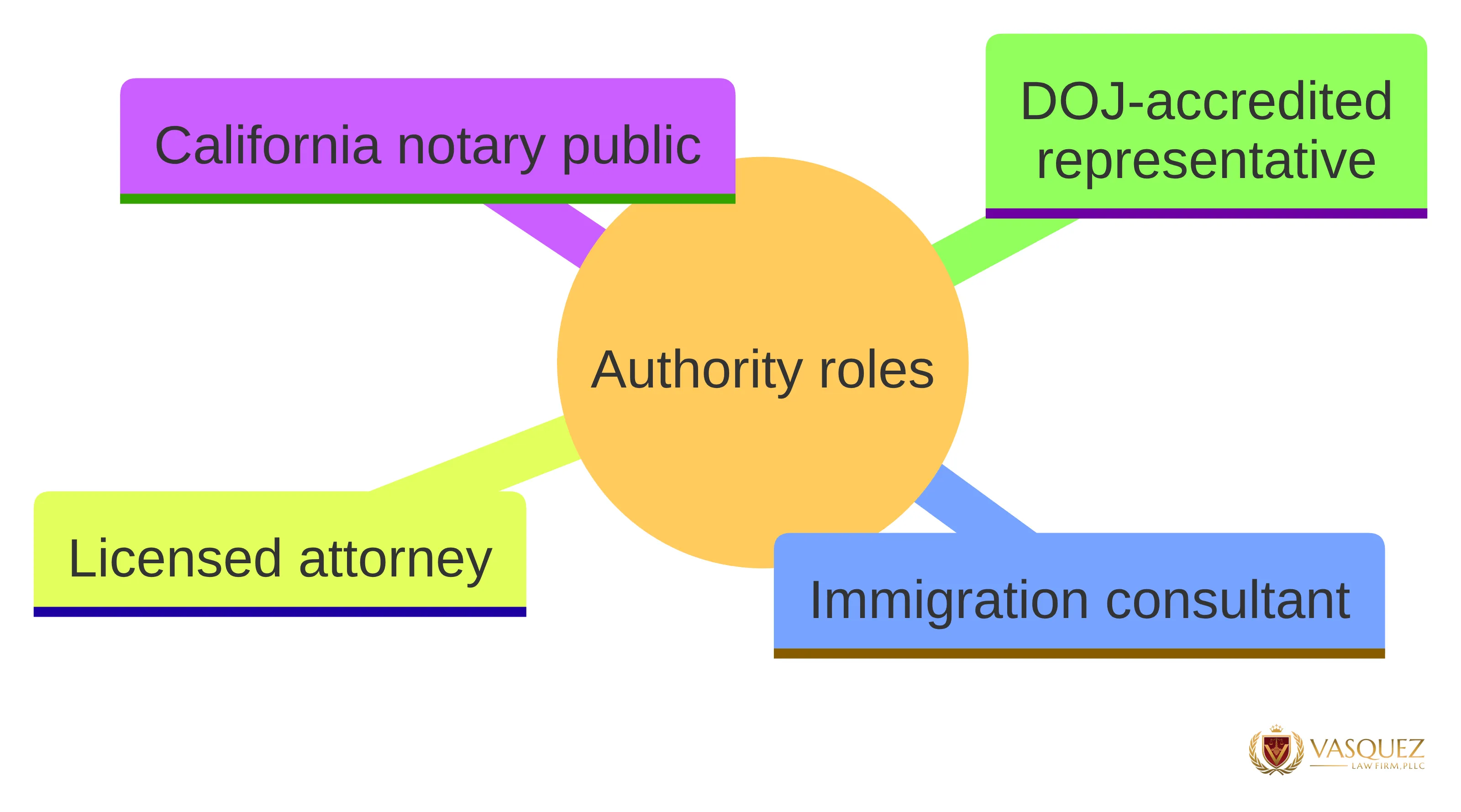
A licensed attorney is a lawyer admitted to practice in a U.S. jurisdiction. A DOJ-accredited representative's authority depends on accreditation, the permitted scope of practice, and recognition of the organization where that representative works. Treat a notary commission, consultant title, or document-preparation role as a separate question from legal authority, and do not assume that such a role permits immigration representation.
The provider's answer should identify both the person and the organization connected to the proposed service. A website, office, community referral, or familiar title does not replace that identification. If the person offering advice cannot explain whether the person is an attorney or an accredited representative, pause the intake and obtain a clearer answer before sharing sensitive details or paying for legal work.
Check whether the representative can handle the relevant setting
The relevant immigration setting affects the authority you need to ask about. Licensing guidance says that licensed attorneys may represent clients before USCIS, but immigration-court appearances require applicable EOIR registration. That distinction gives you a concrete question: where would the provider act if your matter moves beyond an agency filing or involves court proceedings?
Do not treat experience with one setting as an answer about another. Ask whether the provider handles USCIS matters, immigration-court matters, or both, and ask what registration or other authority applies to the setting you are considering. If the provider says another attorney or organization would handle a different setting, record that name and role before you decide whether the arrangement fits your needs.
A setting check should produce specific answers rather than a general assurance. Ask:
- Which agency, court, or other forum would receive the filing or hear the matter?
- Would you or another attorney communicate with that forum?
- Does the provider's authority cover the setting involved?
- If court representation may be needed, what applicable EOIR requirement has the provider addressed?
- What happens if the matter changes from an agency process to a court process?
Licensing guidance says to check the relevant state bar and EOIR requirements for court matters. Use that instruction as a boundary for your comparison: a provider should be able to explain who has authority for the setting under discussion. If the answer depends on facts you have not yet shared, ask which facts would change the setting before relying on a proposed service.
A change in setting should trigger a new authority question. A person who can help with a USCIS filing may not be the person who would appear in immigration court, and an organization may assign different attorneys to different parts of the matter. Write down the proposed provider for each setting, then ask directly who would act if the matter changes. Do not fill an authority gap with an assumption.
Use matter-fit questions instead of relying on promises
Matter fit means asking whether the provider's immigration practice matches the issue you want to discuss, without asking the provider to predict your result from a short description. Start with a plain-language account of your goal, such as applying for a status, responding to a notice, addressing a family-related immigration issue, or understanding a possible defense. Include the setting you know about, the dates that seem relevant, and any prior filing, denial, removal, or court information you have.
A useful provider should be able to tell you what information is needed to understand the question and what the next review would cover. You are looking for a clear explanation of whether the provider is prepared to discuss the type of matter you described and what remains unknown.
Matter-fit questions can test the scope of the proposed service without demanding an immediate eligibility decision:
- Does your practice handle matters like the one I am describing?
- What facts could change the type of service or forum involved?
- Which documents, notices, or prior filings would you want to see first?
- Who would review my history before any recommendation is made?
- What can you explain during the first conversation, and what requires a fuller review?
- What would the next step be if your practice is not the right fit?
- What information should I avoid guessing about until you review the documents?
Pay attention to the structure of the answer. A careful explanation identifies the information needed, separates known facts from questions, and avoids turning a short conversation into a promised outcome. A provider who gives only a broad promise has not answered the matter-fit question; ask for the missing conditions or continue comparing options.
Your preparation should make the issue easier to describe without trying to build a legal strategy yourself. Prepare a short timeline, the names of agencies or courts shown on your notices, known deadlines, prior applications or decisions, and the questions you want answered. Keep facts you know separate from facts you are unsure about. Tell the provider when a date, document, or prior event is uncertain instead of presenting a guess as a fact.
Test communication and language access before choosing
Communication access is part of evaluating an immigration attorney because you need to understand questions, choices, documents, and next steps. For child clients, the cited ethics guidance says attorneys should take reasonable steps to communicate with clients in a language they understand. That guidance concerns child clients, so use it as a clear benchmark for asking how communication will work in your own situation rather than treating it as an answer to every representation question.
Ask whether the attorney can communicate with you in your preferred language, whether a qualified interpreter will be used when needed, and how confidential information will be handled during interpreted conversations. A language label alone does not tell you how meetings, documents, urgent notices, and follow-up questions will be managed. Ask for the process.
Interpreter guidance says interpreters should protect confidential information, interpret what is said, and not explain legal matters or offer personal opinions. Use that distinction when you test communication access:
- Who will explain the legal issue to me?
- Who will interpret the conversation?
- How will confidential information be protected?
- Will the interpreter interpret what each person says without adding advice or opinions?
- How can I ask for clarification if a legal term or document is unclear?
- Which language will be used for written instructions and follow-up messages?
- Who should I contact if I do not understand an instruction after the meeting?
The attorney or other authorized provider should remain responsible for the legal explanation. An interpreter can help convey the conversation, but interpreter guidance says the interpreter should not add legal advice or personal opinions. If you cannot tell who is answering a legal question and who is interpreting, ask the provider to explain the roles before continuing.
The first contact can show whether the proposed communication process is workable. Notice whether the provider lets you finish describing the issue, explains unfamiliar terms, identifies who will answer later questions, and gives you a way to request clarification. If a family member is expected to explain legal matters instead of an interpreter or attorney, ask why and request a communication method that keeps the legal explanation with the authorized provider. Choose a process you can understand well enough to describe back in your own words.
Compare the proposed working relationship side by side
Comparing the working relationship side by side helps you notice differences that a polished introduction can hide. Use the same questions with each provider, write down the answers in the same format, and mark an answer as unknown when you need clarification. Do not award points for confidence or choose a provider because of a promise that has not been tied to your facts.
The table below gives you a neutral worksheet for two options. Replace Option A and Option B with the names of the providers you are considering.
| Question | Option A | Option B |
|---|---|---|
| Who is authorized to provide advice or representation? | ||
| Which jurisdiction, organization, or accreditation applies? | ||
| Can the provider handle the relevant agency or court setting? | ||
| What facts and documents does the provider need first? | ||
| Who will communicate with you and in which language? | ||
| Will an interpreter be used, and what will that interpreter do? | ||
| Who will perform the legal work and communicate with the forum? | ||
| What are the proposed next steps? | ||
| What does the fee arrangement cover, and what questions remain? | ||
| What will you receive in writing? |
A strong comparison is not the one with the fullest sales language. It is the one that leaves you with a clear provider identity, a defined setting, a matter-specific information request, an understandable communication plan, and next steps you can describe in your own words. Unanswered questions belong in the follow-up conversation, not in an assumption.
Use the worksheet after each conversation while the details are still clear. Separate facts from impressions: a provider's name, role, setting, and proposed next step are facts to record, while phrases such as “seemed confident” are impressions that need less weight. Add a question mark beside every answer that depends on a document, another attorney, a court setting, or a fee term you have not received in writing.
Do not force a numerical score if the options are not offering the same service. A provider who handles one setting cannot be compared on court representation as though both options offered it. Compare like with like, and treat a missing answer as a reason to ask a follow-up question rather than as proof for or against the provider.
Verify licensing and disciplinary information
Licensing verification connects the provider's name to the authority claimed during your conversation. jurisdiction and says to check the relevant state bar and EOIR requirements for court matters. Record the exact spelling of the attorney's name, the jurisdiction identified, and whether the proposed work involves court representation.
Use the relevant state bar information to check the attorney's admission status, then compare the result with the name and jurisdiction the provider gave you. If another attorney will handle the work, perform the same check for that attorney rather than assuming the person who answered the phone is the person with authority. For a DOJ-accredited representative, check the accreditation and the recognition of the organization connected to the representative's work.
Disciplinary information is a separate check from licensing status. The referenced DOJ and EOIR directory provides information about currently disciplined attorneys, including the discipline imposed, its effective date, and whether the attorney was later reinstated. Use the directory when the provider's work may involve the immigration court system, and record what you find rather than relying on a verbal description.
A result that needs clarification is not automatically an answer about whether you should hire the provider. Ask the provider to explain any difference between the name, jurisdiction, registration, or history you found and the information given to you. If you cannot reconcile the difference, pause before signing an agreement, paying a fee, or sharing additional sensitive information. Keep your notes with the provider's written contact information so you do not confuse people with similar names.
A useful verification record contains the attorney's full name, admission jurisdiction, organization, proposed role, relevant agency or court setting, and the date you checked the information. For an accredited representative, record the organization and the stated scope of accreditation. Keep the record separate from your personal conclusion: “I found this status” is different from “this provider is suitable for my matter.” Resolve discrepancies before moving forward.
Recognize warning signs that call for caution
A concern about authorization is a reason to pause and verify the provider's authority. Pause if a provider relies on the word notario, a notary commission, or a document-preparation title while offering to give immigration legal advice or represent you. Ask for the provider's attorney license or DOJ accreditation and the organization connected to that authority. If the provider cannot answer clearly, do not treat the service as authorized merely because the office has forms, a website, or a familiar community reputation.
Other warning signs should prompt questions, independent checks, or a decision to stop the conversation:
- The provider will not identify the attorney or accredited representative who would give legal advice.
- The provider avoids answering which agency or court setting the service covers.
- The provider pressures you to sign or pay before explaining the service, next steps, and fee arrangement.
- The provider discourages you from asking questions in your preferred language or treats interpretation as a substitute for legal explanation.
- The provider gives a broad answer but cannot say what information or documents are needed to move forward.
- The proposed contact person, attorney, and organization do not match, and no one explains the difference.
One unclear answer may be a communication problem that can be resolved. A pattern of unclear authority or pressure is a reason to pause and seek a clearer explanation before proceeding.
A warning sign does not require you to reach a legal conclusion on the spot. Separate the problem into an answer you can obtain and a boundary you should respect. Ask for the provider's identity, authority, setting, written service description, or fee explanation when that information is simply unclear. If the provider continues to avoid the question, pressures you, or promises a result without reviewing the relevant facts, stop the conversation and compare another option.
Evaluate Vasquez Law Firm using the same checklist
Vasquez Law Firm offers immigration legal help. Those services make our firm a potential option for your comparison, not an automatic answer about your eligibility, representation needs, or case strategy. Use the same authority, setting, matter-fit, communication, and working-relationship questions with us that you would use with any other provider.
When you contact us, describe the immigration issue you want to discuss, identify any agency or court information you have, and ask what facts or documents would help begin the evaluation. Ask who would communicate with you, who would handle the legal work, what setting the proposed service covers, and what the next step would be. Clear answers let you compare our proposed relationship with your notes for other options.
Our consultations are free when the case qualifies. We also offer free consultations for immigration cases. Because the qualification condition matters, ask what the initial conversation will cover and what information is needed to determine whether the consultation qualifies before you rely on that term.
A focused first message can include four items:
- The immigration goal or concern in plain language.
- Any notice, filing, court information, or deadline you know about.
- The language you prefer for communication.
- The questions you want answered about authority, matter fit, next steps, and fees.
That preparation gives us a workable starting point while preserving your ability to compare our answers with other providers. It also keeps the conversation focused on the facts and questions that affect the service you are considering.
Treat our firm as one option to evaluate through the same process. Record who would answer your legal questions, which setting the proposed service concerns, what information we request, how language access would work, what the consultation condition means, and what next step we describe. You can then compare those answers with the answers from any other provider without assuming that a service description determines your eligibility or future result.
Record the answers and choose your next conversation
Your final comparison should leave you with a short written record, not a vague impression. Before choosing your next conversation, confirm that you can answer these questions:
- Who is authorized to advise or represent you?
- Which U.S. jurisdiction, DOJ accreditation, or recognized organization applies?
- Which agency or court setting can the provider handle?
- Does the provider understand the type of matter you want to discuss?
- How will you communicate, and how will interpretation work if needed?
- Who will perform the work and explain the next steps?
- What does the fee arrangement cover, and what remains unclear?
- Have you checked licensing and relevant disciplinary information?
Choose the provider whose authority, service fit, communication plan, and proposed next steps you can describe clearly. If a material answer remains unresolved, make that question the subject of your next contact rather than filling the gap with an assumption. A qualified immigration professional must decide individual suitability and case strategy after considering your facts; use this guide to choose a careful conversation, not to make that decision yourself.
Your next step is to gather the names, notices, dates, and questions that relate to your potential immigration matter, then use the checklist to organize the conversation. Clear preparation gives you a practical way to compare providers without ranking anyone on promises or guessing what your facts mean legally. If you want to include Vasquez Law Firm in that comparison, bring the same questions about authority, matter fit, communication, setting, fees, and next steps.
Sources
- Immigration Lawyer | Nationwide Federal Practice | Vasquez Law — vasquezlawnc.com
- Attorney Licensing in the United States | List of State Bar Directories — www.lawyerlegion.com
- Common Scams | USCIS — www.uscis.gov
- Practical and Ethical Considerations and Reminders when ... — cilacademy.org
- How to Verify an Immigration Attorney Is Licensed and Avoid Notario Fraud — sacattorneys.com
- 7 Working with Interpreters — probonodeskmanual.loyno.edu
- How Medicare Works: What Dreamers Should Know in 2026 | Vasquez Law Firm
- How Immigration Politics 2026 Could Affect Your Future | Vasquez Law Firm