

Green Card Renewal Has No Guaranteed Universal Timeline
Green card renewal timing is best treated as a sequence of case milestones, not a promise of one fixed number of days. Processing information can change, so an older estimate should not be treated as a dependable prediction.
The waiting period also has two different meanings. USCIS may still be deciding whether the application was properly accepted, or the application may have moved into later review. Those are not the same point in the process. Your card’s expiration date, the date you submitted Form I-90, the date USCIS accepted it, and the wording of each notice give you a more useful timeline than a general number found in a search result.
A delayed card does not automatically answer every question about travel, proof of status, employment, or another immigration matter. Treat each concern separately. If an urgent need appears while the renewal is pending, use the exact document and case information in front of you when deciding what follow-up is needed.
Green card renewal planning should begin before the expiration date. We advise green card holders to submit Form I-90 for renewal about six months before expiration. That recommendation gives you time to organize the filing and respond to a notice or appointment without waiting until the card has already expired.
We recommend calling a lawyer if your green card is expired or lost. That recommendation does not predict what your case will require; it identifies a point at which individual facts may affect the next step.
Form I-90 Renewal Begins When USCIS Accepts the Application
Form I-90 renewal does not begin in the same practical way as soon as you place an application in the mail or submit it electronically. The first milestone to identify is USCIS acceptance. Until that milestone occurs, you should not treat the submission as though it has entered the full renewal process.
Acceptance is also not the same as approval. Acceptance tells you that USCIS has taken the filing into its process; it does not decide every issue that may arise later. Keep those two questions separate: has USCIS accepted the application, and what will USCIS decide after reviewing it?
USCIS Form I-90 instructions say that an application is not properly filed until USCIS accepts it. After acceptance, USCIS checks the application for completeness, and the instructions say an improperly completed application may be rejected or denied.
That sequence gives you a practical way to interpret an early delay. If you are waiting for an acceptance notice, your first question is whether USCIS has accepted the filing. If USCIS has accepted it, your next question is what the case status and notices say about the later review. Do not use a general processing estimate to skip over the acceptance milestone.
Use a short record for the first stage of the case:
- Record the date you submitted Form I-90.
- Keep the submission confirmation, payment record, and copies of what you filed.
- Record the date of any USCIS acceptance notice.
- Save every later notice with the envelope or electronic message connected to it.
- Compare the notice language with the action you believe USCIS has taken.
This record helps you distinguish a submission that is still awaiting acceptance from an accepted application that is moving through review. It also gives you organized information if you later need to ask a focused question about an unusual delay.
Follow the Renewal Through Acceptance, Review, Appointments, and Delivery
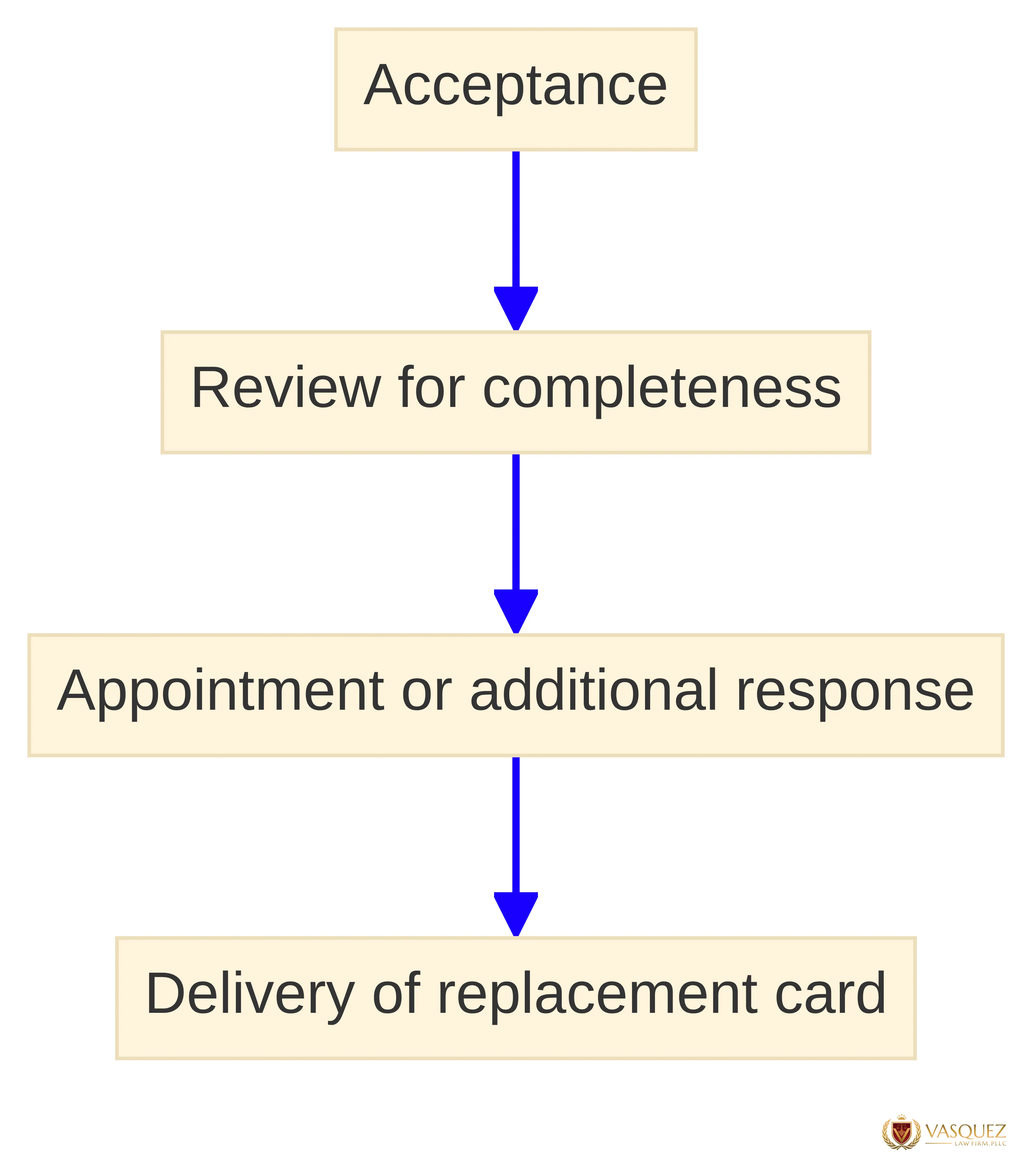
Green card renewal is easier to follow when you divide it into four practical stages: acceptance, review for completeness, any appointment or additional response, and delivery of the replacement card. They give you a map for identifying where the case stands and what kind of information you need next.
Acceptance answers whether USCIS has taken the application as properly filed. Review concerns whether the information submitted is complete enough for the agency to continue. An appointment or notice may create a separate task. Delivery is a later practical stage, so acceptance should not be treated as proof that the replacement card is already in hand.
A USCIS Application Support Center appointment can include an attestation about the application. The Form I-90 instructions say that you must confirm under penalty of perjury that the information is complete, true, and correct. If you cannot make that attestation in good faith at the appointment, USCIS may require you to return for another appointment.
Prepare for that responsibility by reading the application and notices before the appointment. Do not guess at an answer merely to finish the appointment. If a fact has changed or the information is no longer accurate, identify the issue and obtain individualized guidance before making an attestation you cannot make in good faith.
Your next action depends on the stage:
- Before acceptance: keep the submission record and look for the acceptance decision.
- After acceptance: use the case status and notices to identify whether USCIS has requested an action or appointment.
- At an appointment: answer for the application as it stands and treat the attestation seriously.
- After later review: keep the delivery question separate from the question of whether the filing was accepted.
This stage-by-stage approach prevents a common mistake: treating the entire wait as one unexplained block of time. Each notice should move your question from “How long is this taking?” to “What has USCIS done, and what must I do next?”
Incomplete Information and Case Changes Can Affect the Practical Renewal Process
Incomplete information can change the practical path of a green card renewal. USCIS says it checks Form I-90 for completeness after acceptance, and its instructions say an improperly completed application may be rejected or denied. That means an application problem is not merely a reason to expect a slower delivery; it can affect whether the filing continues through the renewal process at all.
Your address can also matter to case communication. USCIS instructions say that a non-U.S. citizen must report a new address within 10 days of moving from the previous residence. Use the current USCIS address-change process rather than sending an address update to the lockbox. Keep proof of the update with your case record.
Three questions can help you identify whether a case change deserves attention:
- Did the information remain accurate? A change in your facts can affect what you should say or do next.
- Did your address change? If it did, address reporting and reliable receipt of notices become immediate case-management tasks.
- Can you make the required appointment attestation in good faith? If you cannot, do not treat the appointment as a routine formality.
These questions do not produce a processing-time prediction. They help you separate a normal wait from a situation in which a filing, notice, address, or appointment issue may require action. Filing Form I-90 also does not resolve every travel, status, or documentation question, so handle those concerns on their own terms.
We recommend contacting a lawyer if you want help with green card renewal or an adjustment-of-status application. That recommendation is especially relevant when the case includes an expired or lost card, changed information, or a notice you do not understand. Bring your case record so the discussion can focus on dates, documents, and the specific problem rather than a general estimate.
Use Receipt Notices and Temporary Evidence Carefully While Waiting
A receipt or case notice is useful because it gives you written information about what USCIS has done with your submission. Read the notice as a document with its own dates, instructions, and limits. Keep it with the filing record, and use its exact wording when you ask what a pending renewal means for a particular purpose.
Do not treat a receipt notice as a universal answer about travel, proof of status, employment, or another immigration benefit. A pending renewal can involve more than the question of whether Form I-90 was submitted. Before relying on a document, identify the purpose for which you need it and whether the notice actually addresses that purpose.
Lunel Law states that applicants with urgent travel or proof-of-status needs may request a temporary I-551, also called an ADIT stamp, at a USCIS office. The passage describes the stamp as short-term evidence placed in a passport and does not establish that every applicant will receive one.
That distinction matters. An urgent need may justify asking about this temporary evidence, but a request is not a guarantee of issuance. Keep the request connected to the actual travel or proof-of-status problem, and do not assume that filing Form I-90 by itself settles the problem.
When a document matters for an immediate decision, make a focused record:
- Write down what you need to prove and by what date.
- Identify the notice or document you have, including its dates and wording.
- Separate an urgent travel question from a routine renewal-status question.
- Ask for individualized help before relying on a pending filing as proof for a purpose the document does not clearly cover.
This approach keeps the waiting-period question narrow. It also reduces the risk of treating one document as if it automatically answers every immigration or travel question.
Check Your Case and Follow Up When the Delay Becomes Unusual
Case tracking works best when you compare three things: your own milestone record, the current USCIS processing information for the case, and the latest notice or status update. Start with the acceptance question, then identify the last action USCIS recorded. A general search result is less useful than information that matches the form, case type, and office or process connected to your filing.
Set a review point based on the current official information rather than choosing an arbitrary promise to yourself. If the case remains within the applicable estimate, preserve your records and continue checking for a new notice. If the case moves beyond the applicable information or a notice creates a new problem, change from passive waiting to focused follow-up.
Use the branch that matches your situation:
- You have no acceptance: USCIS says the application is not properly filed until acceptance. Check the filing record and use current USCIS information to identify the appropriate follow-up.
- You have acceptance but no clear next event: Compare the case status and current processing information, then keep the notices and dates together while you wait.
- Your address changed: USCIS instructions say non-U.S. citizens must report a new address within 10 days of moving. Complete that task through the current USCIS process and preserve the confirmation.
- Your card is expired or lost: We recommend calling a lawyer.
- You have an urgent travel or proof-of-status concern: Ask about the document or temporary-evidence issue specifically rather than assuming the pending renewal answers it.
- You want help with the renewal itself: We recommend contacting a lawyer for help with a green card renewal or adjustment-of-status application.
Each branch ends with a different action because the same waiting period can create different practical problems. Match the follow-up to the milestone and urgency you can document.
Keep a simple case log with the submission date, acceptance date, expiration date, notices received, address changes, appointments, and follow-up attempts. A dated log does not speed up the case, but it lets you describe the delay precisely and avoid relying on memory. If you seek help, provide the log together with the notices rather than only saying that the case feels late.
Know Which Renewal Problems Need Individualized Immigration Advice
General renewal information can explain the process, but it cannot decide what your particular filing, notice, travel plan, or immigration history requires. Individualized review becomes more useful when the practical question is no longer simply “Where is my renewal?” and instead involves a document conflict, an expired or lost card, a changed fact, an appointment attestation, or an urgent need for proof of status.
A long wait alone does not establish what happened in your case. The relevant question is whether you can identify the case milestone, the latest notice, the current processing information, and the consequence that concerns you. Those details give you a focused issue to discuss rather than a request for a prediction.
Consider seeking case-specific help when one of these situations applies:
- Your green card is expired or lost. We recommend calling a lawyer in that situation.
- You want help with a green card renewal or adjustment-of-status application. We recommend contacting a lawyer for that help.
- You cannot confirm that the information in your application is complete, true, and correct at the USCIS appointment. The Form I-90 instructions describe that attestation as one you must make under penalty of perjury.
- USCIS has rejected or denied an improperly completed application, or a notice requires a response you do not understand.
- You need urgent travel or proof of status and are considering temporary evidence. A temporary I-551 or ADIT stamp may be requested in the circumstances described by Lunel Law, but issuance is not established for every applicant.
These triggers do not predict eligibility or outcome. They identify when a general timeline is no longer enough to answer the question in front of you.
Prepare for a focused discussion by gathering your green card or a copy of it, the Form I-90 submission record, acceptance notice, later notices, expiration date, address-change information, appointment details, and the specific deadline or travel concern involved. Organize facts in date order. Clear dates make it easier to separate an ordinary pending case from a notice or documentation problem.
Prepare Early and Choose the Safest Next Step
A practical estimate combines current USCIS processing information with your own milestones: submission, acceptance, completeness review, any appointment or notice, and eventual delivery. While you wait, keep your records together, report an address change through the current USCIS process, read every notice for its exact instructions, and separate urgent travel or proof-of-status questions from ordinary case tracking.
The next step depends on the facts you can document. If the case is simply pending, continue comparing the status with current official processing information. If the card is expired or lost, a notice creates a problem, an appointment attestation is uncertain, or an urgent documentation need has appeared, move to focused help instead of relying on a general estimate.
We recommend contacting a lawyer if you want help with green card renewal or adjustment-of-status applications, and we recommend calling a lawyer if your green card is expired or lost. A qualified immigration professional can decide what individualized review is appropriate for your circumstances; this article cannot make that decision for you.
Questions About Green Card Renewal Delays and Temporary Proof
What is the typical timeline for green card renewal?
The timeline for green card renewal varies based on several factors, including USCIS processing times and individual case circumstances. It's best to check the current processing information for your specific service center.
What should I do if my green card is expired or lost?
If your green card is expired or lost, it is recommended to contact a lawyer for assistance. They can provide guidance on the necessary steps to take in your situation.
How can I track the status of my green card renewal application?
You can track your green card renewal application by comparing your own milestone records with the current USCIS processing information and any notices you receive regarding your case.
Can I travel while my green card renewal is pending?
Traveling while your green card renewal is pending can be complicated. It's important to understand the implications of your current status and any documentation you may need for travel.
What should I do if there is an unusual delay in my green card renewal process?
If you experience an unusual delay in your green card renewal process, you should follow up with USCIS using the appropriate channels and consider seeking legal advice if necessary.