

Start with the country-law question
Dual citizenship can mean that you hold citizenship in more than one country. That status can arise automatically under the citizenship laws of the countries involved, through marriage, or through a voluntary application that meets a country’s laws and requirements. The path depends on the countries connected to your situation; it is not a single process that works the same way everywhere.
The first question is not whether a general online checklist looks familiar. The first question is which country’s nationality law may apply to you and how that law interacts with U.S. law. The relevant rules can come from both systems, so a step that makes sense under U.S. immigration law may not answer the other country’s citizenship question.
Use this guide to sort your next decision into three parts:
- Identify the country-law question before choosing a form or filing route.
- Separate the U.S. immigration or naturalization issue from the other country’s nationality issue.
- Decide whether your facts and records are clear enough for general orientation or whether a consultation would give you a more appropriate way to assess them.
A country-specific question deserves country-specific handling. If you do not yet know whether the other country permits dual citizenship, contact that country’s relevant embassy or consulate before proceeding. That check does not decide your U.S. eligibility; it identifies the separate nationality-law question that must be addressed.
Begin by naming the two countries involved, even if one connection is uncertain. Write down whether the possible connection comes from your birth, a parent or grandparent, a marriage, a prior nationality, or a planned U.S. naturalization application. This simple inventory helps keep a nationality question from becoming confused with an immigration-status question.
Do not treat the phrase “dual citizenship” as the answer to your case. It describes a possible legal relationship with more than one country, but the way that relationship is created and documented depends on the laws that apply to you.
Separate the U.S. question from the other-country question
The U.S. question and the other-country question are related, but they are not interchangeable. A U.S. immigration or naturalization pathway addresses the U.S. side of your situation. The other country’s nationality law may determine whether you can acquire, keep, or exercise that country’s citizenship under its own rules.
Start by writing the two questions separately:
- What U.S. status or citizenship route is being considered? You may be asking about naturalization or another immigration status matter. The applicable U.S. requirements and filing instructions must be identified for your facts.
- What does the other country require or permit? That question may involve the country’s nationality law, an embassy or consulate, and records showing your family relationship, birth, marriage, or prior nationality history.
- Where do the questions overlap? Your identity documents, immigration history, and records of prior applications may affect how the two sides are explained and documented.
This separation prevents a common planning mistake: treating approval or progress on one side as an answer to the other. A U.S. filing does not, by itself, establish what another country will recognize. Likewise, an ancestry or marriage connection to another country does not by itself establish a U.S. naturalization route.
Keep a short list of open questions rather than choosing forms first. Mark each question as U.S.-specific, other-country-specific, or dependent on both systems. That list gives you something concrete to take to an embassy, consulate, or immigration-law consultation.
For example, “Can I apply for U.S. naturalization?” is a U.S. question. “Will my country of origin permit me to keep its citizenship if I become a U.S. citizen?” is an other-country question. “Do my name changes and prior immigration filings need to be explained in both places?” may depend on both systems. Separating the wording makes it easier to identify which authority or professional should address each point.
Keep the distinction in your records as the matter develops. Place U.S. forms and notices in one group, other-country communications in another, and shared identity or family records in a third. Organization cannot resolve the legal questions, but it can keep one country’s answer from being mistaken for the other country’s answer.
Use the country-law fork before choosing a next step
The country-law fork asks whether the other country’s rules are clear enough for you to identify the relevant question. Use the answer to choose a next step, not to assume an outcome.
If you do not know whether the other country permits dual citizenship: contact the relevant embassy or consulate before proceeding. Ask which nationality rules apply to your circumstances and which public instructions identify the required records. Keep the answer with your case documents, and use a consultation if the answer raises a conflict with your U.S. immigration history.
If the other country’s position is clear but your U.S. route is uncertain: separate that country-law information from the U.S. question. Gather your U.S. immigration records and identify whether the issue concerns naturalization, an existing status, or another immigration matter. Then seek an immigration-law consultation if you need the facts assessed together.
If both sides are clear at a general level but your documents are incomplete or inconsistent: organize what you have before selecting a filing route. A missing birth record, a different name across documents, a prior visa application, or an immigration notice can change the questions that need to be addressed. Do not treat a general route description as a case conclusion.
If the country-law answer and your records appear consistent: use the official instructions for the applicable process and keep the U.S. and other-country steps in separate folders. A consultation can still help you organize the questions before you file, particularly when several citizenship routes or immigration records are involved.
The practical boundary is simple: the fork tells you which question comes next. It does not determine that you qualify for citizenship or that a particular application will be approved.
The fork also gives you a way to recognize what kind of help you need:
- An embassy or consulate may be the appropriate place to ask how that country describes its nationality rules and document requirements.
- USCIS instructions govern the details of a U.S. naturalization filing.
- An immigration-law consultation can help you connect the U.S. immigration history, identity records, and country-law questions when they affect one another.
Use those paths for their distinct purposes. Do not ask one source to decide a question that belongs to another legal system.
Identify the route your facts may raise
The possible citizenship routes include birth, naturalization, marriage, and ancestry, but the applicable route and requirements depend on the countries’ laws and your circumstances. The route label is a starting point for organizing facts, not an eligibility answer.
Birth: Start with the place of birth, the citizenship of the relevant parents, and the records that document those facts. A birth-related route may raise questions about registration, prior nationality, or the laws in force under the country involved. Keep the question tied to the specific country rather than assuming that birth creates the same result everywhere.
Naturalization: A naturalization route generally requires an application under the relevant country’s legal requirements. If the U.S. is the country being considered, the U.S. filing and interview process must be assessed separately from whether your other country recognizes or permits dual citizenship.
Marriage: Marriage may be part of a citizenship route in some countries, but the conditions are country-specific. Gather the marriage record and any documents showing the identity and nationality history connected to the relationship. Do not treat the existence of a marriage route as proof that your facts meet its requirements.
Ancestry: An ancestry route may depend on the parent or grandparent involved, the chain of records connecting you, and the nationality law that applies. Names, dates, and document formats matter because the relationship must be explained through records.
Choose the route that matches the facts you can document, then identify the questions that still need case-specific review. A route description can help you prepare; it cannot replace the country’s applicable instructions or an assessment of your individual circumstances.
Create a route worksheet with four entries: the possible route, the person or event connecting you to the country, the records that support that connection, and the rule you still need to clarify. For a birth or ancestry theory, list each family relationship in order. For a marriage theory, list the relevant marriage and identity records. For naturalization, list the U.S. or other-country process you are considering separately.
This worksheet is useful even when the route is uncertain. It shows whether the main problem is locating a record, understanding a country’s nationality rule, separating the U.S. process from the other-country process, or reviewing a personal immigration history. Take the unresolved entries to the appropriate authority or consultation instead of filling them with assumptions.
Know when general information is no longer enough
Individualized legal review becomes especially useful when the country-law question and your personal history cannot be separated. General information may orient you, but it cannot reconcile every document, route, and filing question that can arise in one matter.
Consider arranging a consultation when:
- You are unsure whether the other country permits dual citizenship and the answer may affect your planned U.S. step.
- Your name, date of birth, place of birth, marital history, or nationality appears differently across records.
- You have prior visa applications, work permits, green cards, or correspondence with immigration authorities that must be placed into a single history.
- You are considering naturalization and need to understand which records or prior events belong with the U.S. application.
- You have received an immigration notice, a request for evidence, or an interview instruction and need the documents connected to that event organized.
- Your possible route involves birth, marriage, ancestry, or naturalization and you cannot tell which facts establish the relevant connection.
These circumstances do not establish that you qualify or that a filing is required. They identify why a personal review may be more useful than collecting general explanations. An immigration-law consultation can cover your goals, document review, application preparation, possible filing steps, responses to requests for evidence, interview preparation, and discussion of next steps after a decision.
Use a consultation to turn uncertainty into a defined list of questions. Bring the records you have, identify what is missing, and describe the country-law fork plainly. That gives the discussion a factual starting point without assuming a result.
A consultation may also be appropriate when the question has changed over time. You may have started by asking whether a second citizenship is possible and later discovered that the real issue concerns an old visa application, a name variation, a previous marriage, or a notice from immigration authorities. State the change directly rather than presenting only the original question.
Seek personal review before treating a generic route description as a filing plan when several issues appear together. The combination of country rules, identity records, and immigration history is the reason to focus on your facts instead of relying on a broad checklist.
What an immigration lawyer can assess
An immigration-law consultation can assess how your goals, records, and immigration history fit together before you choose a next step. The discussion may begin with the country-law question and then move to the U.S. side of the matter.
A lawyer may help you organize questions about:
- Your objective: whether you are exploring a possible second citizenship, a U.S. naturalization route, documentation of an existing nationality, or a related immigration-status matter.
- Your history: prior visas, green cards, work permits, applications, notices, and correspondence with immigration authorities.
- Your identity records: birth, marriage, divorce, adoption, naturalization, or other records that connect names and family relationships.
- The possible route: whether the facts raise a birth, naturalization, marriage, or ancestry question, and which country’s rules need to be examined.
- The filing stage: whether you are still gathering information, preparing an application, responding to a request for evidence, or preparing for an interview.
- The next decision: which question should be answered first and which documents should be gathered before any filing is considered.
The process we describe for immigration matters includes an initial consultation, document review and gathering, application preparation, filing with USCIS when applicable, responses to requests for evidence, interview preparation, and discussion of the resulting decision or next steps. We offer legal help for immigration issues and bilingual immigration help to explain complex immigration topics.
A consultation is a place to identify the right questions and organize the record. It is not a promise that a particular route applies, that an application will be approved, or that every country will treat your citizenship in the same way.
You can make the discussion more productive by explaining the decision you are trying to make, not only the documents you possess. For example, say whether you need to understand a possible route, prepare for a U.S. filing, organize an old immigration history, or determine which country-law question should be answered first. Then connect each goal to the records you brought.
Ask for the boundaries of the discussion as well. Which questions concern U.S. immigration law? Which require information from the other country? Which records remain missing or inconsistent? Clear boundaries help you leave with a practical list of follow-up questions without treating the conversation as a guarantee of eligibility or approval.
If naturalization is part of the question, verify the current U.S. process
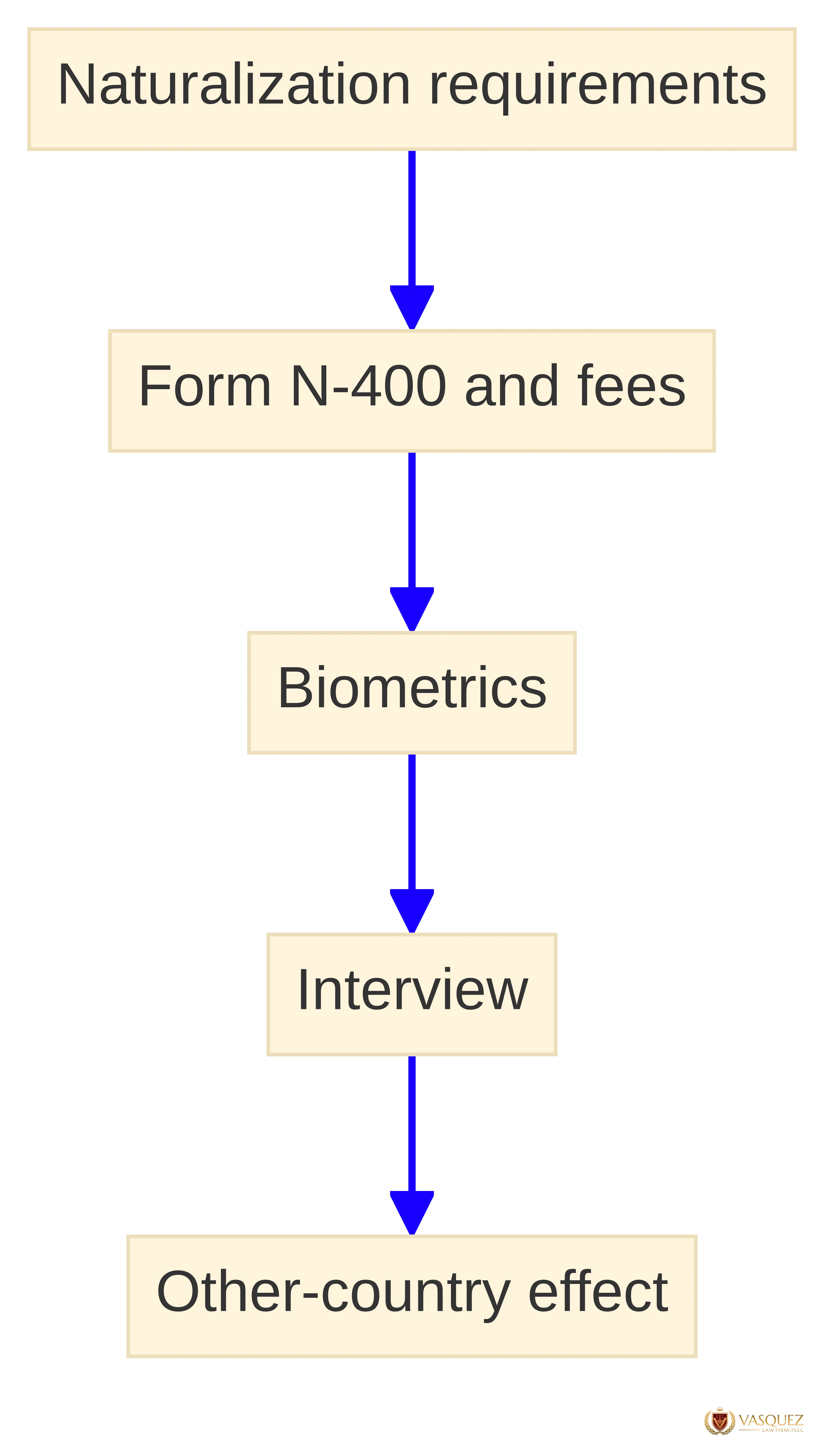
A U.S. naturalization pathway involves its own requirements and filing sequence, separate from the other country’s nationality rules. The U.S. process described in the available guidance includes meeting the applicable naturalization requirements, filing Form N-400 with the required fees, attending biometrics, and completing a naturalization interview. Current USCIS instructions control the process.
Use that sequence as a checklist of questions rather than as a conclusion about your case:
- Naturalization requirements: Identify which U.S. requirements apply to your circumstances before treating Form N-400 as the right filing.
- Form N-400 and fees: Determine whether the form and required fees match the route you are considering and the instructions in force for your filing.
- Biometrics: Account for the biometrics step described in the applicable guidance and keep any notice with your immigration records.
- Interview: Prepare for the naturalization interview using the current USCIS instructions and the documents relevant to your circumstances.
- Other-country effect: Continue the separate inquiry into whether the other country permits or recognizes dual citizenship under its own law.
The U.S. naturalization sequence does not answer the other-country question. You may hold citizenship in more than one country, but the way that status arises depends on the laws of the countries involved. If the U.S. process is part of your plan, preserve the notices and forms connected to it and bring them to any consultation.
Do not rely on an old checklist when a current USCIS instruction addresses the same step. Use the current agency instruction for the filing details, and seek individualized review when your documents, prior immigration history, or other-country obligations create questions that the general sequence does not answer.
Naturalization records can matter beyond the form itself. Keep copies of the application materials, notices, responses, and interview instructions together with the identity records used to support them. If a name, date, address, marital history, or prior immigration event appears differently across documents, mark the difference for discussion rather than silently correcting it.
The U.S. process and the other-country process may proceed on different tracks. Keep a separate note for each track, record which authority issued each instruction, and avoid treating completion of one step as completion of the other country’s requirements.
Build a consultation packet around your identity and history
A consultation packet should show who you are, how your immigration history developed, and which country-law question you need to address. The packet does not need to answer the legal question before the consultation; it needs to make the known facts easier to organize.
Gather the records available to you in these groups:
- Identity and family records: birth certificates, marriage or divorce records, adoption records, naturalization certificates, and documents showing name changes or family relationships.
- Immigration records: green cards, previous visa applications, work permits, immigration notices, and correspondence with immigration authorities.
- Country-law records: communications or instructions from the relevant embassy or consulate, along with documents connected to the possible birth, marriage, ancestry, or naturalization route.
- U.S. filing records: copies of forms, fee notices, biometrics notices, interview notices, requests for evidence, and other papers connected to a naturalization or immigration matter.
- Your question list: the country involved, the citizenship route you are exploring, the facts that seem clear, and the points that remain uncertain.
Create a short timeline in plain language. Include the places where you lived, major immigration filings, changes to your name or family status, and the dates shown on important notices. Mark missing records instead of filling gaps from memory.
Before contacting us, gather relevant documents such as green cards, prior visa applications, work permits, and correspondence with immigration authorities. A consultation can then focus on the relationship among those records, your goal, and the applicable country-law questions.
Add a one-page cover sheet to the packet with these details:
- Your full name and any names used on earlier records.
- The country whose citizenship you are exploring.
- The possible route: birth, naturalization, marriage, ancestry, or another route identified in the country’s instructions.
- Your current U.S. immigration status or the U.S. process you are considering.
- The main question you want answered first.
- A list of missing, damaged, untranslated, or inconsistent records.
Do not send every record without a clear purpose if you can first identify the issue each document addresses. Label files by subject and date, keep a separate list of originals, and bring the questions that the packet cannot resolve. These steps give the consultation a usable factual starting point.
Match copies and originals to the applicable filing
Document format depends on the applicable filing and the instructions governing that filing. For a U.S. naturalization application, USCIS guidance says relevant document copies, preferably certified copies, should be submitted with the application, while required originals may be needed at the interview.
USCIS identifies case-dependent examples of originals that may matter at a naturalization interview, including birth, marriage, divorce, adoption, and naturalization certificates. The same guidance also identifies relevant court orders and certain records involving child support, arrests, probation, or parole. Those examples do not create a universal list for every application; they show why your document packet must follow the instructions connected to your facts.
Organize your records in three layers:
- Working copies: Keep a readable copy of each document in the packet you use for planning.
- Certified or official copies: Mark records that may need a certified copy under the applicable instructions, and obtain them through the responsible authority when required.
- Originals: Keep originals organized so you can identify them if the filing or interview instructions require them.
The other-country side may use different document rules because the relevant nationality law is country-specific. Ask the responsible embassy, consulate, or legal professional what format applies before sending records. Do not assume that the document practice for a U.S. filing answers the other country’s requirements.
Use a document index with the title, issuing authority, date, language, and the fact the record is meant to show. Note whether you have an original, a copy, a certified copy, or only a photograph or scan. This makes a missing formal record visible without treating a substitute as automatically acceptable.
If names or dates differ, preserve both versions and write a short explanation of the difference for discussion. Do not alter an official record to make it match another document. The significance of a variation depends on the applicable filing, the country’s requirements, and the facts surrounding the record.
Follow the instructions for the specific filing before sending anything. A document that is useful for a consultation may not be the document format required for a government filing, and a U.S. document instruction may not apply to a nationality application in another country.
Account for responsibilities in both countries
Dual citizenship may place you under the laws and enforcement policies of both countries, especially while you are physically present in one of them. That practical point belongs in your planning even when your immediate question concerns only a U.S. application.
Separate your questions into three categories:
- Status: What does each country recognize about your citizenship or immigration status?
- Conduct: Which laws and policies may apply while you are in that country?
- Documents and movement: Which passport, identity record, notice, or registration question needs a country-specific answer before you travel or file?
Do not assume that a U.S. result settles the other country’s obligations. Do not assume that an embassy’s answer about nationality settles your U.S. immigration history. Keep the two sets of questions in your notes and identify where they overlap.
If you expect to be physically present in either country, add that fact to your consultation questions. A lawyer can help you identify which records and legal issues belong in the discussion, while the relevant country authority can address its own nationality procedures. The purpose of this step is to prevent a narrow filing question from hiding a separate country-law issue.
List practical questions before you travel or submit a filing. Ask which country’s documents or procedures are relevant to the event, whether the question concerns nationality or immigration status, and which authority is responsible for the answer. Keep those questions separate from a prediction about the result.
The point is not to assume that dual citizenship creates the same duties everywhere. The point is to recognize that more than one country’s law may matter and to obtain the country-specific information that applies to your circumstances.
Choose a North Carolina or Florida consultation when the questions are personal
A North Carolina or Florida connection can give you a practical reason to seek an immigration consultation when your dual-citizenship questions depend on personal records and immigration history. Attorney Vasquez is admitted in North Carolina and Florida and can assist with immigration cases. We offer legal help for immigration issues, bilingual immigration help to explain complex immigration topics, and free consultations.
Choose a consultation when you want to discuss your own documents and timeline rather than compare general route descriptions. Bring the country-law question, the U.S. question, and the records that connect them. If Spanish-language communication would make the discussion clearer for you or your family, our bilingual immigration help is part of the services we offer.
A focused consultation can be useful even when you have not decided whether to file. You can use the conversation to identify the facts that need confirmation, the documents that belong in the packet, and the next question that should be answered first. You do not need to present your situation as a finished application.
Keep the decision narrow: seek help when the personal facts, country rules, or records make a general answer insufficient. That approach lets you ask for assistance without assuming that a second citizenship is available or that a U.S. filing will produce a particular result.
Before contacting the firm, prepare a short explanation in the language in which you can describe your history most clearly. Include the country involved, the possible route, your U.S. immigration question, and the records that may need review. If family members are part of the nationality history, identify their relationship to you and the records that connect you.
The firm’s consultation offer does not establish eligibility or promise approval. It gives you a way to present the facts and ask which questions require individualized immigration-law review. Use the contact form when you are ready to provide that focused information.
Gather the records and submit a focused inquiry
A focused inquiry should identify the country involved, the citizenship route you are considering, the U.S. immigration question, and the records you already have. Gather your identity documents, immigration history, prior applications, notices, work permits, green cards, and correspondence with immigration authorities. Separate originals from working copies, and note which records are missing or use different names.
Use the country-law fork before choosing a filing route: contact the relevant embassy or consulate when the other country’s dual-citizenship rules are unclear, and use current USCIS instructions for any U.S. naturalization step. If your facts or documents require interpretation across both systems, request a consultation rather than treating a general route description as an eligibility decision.
A qualified immigration professional must assess your individual suitability, and a consultation does not guarantee eligibility, approval, a processing time, or a particular outcome. It can give you a structured place to explain your history, organize the country-law questions, and decide what information should come next.
Before you submit your inquiry, write down the single question that matters most to you and attach or describe the records that bear on it. Explain any name differences, prior filings, notices, or missing documents instead of assuming they are unimportant. This gives the initial conversation a clear starting point.
You can now provide the records and questions that will let the firm understand what you need.
Sources
- How Immigration Lawyer Tampa Services Can Help You in 2026 | Vasquez Law Firm — vasquezlawnc.com, 2026-05-20
- Dual Citizenship Benefits and Drawbacks: U.S. Guidelines Explained — www.investopedia.com
- Commonly Asked Questions About the Naturalization Process | USCIS — www.uscis.gov
- Issues with Dual Citizenship – Zhang & Associates P.C. – Attorneys in New York, Silicon Valley, Seattle, Los Angeles, Chicago, San Jose, Houston, Austin, Madison, and San Francisco — www.hooyou.com
- Dual Citizenship and Vital Records — www.health.ny.gov
- What Does DHS Mean for Immigration in 2026 | Vasquez Law Firm
- How Federal Immigration Cases Work in Charlotte NC in 2026 | Vasquez Law Firm